


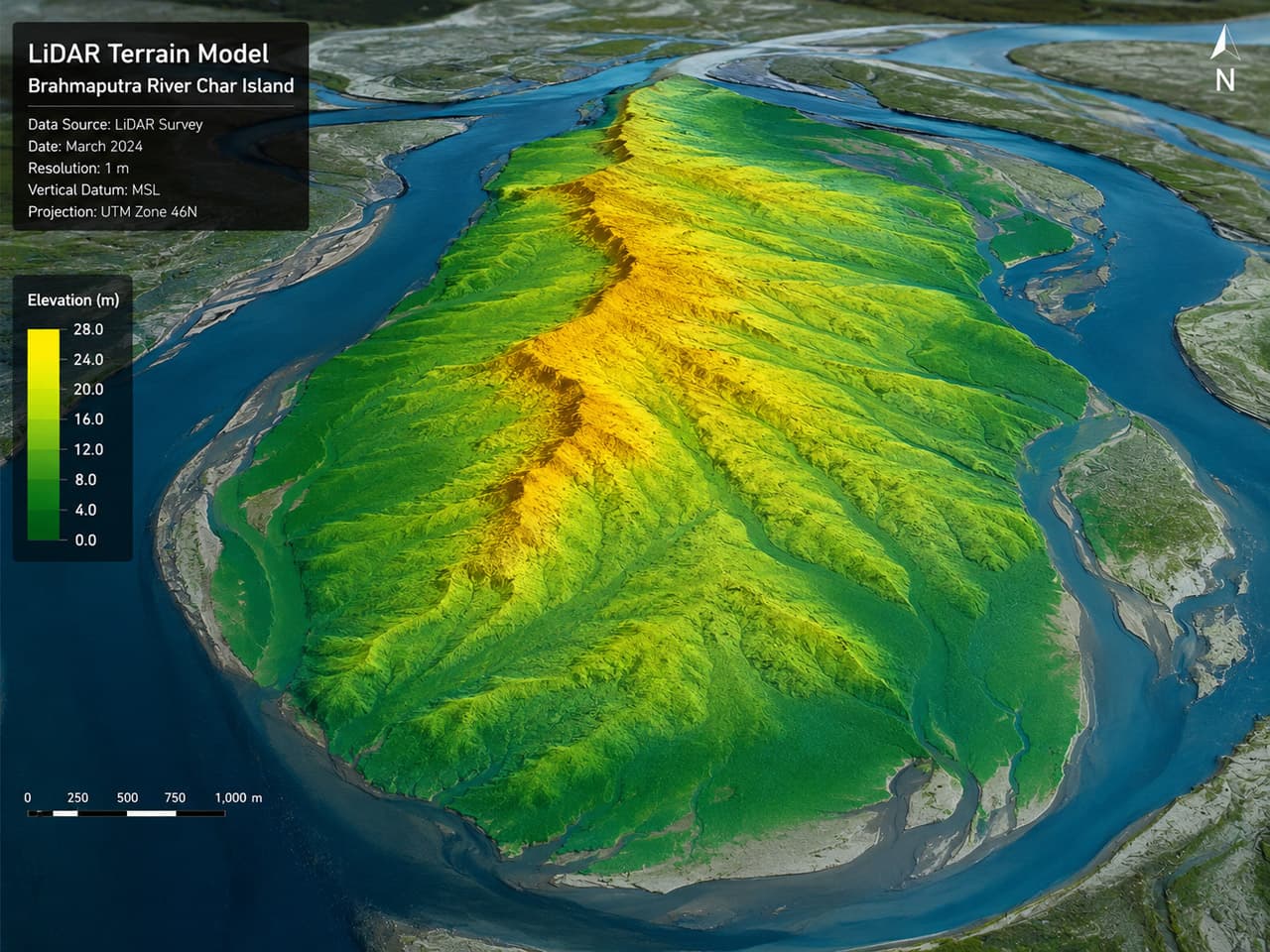
Hero image caption: LiDAR terrain visualization of a Brahmaputra-Jamuna char, showing subtle elevation ridges, low flood basins, abandoned channels, homestead mounds, crop plots, and river-edge erosion scars.
A char island rises maybe 1.5 metres above the Jamuna in the dry season. Hundreds of families build their homes on it, not knowing that the whole island is less than half a metre different from one side to the other. That half-metre is the difference between flooding and survival.
This is the reality of Bangladesh’s char lands: fragile river islands made by sediment, reshaped by flood, and inhabited by people who live with uncertainty as part of daily life. A char can appear wide, dry, and safe in February. By July, the same land may be cut by channels, submerged by monsoon flow, or eaten away by bank erosion. For families who build houses from tin, bamboo, earth, and hope, knowing which part of the island is 30 centimetres higher is not a technical detail. It is settlement intelligence.
Airborne LiDAR offers a way to see that hidden terrain. It does not remove flood risk. It does not stop erosion. But it can reveal the micro-elevation patterns that decide where houses, roads, tube wells, schools, and evacuation paths should be placed.
Life on the Chars
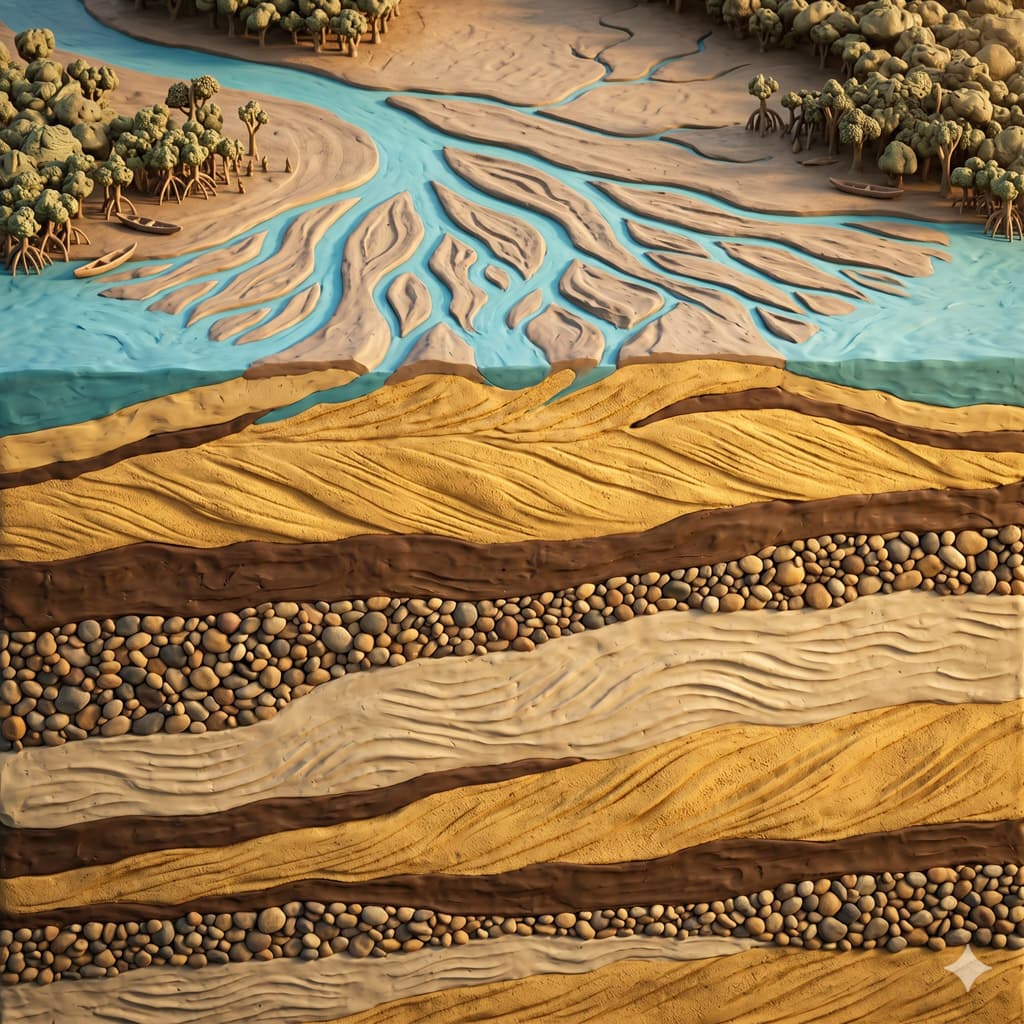
Chars are temporary or semi-permanent landforms created by sediment deposition in braided rivers such as the Brahmaputra-Jamuna. They are productive but unstable: fertile enough for crops, open enough for settlement, and risky enough that families may be displaced repeatedly by flood and erosion.
Along the Jamuna, vulnerability is both physical and social. A World Bank environmental and social assessment for the Jamuna River Economic Corridor noted that people living along the Jamuna banks and chars are highly vulnerable to flooding and bank erosion, and cited survey evidence that 35% of people living along the Jamuna and its chars had been displaced three to five times in their lifetime by riverbank erosion. (World Bank)
This repeated displacement shapes everything: land tenure, school attendance, livestock ownership, health access, and women’s safety during floods. Many char households choose settlement locations based on local memory, visible ground height, proximity to relatives, and access to fields. But human eyes cannot easily read a 20-centimetre slope across a flat sandy island. During rising water, that invisible slope becomes visible too late.
What LiDAR Sees That Eyes Cannot
LiDAR — Light Detection and Ranging — uses laser pulses from an aircraft or drone to measure distance to the ground. Each pulse returns a 3D point. Millions of points form a dense point cloud, which can be classified into ground, vegetation, buildings, water, and other surfaces. After processing, the ground points become a high-resolution Digital Elevation Model, or DEM.
For char planning, the key value is vertical precision. Standard satellite DEMs are often too coarse for settlement decisions on low-relief floodplains. A 30-metre grid cell may average together a homestead mound, a footpath, a pond edge, and a low basin. LiDAR can capture the small elevation differences that determine flood depth and duration.
Topo-bathymetric LiDAR is especially relevant for river environments because green laser systems can sometimes map shallow water and exposed bars together, creating a more continuous view of channel and floodplain terrain. Reviews of topo-bathymetric LiDAR note its potential for producing high-resolution DEMs for terrestrial and submerged river areas, with reported vertical RMSE values around 0.16 m in real-world experiments for hydrodynamic modelling. (<a href="https://www.researchgate.net/publication/381024016LiDARtopo-bathymetryforriverbedelevationassessmentAreviewofapproachesandperformanceforhydrodynamicmodellingoffloodplains?utmsource=chatgpt.com”>ResearchGate) Other LiDAR accuracy guidance commonly reports airborne LiDAR vertical RMSE well within 0.3 m, depending on terrain, vegetation, sensor, and control quality. (<a href="https://www.naturalhazards.com.au/sites/default/files/2024-02/Vertical%20accuracy%20assessment%20of%20freely%20available%20global%20DEMs%20%20FABDEM%20%20Copernicus%20DEM%20%20NASADEM%20%20AW3D30%20and%20SRTM%20%20in%20flood-prone%20environments%20%281%290.pdf?utm_source=chatgpt.com”>naturalhazards.com.au)
The accuracy assessment is usually expressed as Root Mean Square Error:
RMSE = √(Σ(zlidar - zgps)² / n)
Here, zlidar is the LiDAR-derived elevation, zgps is the surveyed checkpoint elevation, and n is the number of checkpoints. In plain language, RMSE tells us how far the LiDAR elevations are, on average, from trusted ground measurements. For airborne topographic surveys over open sandy chars, a well-controlled project may target roughly 5–15 cm vertical RMSE. For topo-bathymetric surveys including shallow water, vegetation, turbidity, and wet sand, typical practical values may be closer to 10–25 cm.
The Survey Campaign
A char LiDAR campaign should be planned around river behaviour, not just flight logistics. The best window is usually the dry season or falling-water period, when maximum land is exposed, vegetation is lower, and access for GPS checkpoints is safer. But a second survey after monsoon can be even more valuable because it reveals erosion, deposition, and settlement exposure after flood impact.
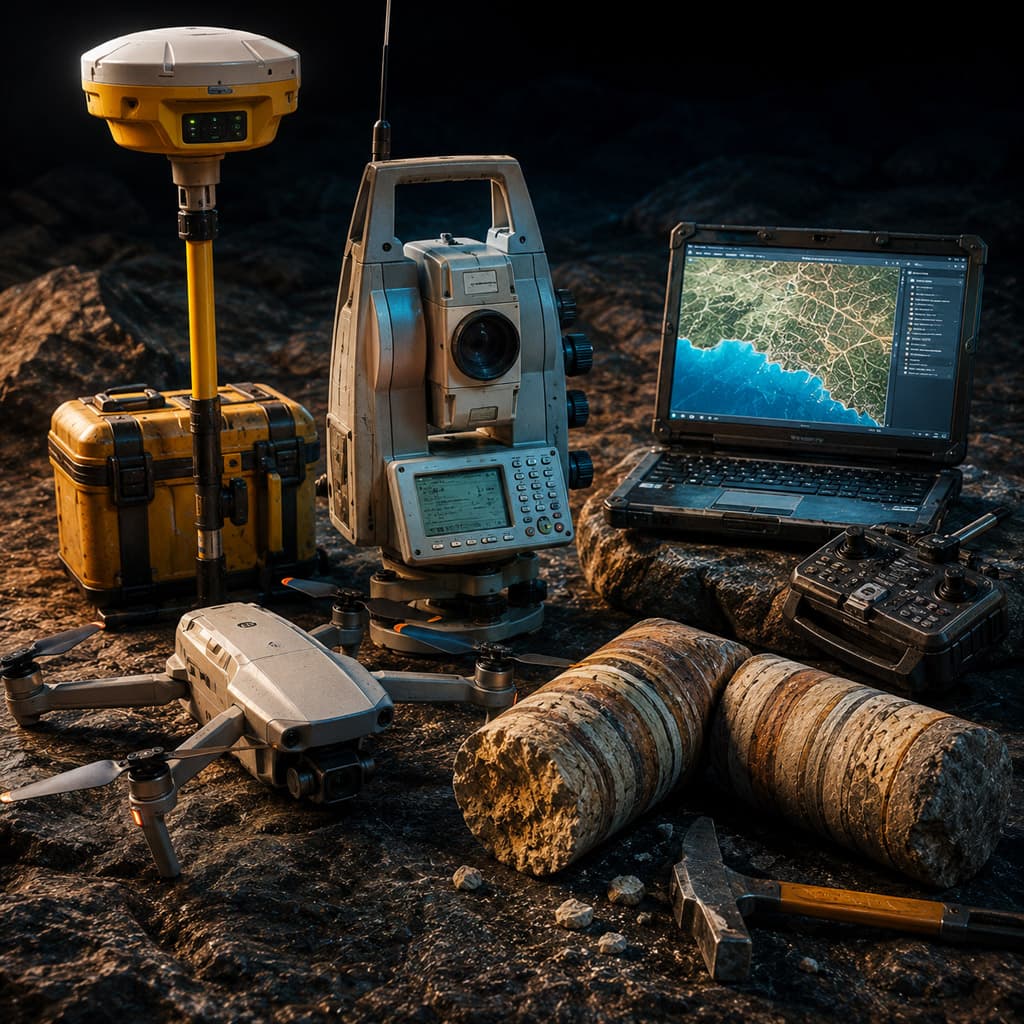
A practical campaign over a Brahmaputra-Jamuna char cluster would include airborne LiDAR strips across the island, adjacent channels, banklines, and nearby mainland access points. Surveyors would place GNSS checkpoints on stable open surfaces: school yards, homestead plinths, road crowns, crop fields, and sand ridges. Local residents should be involved from the start because they know which areas flood first, where currents cut new channels, and where people move during emergencies.
The output should not be a technical DEM alone. It should include village-scale maps that people can read: high ground, low ground, flood paths, safe plinth zones, possible road alignments, and erosion-warning margins.
Reading the Elevation Map
Once processed, the LiDAR DEM turns a visually flat island into a readable terrain surface. A slight ridge may appear along an old sandbar. A shallow depression may reveal an abandoned channel. Homestead clusters may sit on artificially raised mounds. Crop fields may occupy lower, seasonally flooded zones. Footpaths may follow natural high lines without residents consciously describing them that way.
| Zone | Elevation range m | Flood risk | Recommended land use | |
|---|---|---|---|---|
| ——————————– | ———————– | ———————————————— | ————————————————————– | |
| Zone A: high ridge | >2.0 m | Lower seasonal flood risk, still erosion-exposed | Homesteads, schools, cyclone/flood shelters, tube wells | |
| Zone B: raised settlement belt | 1.5–2.0 m | Moderate flood risk during high monsoon | Houses with raised plinths, community roads, storage platforms | |
| Zone C: seasonal crop plain | 1.0–1.5 m | High flood risk during normal monsoon | Seasonal crops, grazing, temporary structures | |
| Zone D: low basin / channel scar | 0.5–1.0 m | Very high flood duration and waterlogging | Wet-season water storage, fisheries, no permanent housing | |
| Zone E: active river edge | <0.5 m or unstable bank | Extreme erosion and inundation risk | Buffer zone, no permanent settlement |
These ranges are illustrative; actual thresholds must be tied to local river gauge levels, historical flood marks, hydrodynamic models, and community observations.
A simple GIS workflow can delineate char land above a planning threshold:
import numpy as np
import rasterio
from rasterio.features import shapes
from shapely.geometry import shape

with rasterio.open("brahmaputra_char_dem.tif") as src:
    dem = src.read(1)
    transform = src.transform
    nodata = src.nodata

# Char above 1.0m threshold
char_mask = (dem > 1.0) & (dem != nodata)
char_shapes = list(shapes(char_mask.astype(np.uint8), transform=transform))
char_polygons = [shape(s) for s, v in char_shapes if v == 1]
print(f"Char islands identified: {len(char_polygons)}")
In production, this would be combined with river stage records, Sentinel-1 flood frequency maps, erosion history, household locations, land tenure, and field validation.
From Data to Settlement Guidance
The purpose of LiDAR mapping is not to produce beautiful terrain images for reports. It is to help vulnerable communities make safer decisions. Four recommendations can come directly from char elevation data:
- Safe building zones
- Road alignment
- Plinth height requirements
- Evacuation routes
A settlement plan might identify the highest stable ridge for schools and shelters, recommend minimum plinth heights for houses, align roads along natural high ground, and mark low basins where permanent housing should be avoided. It can also identify households that need relocation support before the next flood season.
“When the water comes, we learn the island again. One neighbour’s yard stays dry, another goes under first, but before the flood we cannot see that difference. If we had a map, we would know where to raise the house.” — Char resident, Jamuna River
There is also an ethical dimension. Elevation maps can affect land value, relocation decisions, and claims over newly emerged land. Data should therefore be shared carefully, explained clearly, and used with community participation. A map that labels one area “unsafe” without offering alternatives can create fear. A map that combines risk with practical guidance can support dignity.
The Brahmaputra-Jamuna chars will continue to move. No LiDAR survey can freeze a braided river. But it can provide a snapshot precise enough to guide today’s settlement choices and a baseline strong enough to measure tomorrow’s change. In a place where half a metre can separate survival from disaster, that is technology serving the people who need it most.
Sources / References
- World Bank — Bangladesh: First Phase of the Jamuna River Economic Corridor Development Program, Environmental and Social Impact Assessment Executive Summary.
- Frizzle et al. — “LiDAR topo-bathymetry for riverbed elevation assessment: A review of approaches and performance for hydrodynamic modelling of flood plains,” 2024.
- Meadows et al. — “Vertical accuracy assessment of freely available global DEMs in flood-prone environments,” 2024.
- Ullah, Islam and Malak — “Charland Dynamics of the Brahmaputra-Jamuna River in Bangladesh,” 2016.
- Nahin et al. — “Flood vulnerability assessment in the Jamuna river adjacent Jamalpur district using GIS and AHP,” 2023.
- National Research Council — Elevation Data for Floodplain Mapping, 2007.








Responses (0 )