




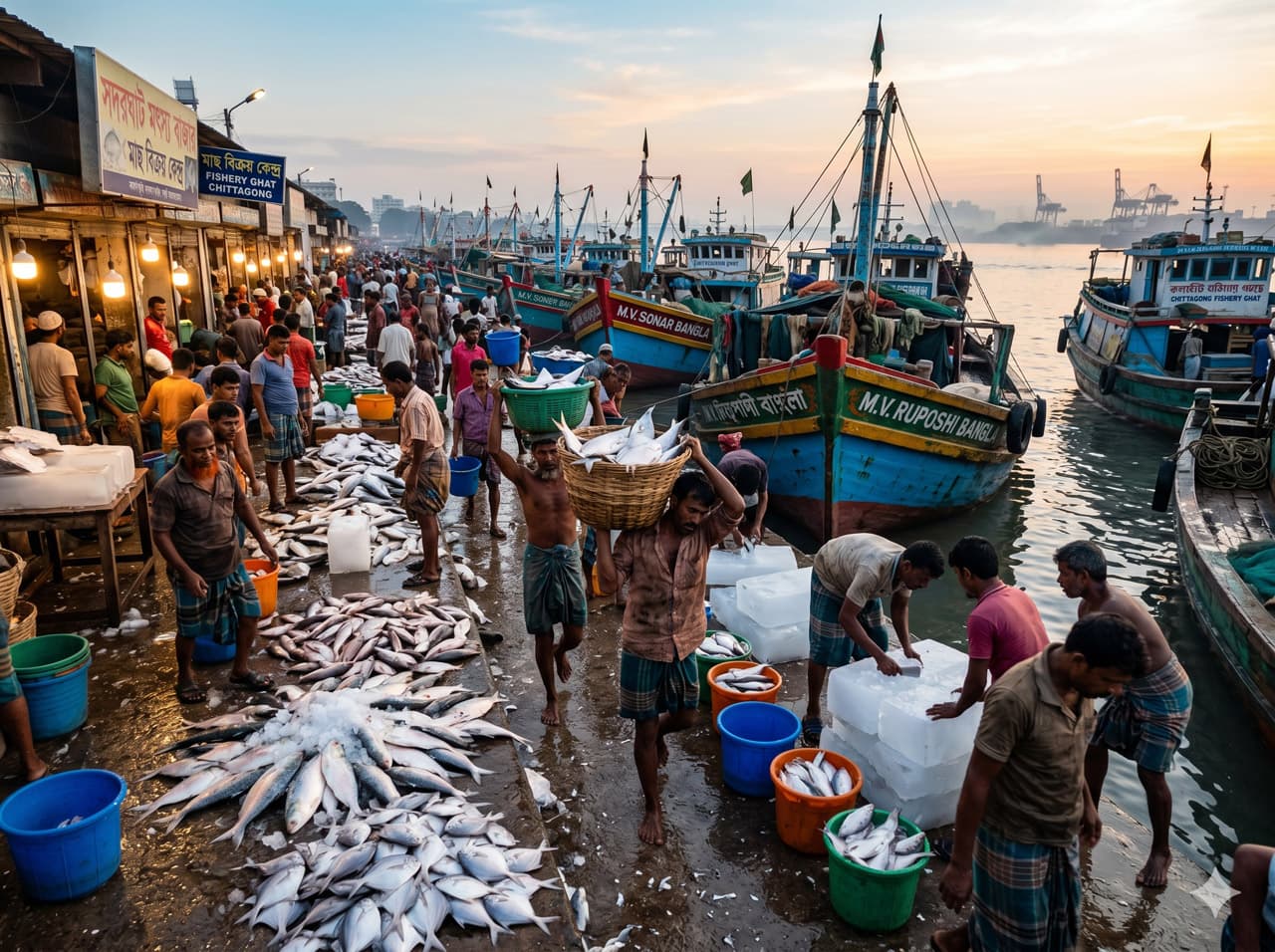
Bangladesh’s fishing industry feeds 180 million people — and it depends on ocean circulation patterns most fishermen have never heard of. From the hilsa boats of Chandpur and Bhola to the marine trawlers working beyond Cox’s Bazar, every net is lowered into a moving ocean. The Bay of Bengal is not a still blue basin; it is a seasonal machine of winds, currents, river plumes, heat, salinity, plankton blooms, and fish migrations. For a fishing nation, oceanography is not an abstract science. It is the hidden weather beneath the water.
Bangladesh’s marine and coastal fisheries sit at the northern rim of one of the world’s largest semi-enclosed tropical seas. The Bay receives enormous freshwater and sediment input from the Ganges-Brahmaputra-Meghna river system, while the South Asian monsoon reverses winds and surface currents across the basin. These changes influence sea surface temperature, salinity, nutrients, chlorophyll-a, plankton, and ultimately fish abundance. Studies of Bay of Bengal productivity show that river-borne nutrients are especially important near the northern coast, while deeper ocean nutrients, upwelling, vertical mixing, and atmospheric inputs also help control chlorophyll-a patterns across the wider bay. (APN Global Change Research)
The Bay’s Seasonal Personality
The Bay of Bengal has a strong seasonal personality. In winter, cooler and drier northeasterly winds help create a different circulation pattern from the humid southwest monsoon. Classic ocean-circulation studies describe a large anticyclonic surface gyre during the northern winter, which weakens and changes into a more cyclonic pattern by late summer. In simpler terms, the Bay changes its “spin” with the monsoon. Currents reverse, eddies form, river water spreads, and fishing grounds shift. (coaps.fsu.edu)
During the southwest monsoon, heavy rainfall and river discharge pour freshwater into the northern Bay. This creates a low-salinity surface layer that can strongly stratify the water column. Stratification means the upper ocean becomes layered: lighter freshwater sits above denser saltwater. This can trap heat near the surface and sometimes limit the upward movement of nutrients from deeper water. That is one reason the Bay has a fascinating paradox: it receives huge river nutrient inputs, yet parts of the open Bay can remain relatively low in productivity because light, turbidity, stratification, and nutrient mixing do not always align. (Frontiers)
| Season | Typical SST range °C | Surface current tendency | Fish abundance level | |
|---|---|---|---|---|
| ———————————– | ——————– | ———————————————————————————- | ———————————————————————- | |
| Winter / Northeast monsoon, Dec–Feb | 24–28 | Broad anticyclonic circulation; coastal currents influenced by northeasterly winds | Moderate; clearer waters, localized productivity | |
| Pre-monsoon, Mar–May | 28–31 | Transitional currents, eddies, warming surface layer | Variable; fish respond to fronts and early productivity patches | |
| Southwest monsoon, Jun–Sep | 28–30 | Strong monsoon-driven circulation, river plume expansion, coastal mixing | High in many coastal zones; strong river influence and nutrient supply | |
| Post-monsoon, Oct–Nov | 27–29 | Reorganizing currents, eddies, retreating freshwater plume | High to moderate; important for hilsa movement and fishing effort |
These values are broad teaching ranges rather than fixed boundaries. A fisherman experiences them as changes in water color, wind direction, current pull, and the “feel” of the sea.
Upwelling and the Food Web
Fish do not simply follow water; they follow food. The food begins with phytoplankton — microscopic plants that use sunlight and nutrients to grow. When nutrients reach the sunlit surface layer, phytoplankton can bloom. Zooplankton feed on them, small fish feed on zooplankton, and larger fish follow.
Upwelling is one way nutrients reach the surface. It occurs when winds and currents move surface water away, allowing deeper, nutrient-rich water to rise. In the Bay of Bengal, upwelling signals are not as simple or as strong everywhere as in some eastern boundary oceans, partly because freshwater stratification can suppress vertical mixing. Still, studies show that nutrients from the subsurface ocean influence chlorophyll-a especially in parts of the western and southwestern Bay, while river-borne nutrients dominate closer to the northern coast. (APN Global Change Research)
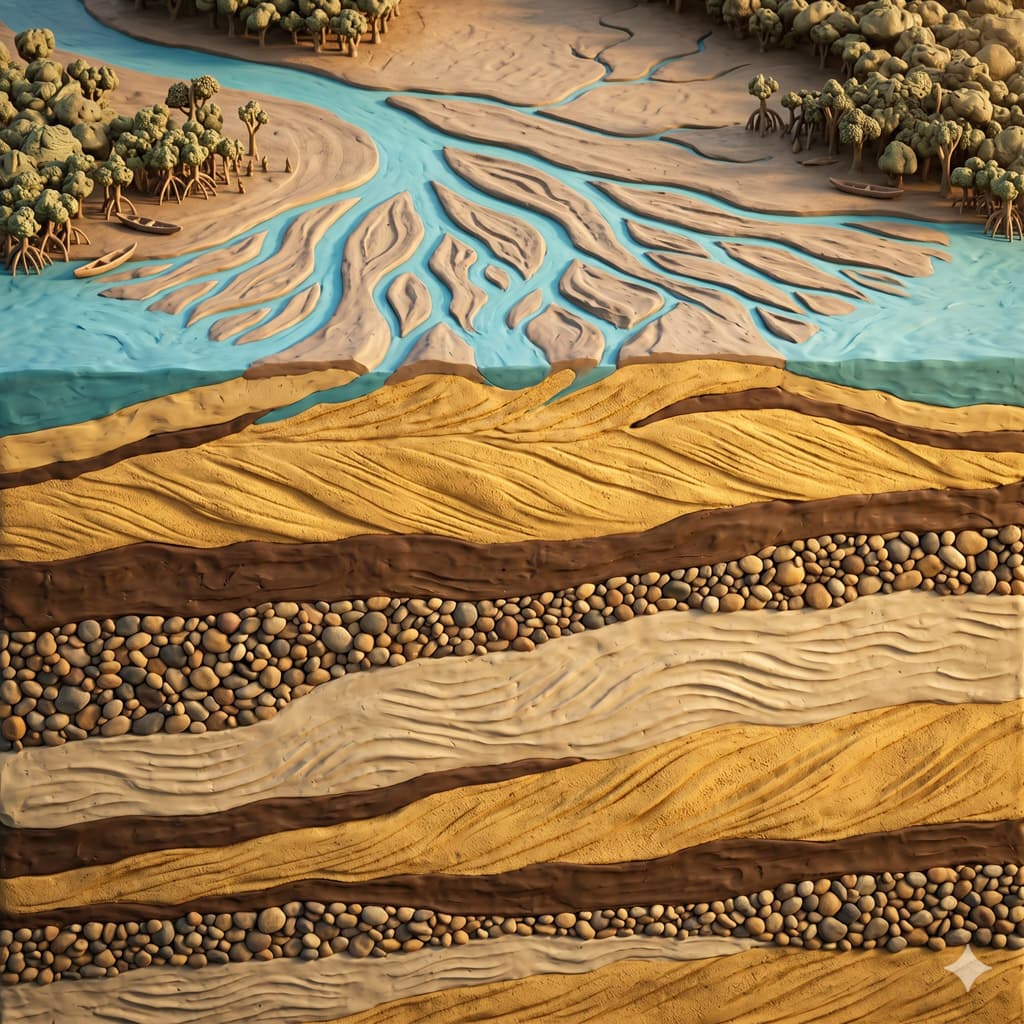
For Bangladesh, this matters because coastal productivity is tied to both river discharge and marine circulation. When the Ganges-Brahmaputra-Meghna system delivers freshwater, sediment, and nutrients, it can fertilize nearshore waters. But too much sediment can reduce light penetration, limiting photosynthesis. So the Bay’s food web depends on a delicate balance: enough nutrients, enough light, suitable temperature, and the right mixing.
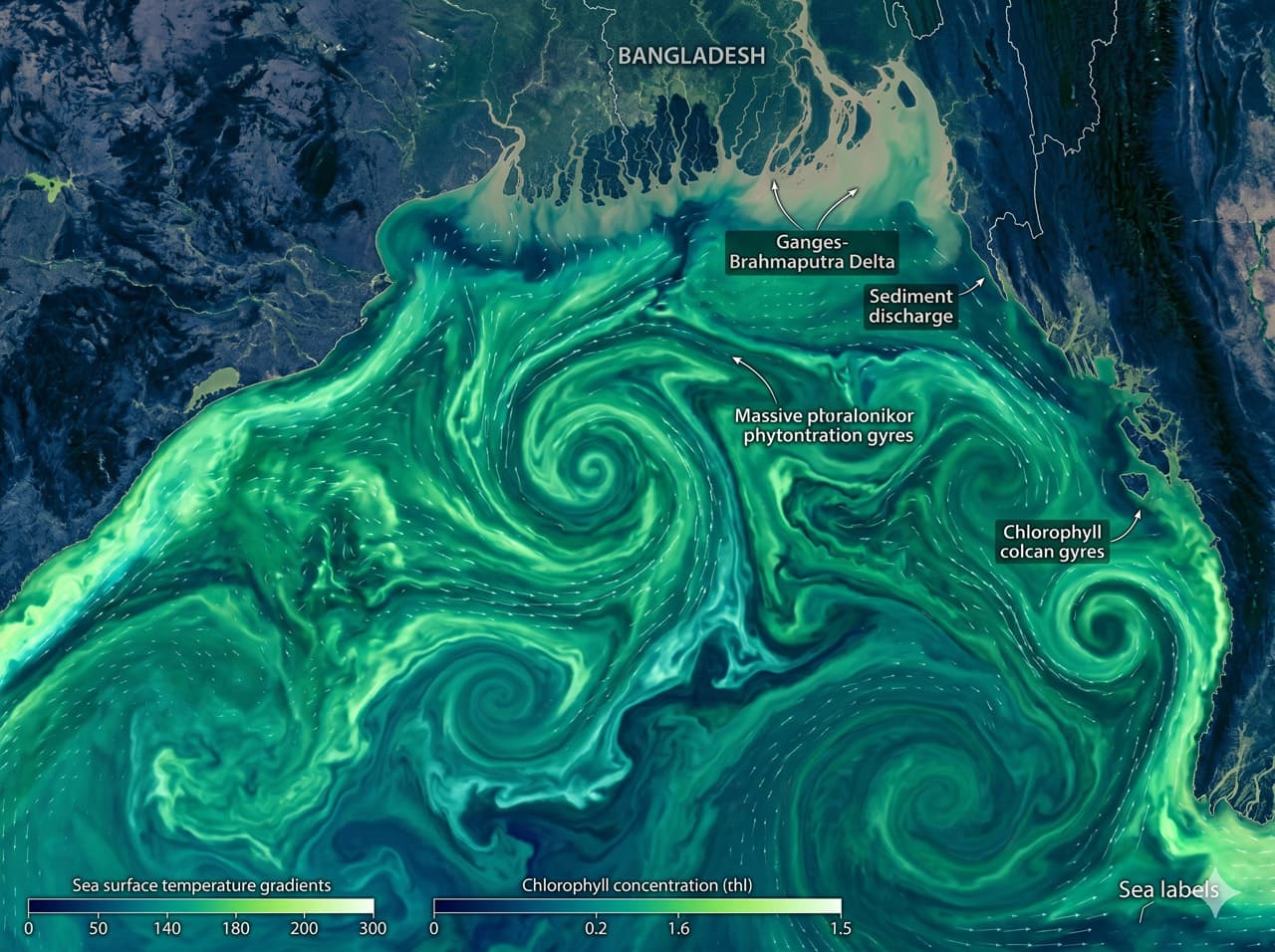
The ocean equivalent of NDVI — the vegetation index used on land — is often chlorophyll-a, a satellite-derived indicator of phytoplankton biomass. Ocean-color sensors estimate chlorophyll from how seawater reflects blue and green light:
Chl-a = f(R_blue, R_green)In plain language, clear ocean water reflects light differently from water rich in phytoplankton. By comparing blue and green reflectance, satellites can map where microscopic marine plants are blooming. This is why ocean color has become essential for fisheries science.
The Hilsa Connection
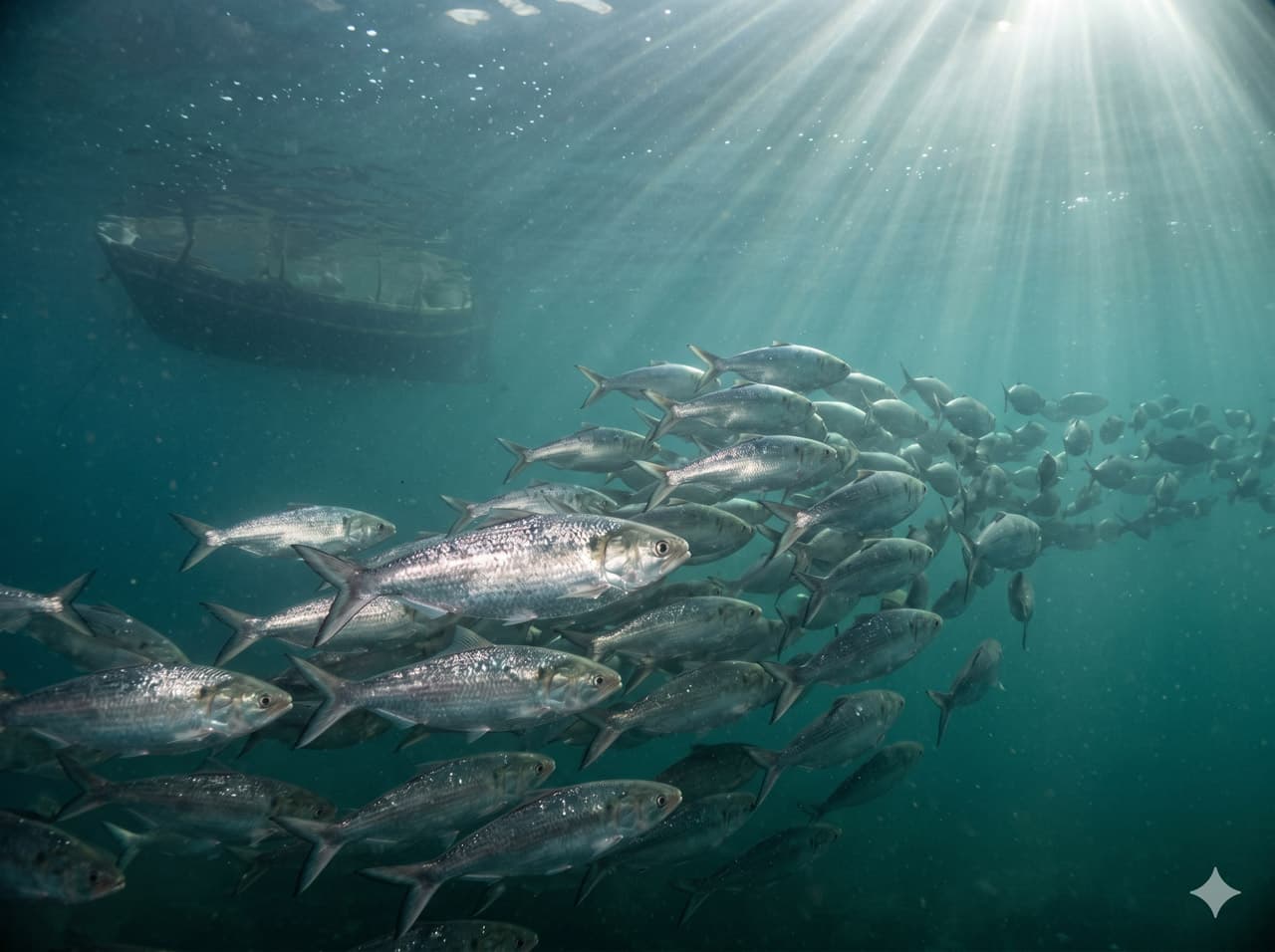
No fish better connects Bangladesh’s rivers, estuaries, and sea than hilsa, Tenualosa ilisha. Hilsa is the national fish of Bangladesh and one of the most culturally and economically important fish of the Bay of Bengal region. It migrates between marine, estuarine, and freshwater environments, making it deeply sensitive to river flow, salinity gradients, plankton availability, and seasonal circulation. IUCN-supported work on hilsa migration emphasizes the importance of understanding spawning grounds, habitat quality, and river-estuary connectivity for conservation. (IUCN Portals)
Research has also linked hilsa fishery production to primary productivity in the Bay of Bengal. In other words, the plankton base of the food web is not just an ecological detail; it is connected to national food security and income. One study notes that Bangladesh’s total hilsa catch has exceeded nine million tonnes since the 1980s, and that primary productivity helps explain variations in the fishery. (PMC)
“When the water turns a soft green-brown and the current carries a cool smell from the south, we know the fish are moving,” says a hilsa fisherman. “The net does not only catch fish — it catches the colour of the water.”
That observation is not superstition. Water color can reveal suspended sediment, plankton concentration, salinity fronts, and mixing zones. Traditional ecological knowledge and satellite oceanography are often reading the same sea in different languages.
Monitoring from Space
Modern fisheries management increasingly depends on remote sensing. Satellites can measure sea surface temperature, chlorophyll-a, sea level anomaly, wind, and ocean color. These data help identify potential fishing zones, productivity hotspots, thermal fronts, and areas where fish may aggregate. Recent work using MODIS Aqua data from 2003–2022 found a basin-wide warming trend in the Bay of Bengal and spatially uneven chlorophyll-a changes, including strong apparent increases in the northern coastal zone and weaker or declining trends offshore. (ScienceDirect)
A very simple Python workflow for working with ocean data might look like this:
import xarray as xr
ds = xr.open_dataset("bay_of_bengal_sst.nc")
print(ds["sea_surface_temperature"].mean())
In real fisheries forecasting, scientists combine SST, chlorophyll-a, currents, bathymetry, salinity, and catch records. The goal is not to replace fishermen’s knowledge, but to support it: safer trips, lower fuel costs, better seasonal planning, and more sustainable harvests.
Caption — Gallery Image 3: Satellite ocean color image of the northern Bay of Bengal showing chlorophyll-a patterns: greenish productive coastal waters shaped by river discharge, monsoon mixing, and plankton blooms.
For Bangladesh, the future of fisheries will depend on reading the Bay more carefully. Climate change is warming the sea, altering monsoon rainfall, intensifying cyclones, changing river discharge, and shifting marine habitats. The same circulation patterns that once guided fish reliably may become less predictable. Protecting coastal fisheries will therefore require both science and stewardship: satellite monitoring, community-based management, hilsa sanctuaries, seasonal bans, bycatch reduction, and better early-warning systems for storms and marine heatwaves.
The Bay of Bengal is not merely the edge of Bangladesh. It is a living engine beneath the nation’s food system. To understand its currents is to understand why fish appear, why they vanish, and how a fishing nation can adapt to a changing ocean.
Sources / References
- Siswanto, E., Sarker, M. L. R., & Peter, B. N. “Spatial variability of nutrient sources determining phytoplankton chlorophyll-a concentrations in the Bay of Bengal.” APN Science Bulletin, 2022.
- Siswanto, E. et al. “Variations of phytoplankton chlorophyll in the Bay of Bengal.” Frontiers in Marine Science, 2023.
- Hossain, M. S. et al. “Primary productivity connects hilsa fishery in the Bay of Bengal.” Scientific Reports, 2020.
- Potemra, J. T. et al. “The Seasonal Circulation of the Upper Ocean in the Bay of Bengal.” 1991.
- IUCN. Migration, Spawning Patterns and Conservation of Hilsa Shad (Tenualosa ilisha) in Bangladesh and India, 2014.
- Hasan, M. A. et al. “A multi-criteria based optimal niche analysis of seasonal productivity in the Bay of Bengal using MODIS data.” Remote Sensing Applications: Society and Environment, 2025.













Responses (0 )