


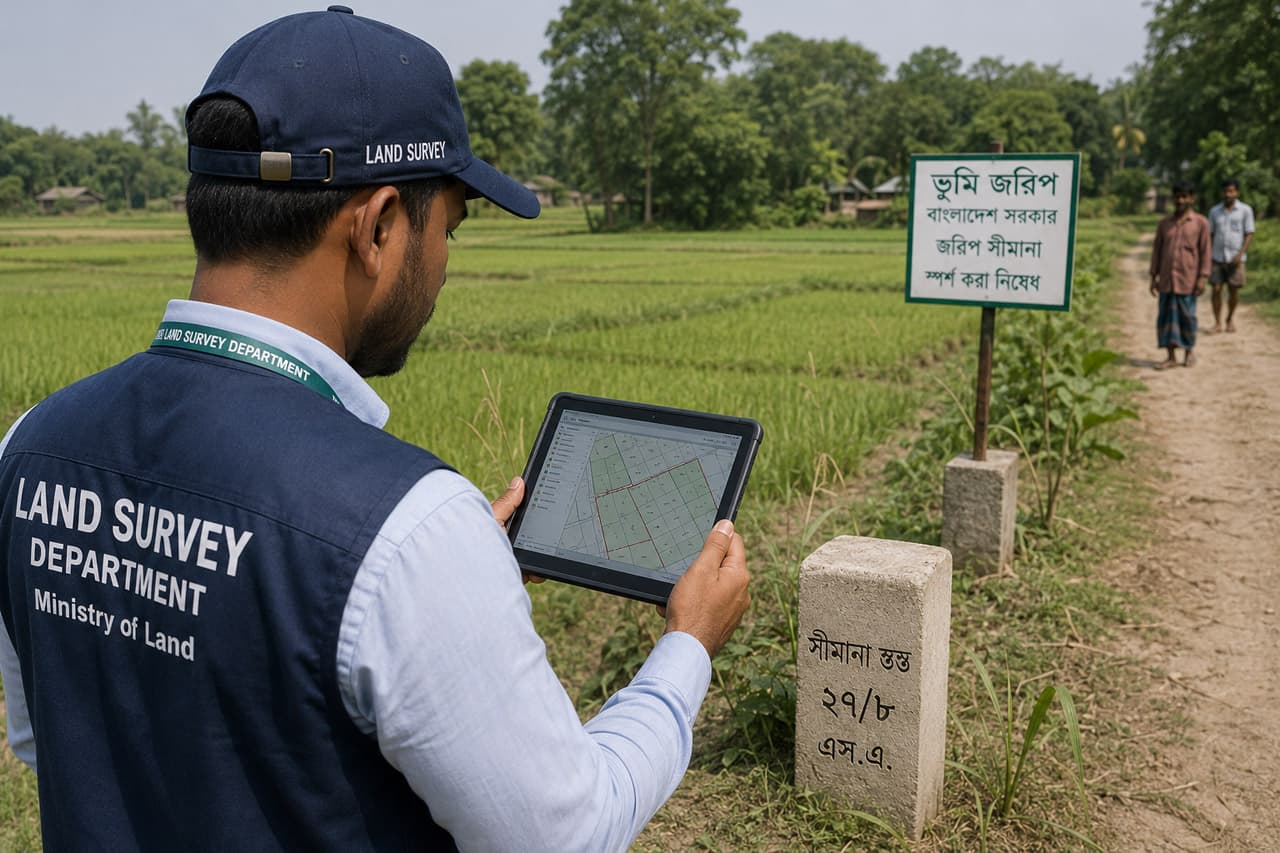
Hero image caption: A survey official standing beside a rural parcel boundary with a tablet, GNSS receiver, and scanned mouza map overlay — where paper land records meet field-verified geospatial data.
Bangladesh has 170 million people competing for 147,570 km² — accurate cadastral records are not a luxury, they are a foundation of justice. In a country where land is inheritance, shelter, collateral, livelihood, political power, and family memory, a parcel boundary is never just a line. It can decide who builds a house, who receives compensation, who pays land tax, who wins a dispute, and who loses everything in court.
A national cadastral geodatabase is therefore more than a GIS project. It is land administration infrastructure. Done well, it can reduce disputes, improve transparency, support taxation, speed up mutation, protect public land, and give citizens clearer access to their rights. Done poorly, it can digitise old errors at national scale.
Why Cadastral Data Matters
Cadastral data records the legal and spatial identity of land parcels. In Bangladesh, the core land record traditionally links two things: the mouza map, which shows plots or dag boundaries, and the khatian, which records rights, ownership, classification, area and related information. Banglapedia describes land records as state documents relating to land tenure and ownership, with mouza maps prepared plot by plot and linked to plot-wise descriptions of ownership and classification. (<a href="https://en.banglapedia.org/index.php/LandRecords?utmsource=chatgpt.com”>Banglapedia)
For citizens, the cadastral record is practical. It helps answer: Where is my plot? What is its dag number? What is the recorded area? Who is listed in the khatian? Has the land been mutated? Is there overlap with public land, road reserve, riverbank, forest, or another private parcel?
For government, the same data supports planning and governance. Accurate parcels help land acquisition, compensation, utility planning, disaster recovery, urban expansion, agricultural protection, zoning, and land development tax. Bangladesh’s national digital land zoning initiative already describes the use of digitised and georeferenced mouza map sheets, satellite imagery, and plot-based land-use mapping to support better land-resource planning. (map.land.gov.bd)
The Current State: Paper and Disputes
Bangladesh’s land administration system is historically fragmented. Survey and settlement, registration, mutation, record correction, revenue collection, and dispute resolution are handled through different institutional processes. A land-management overview describes the cadastral system as involving survey and settlement, ownership determination in disputes, registration of transfers, and updating/maintenance of records and revenue collection. (<a href="https://arcbangladesh.com/LandMain.aspx?utmsource=chatgpt.com”>arcbangladesh.com)
This fragmentation creates familiar problems. A deed may describe one reality, the khatian another, and the ground situation a third. Old mouza maps may be distorted, torn, faded, hand-drawn, or difficult to georeference. Plot numbers may be unclear. River erosion and accretion may change land physically while records lag behind. Urban areas may have subdivisions, encroachments, informal transfers, and overlapping claims.
Bangladesh has made visible progress in digital land services. Digital record rooms, e-mutation, online khatian search, inheritance calculators, and online land development tax have improved citizen access. A recent review notes ongoing land-management automation and digital survey capacity projects, along with services such as e-mutation, digital record room, RS khatian access, and online tax payment. (SCIRP) But a truly national cadastral geodatabase requires more than scanning documents. It requires geometry, attributes, topology, legal status, version history, and field validation.
“The hardest part is not scanning the map. The hardest part is reading a hand-drawn 19th-century mouza sheet, matching a faded dag number to today’s ground reality, and deciding whether the error is in the paper, the field, or the history between them.” — Survey officer
Designing the Geodatabase
A national cadastral geodatabase should be designed as a living system, not a one-time digitisation archive. At minimum, it needs parcel geometry, ownership linkage, survey metadata, source document references, topology rules, administrative hierarchy, and audit trails.
A simplified parcel attribute schema might look like this:
| Field name | Data type | Description | Example value | |
|---|---|---|---|---|
| ——————– | ———– | ———————————————– | ———————- | |
parcel_id | UUID / text | Unique national parcel identifier | BD-KHL-DUM-0123-0456 | |
division_code | text | Administrative division code | 40 | |
district_code | text | District code | 47 | |
upazila_code | text | Upazila or thana code | 12 | |
mouza_code | text | Official mouza identifier | 081 | |
jl_no | text | Jurisdiction list number | JL-56 | |
dag_no | text | Plot or dag number | 245/1 | |
khatian_no | text | Linked record-of-rights number | RS-1034 | |
survey_type | text | CS, SA, RS, BS, BDS or other survey | RS | |
recordedareaacre | numeric | Area recorded in khatian or survey record | 0.42 | |
gisareasqm | numeric | Area calculated from parcel geometry | 1699.68 | |
land_class | text | Agricultural, homestead, pond, road, khas, etc. | Homestead | |
owner_ref | text | Link to ownership table, not full public PII | OWN-77891 | |
sourcemapsheet | text | Scanned map sheet reference | KHLDUM081RS04 | |
validation_status | text | Draft, field-verified, disputed, approved | field-verified | |
geom | geometry | Parcel polygon in official projected CRS | POLYGON(...) |
The geometry should be stored in a projected coordinate reference system suitable for Bangladesh. A common concept is transforming field or GPS coordinates from WGS84 latitude-longitude to BTM — Bangladesh Transverse Mercator for measurement and mapping. In simplified terms:
(latitude, longitude)WGS84 → projection parameters + datum transformation → (Easting, Northing)BTMThe practical point is that area, distance, and overlap checks should be performed in an appropriate projected CRS, not raw latitude-longitude degrees. The exact EPSG definition and transformation parameters must be standardised nationally and applied consistently across agencies.
Topology rules are equally important. Parcels within the same mouza should not overlap unless legally recorded as multi-level or special cases. Gaps should be flagged. Boundary mismatches between adjacent sheets should be reviewed. Public roads, rivers, khas land, forests, and acquired land should be represented as authoritative layers, not manually redrawn in each project.
A simple PostGIS overlap detection query can identify parcels that need review:
SELECT a.parcel_id, b.parcel_id, ST_Area(ST_Intersection(a.geom, b.geom)) AS overlap_area
FROM cadastral_parcels a, cadastral_parcels b
WHERE a.parcel_id <> b.parcel_id
  AND ST_Intersects(a.geom, b.geom)
  AND ST_Area(ST_Intersection(a.geom, b.geom)) > 0.1;
In production, this query should be improved to avoid duplicate pair reporting, filter by mouza, use spatial indexes, and calculate area in a projected CRS. But the principle is clear: the database should actively detect geometry problems before they become legal problems.
Field Validation Workflow
Digitisation creates a draft. Validation creates trust. A practical field validation workflow should include:
- GPS survey — capture boundary points, control points, landmarks, roads, canals, and disputed corners using GNSS or total station where required.
- Photo documentation — attach geotagged photographs of boundary markers, structures, roads, water bodies, and field conditions.
- Deed cross-check — compare dag number, khatian, deed description, recorded area, mutation status, and tax records.
- Community verification — conduct local review with landowners, neighbours, elected representatives, and survey officials before final approval.
Bangladesh’s digital survey procurement documents increasingly reference modern methods such as coordinate-value databases, GCP pillars, orthomosaic maps, georeferencing of previous mouza maps, complete digital cadastral mouza maps, plot indexes, RTK GNSS, UAVs, electronic total stations, and dynamic online databases. (Bangladesh Public Procurement Authority) These are exactly the building blocks of a modern cadastral validation system.
Challenges of Scale
The challenge is national scale. Bangladesh has thousands of mouzas, millions of parcels, many survey vintages, and constant land transformation. A geodatabase must handle old records, new surveys, riverine change, urban subdivision, court cases, acquisition, inheritance, mutation, and citizen objections.
There is also a governance challenge. Who is allowed to edit a parcel? Who approves correction? How are historical versions preserved? How is privacy protected while still allowing public verification? How are disputes flagged without blocking legitimate transactions?
The best architecture is therefore not only technical. It is institutional: clear data standards, national parcel IDs, role-based editing, immutable audit logs, public map access, legal integration, and a transparent correction workflow. The goal is not to replace law with GIS. The goal is to make the legal record spatially clear, traceable, and easier to verify.
A national cadastral geodatabase will not eliminate every land dispute in Bangladesh. But it can reduce uncertainty, expose contradictions earlier, and give citizens a fairer starting point. In a land-scarce country, that is not just digital transformation. It is public justice.
Sources / References
- Banglapedia. “Land Records.” (<a href="https://en.banglapedia.org/index.php/LandRecords?utmsource=chatgpt.com”>Banglapedia)
- Ministry of Land, Bangladesh. “ভূমি নকশা / National Digital Land Zoning Project.” (map.land.gov.bd)
- Directorate of Land Records and Survey, Bangladesh. Official website. (dlrs.gov.bd)
- “Digitalization of Land Documents in Bangladesh.” Open Journal of Social Sciences, 2024. (SCIRP)
- ARC Bangladesh. “Land Management: Land Record System.” (<a href="https://arcbangladesh.com/LandMain.aspx?utmsource=chatgpt.com”>arcbangladesh.com)
- Bangladesh Public Procurement Authority. Digital survey assignment notice describing UAV/RTK/GNSS/ETS and georeferenced mouza-map database requirements. (Bangladesh Public Procurement Authority)















Responses (0 )