


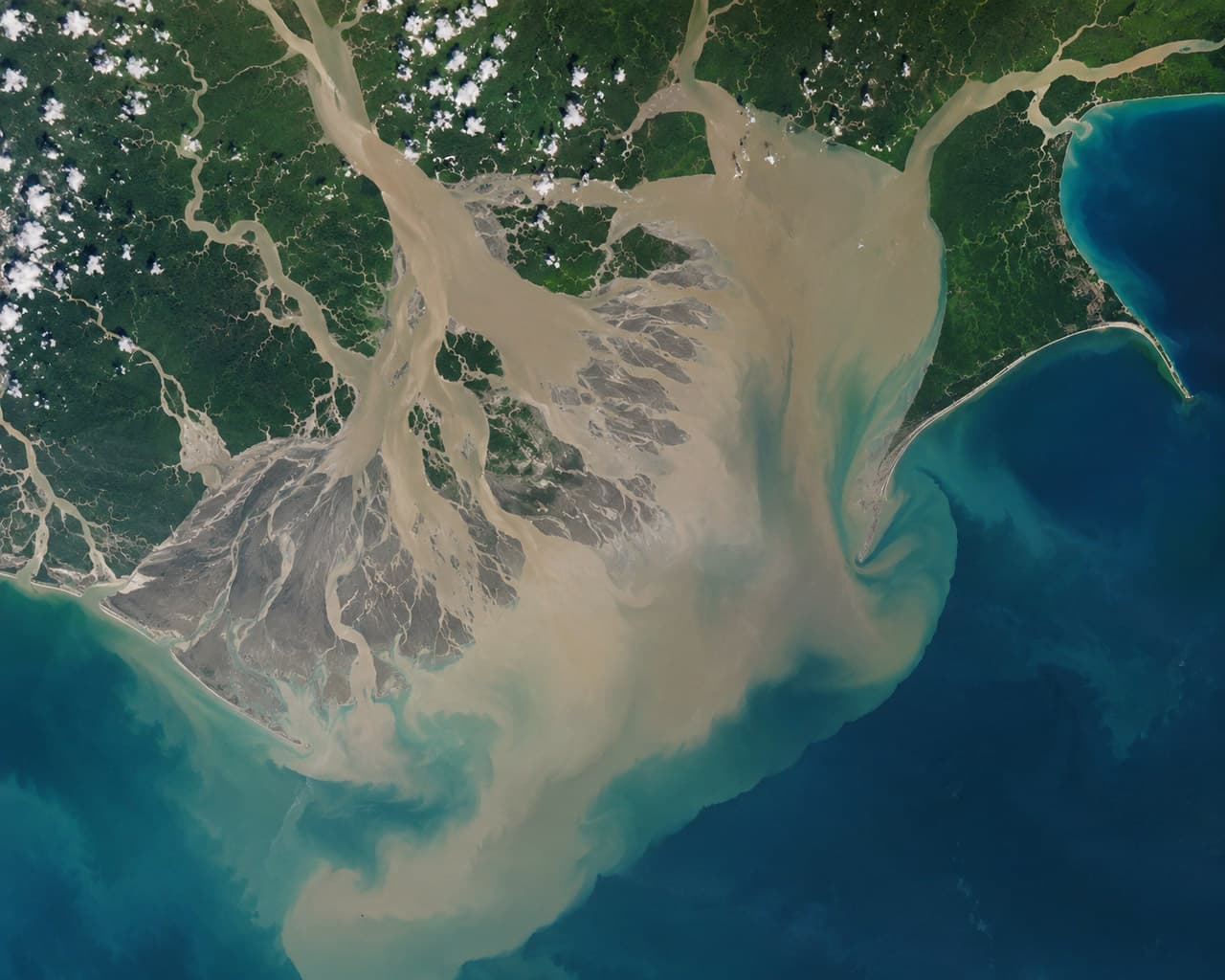
More sediment passes through the Meghna in one monsoon season than any river in the western hemisphere. That is not just a statistic; it is a way of imagining the delta as a living machine. During the rains, the Ganges, Brahmaputra, and Meghna systems gather water from the Himalaya, the Shillong Plateau, the floodplains of Bangladesh, and countless tributaries. By the time this combined flow reaches the Lower Meghna, it is carrying a brown, muscular cargo of silt, clay, and sand toward the Bay of Bengal.
From above, the Meghna Estuary looks like a landscape still deciding what it wants to be: channels split and rejoin, sandbars glow under shallow water, chars appear like newborn islands, and old land is cut away overnight. This is not a static coast. It is one of Earth’s most active sediment theatres, where river flow, tides, waves, monsoon floods, and cyclones continually redraw the map.
Photo caption: Delta aerial satellite image of the Meghna Estuary, showing braided channels, tidal flats, sandbars, and migrating chars formed by the constant exchange of water and sediment.
The World’s Sediment Factory
The Ganges-Brahmaputra-Meghna system is among the world’s largest suppliers of sediment to the ocean. Estimates vary by method and time period: some studies describe roughly a billion tonnes per year moving through the system, while more recent analyses of measured river data suggest lower but still enormous fluxes, with average combined Ganges-Brahmaputra sediment loads around hundreds of millions of tonnes annually. Either way, the Bengal delta remains one of the planet’s great sediment factories. (ScienceDirect)
The Lower Meghna is the final gateway. It carries the combined water and sediment load of the Ganges, Brahmaputra/Jamuna, and Upper Meghna toward the northern Bay of Bengal. In the estuary, river discharge meets tides, salinity gradients, waves, and estuarine circulation. The result is not simple downstream transport. Sediment may move seaward during ebb tide, return landward during flood tide, settle in quiet zones, or be resuspended during storms. Studies of the Meghna Estuary emphasize that both mud and sand are present, and that the interaction of river flow and tidal energy creates complex sediment dynamics. (ASCE Library)
This is why the estuary can both lose and gain land. One shoreline erodes while another grows. One char disappears while another rises from a shoal. The delta is not merely receiving sediment; it is sorting, storing, exporting, and recycling it.
How Bars and Chars Form
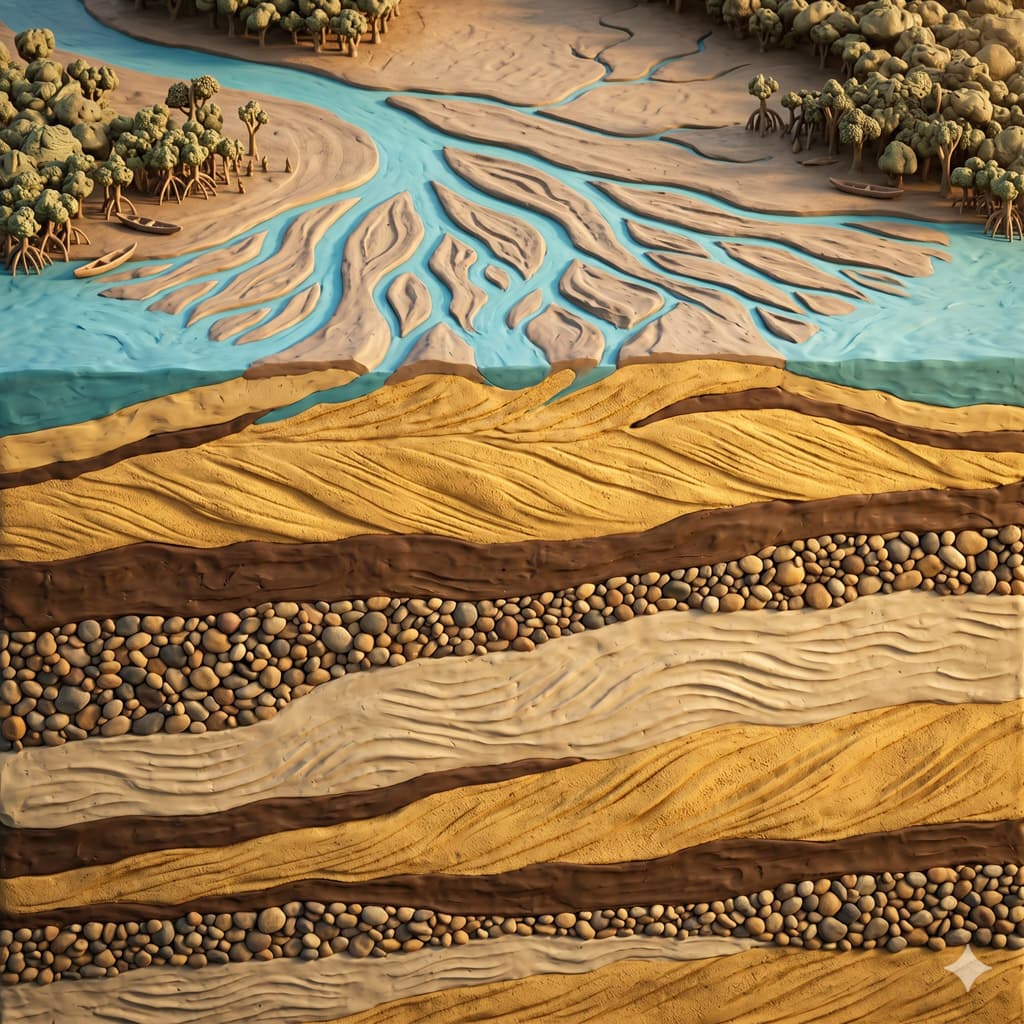
A bar begins when flowing water loses enough energy to drop part of its sediment load. In a river channel, this may happen where the flow widens, slows, curves, or collides with another current. In the Meghna Estuary, bars often form where river currents meet tidal currents, where channels bifurcate, or where sediment-rich water enters shallower zones.
At first, a bar may be submerged — a hidden rise on the riverbed. As more sediment accumulates, it grows upward. During low water, it may emerge as a sandy or muddy surface. Plants arrive, especially grasses and salt-tolerant vegetation. Their roots trap more sediment, slowing water near the surface. Over time, the bar may become a char: a river or estuarine island that people can graze, farm, settle, and sometimes lose again.
But chars are temporary by nature. Their edges are constantly attacked by currents and waves. A char may migrate downstream, split into two, merge with another shoal, or be swallowed by a shifting channel. Recent remote-sensing work on offshore islands in the Meghna Estuary shows major morphological changes over recent decades, driven by river discharge, sediment load, tidal energy, and estuarine circulation. (ScienceDirect)
“The river moves its islands like cattle in the night,” says a Meghna boatman. “You sleep with land on one side, and after the flood, the channel has taken it somewhere else.”
Four major factors control char formation and migration:
- Sediment supply: More suspended sediment and bed material create more opportunity for deposition.
- Flow velocity and channel geometry: Fast, narrow channels erode; wider or slower zones encourage bars.
- Tidal currents and estuarine circulation: Flood and ebb tides redistribute sediment across channels and flats.
- Storms, cyclones, and monsoon floods: Extreme events can rapidly erode banks, breach chars, or build new deposits.
The Physics of Transport
Sediment transport is a balance between gravity pulling grains down and water turbulence lifting or pushing them forward. Clay and fine silt can remain suspended for long distances. Sand often moves closer to the bed, bouncing, rolling, or briefly lifting in turbulent bursts. The mode of transport depends on grain size, flow velocity, turbulence, water depth, and settling velocity.
| Sediment class | Size range in mm | Typical transport mode | |
|---|---|---|---|
| ————– | —————- | ————————————————– | |
| Clay | <0.004 mm | Wash load / long-term suspension | |
| Silt | 0.004–0.063 mm | Suspended load, settles in quiet water | |
| Very fine sand | 0.063–0.125 mm | Suspension and intermittent bedload | |
| Fine sand | 0.125–0.25 mm | Bedload, saltation, near-bed suspension | |
| Medium sand | 0.25–0.5 mm | Mostly bedload and saltation in energetic channels |
A classic way to understand erosion and deposition is Hjulström’s curve. It shows the critical velocity needed to erode, transport, or deposit grains of different sizes. Fine clay is surprisingly hard to erode because particles stick together electrochemically. Sand is easier to lift at moderate velocities. Coarser grains require stronger flow. In the Meghna, this means the same current may erode fine sand from a channel bed, carry silt in suspension, and leave cohesive mud untouched until turbulence becomes strong enough.
Another useful concept is the Rouse number, which helps describe how sediment is distributed vertically in flowing water:
Z = w_s / (κ · u*)Here, Z is the Rouse number; w_s is the settling velocity of a sediment grain; κ is von Kármán’s constant, about 0.4; and u* is shear velocity, a measure of near-bed turbulence. Plainly: if grains settle quickly and turbulence is weak, sediment stays near the bed. If turbulence is strong and grains settle slowly, sediment can remain suspended high in the water column.
This explains why the Meghna can look like liquid earth during monsoon. Fine sediment is not just lying on the bottom; it is mixed through the water, moving with every pulse of current.
A Delta Always Changing
The Meghna Estuary is a place where land is both made and unmade. For Bangladesh, this dynamism is a blessing and a hazard. Sediment deposition can build new land, nourish tidal flats, and help parts of the delta keep pace with sea-level rise. Research on the Ganges-Brahmaputra delta emphasizes that continued sediment delivery and deposition are central to sustaining the delta under future climate and sea-level pressures. (Nature)
But the same processes also threaten communities. Char dwellers live with erosion, displacement, uncertain land rights, salinity shifts, cyclone exposure, and changing navigation routes. A newly formed char may be fertile but fragile. A channel that supports fishing one year may become too shallow the next. A school, mosque, or market built on apparently stable ground can find itself at the edge of a cutbank after a flood season.
The policy lesson is clear: the Meghna cannot be managed as a fixed map. It must be managed as a moving system. Satellite monitoring, sediment budgets, bathymetric surveys, community-based erosion warnings, adaptive embankment planning, and nature-based sediment management all matter. Cross-dams, polders, and land reclamation projects must be evaluated not only for immediate land gain but for how they alter flow paths, sediment trapping, erosion elsewhere, and ecological connectivity.
The delta breathes in sediment and exhales new land. It shifts under monsoon pressure, tidal rhythm, and storm energy. To watch the Meghna Estuary from space is to see geology happening in real time — bars rising, chars migrating, channels swinging, and the coast of Bangladesh being rewritten grain by grain.
Sources / References
- Allison, M. A., et al. “Sediment Dynamics in the Meghna Estuary, Bangladesh.” Journal of Coastal Research / ASCE-related coastal engineering literature. https://ascelibrary.org/doi/10.1061/%28ASCE%290733-950X%282007%29133%3A4%28255%29
- Dietrich, M., et al. “A first-order geochemical budget for suspended sediment discharge from the Ganges-Brahmaputra river system to the Bay of Bengal.” Science of the Total Environment, 2020. https://www.sciencedirect.com/science/article/abs/pii/S0048969720321847
- Rahman, M., et al. “Recent sediment flux to the Ganges-Brahmaputra-Meghna delta system.” Science of the Total Environment, 2018. https://www.sciencedirect.com/science/article/abs/pii/S004896971832223X
- Michels, K. H., et al. “The submarine delta of the Ganges–Brahmaputra.” Marine Geology, 1998. https://www.sciencedirect.com/science/article/abs/pii/S0025322798000218
- Raff, J. L., et al. “Sediment delivery to sustain the Ganges-Brahmaputra delta under climate change and anthropogenic impacts.” Nature Communications, 2023. https://www.nature.com/articles/s41467-023-38057-9
- Khatun, F., et al. “Morphological changes in the offshore islands of Meghna estuary of Bangladesh over 30 years using remote sensing and GIS.” 2025. https://www.sciencedirect.com/science/article/pii/S2589757824000556
- Islam, M. F., et al. “Sedimentation and accretion processes in the lower Bengal Delta.” Hydrological Processes, 2021. https://onlinelibrary.wiley.com/doi/full/10.1002/hyp.14119












Responses (0 )