


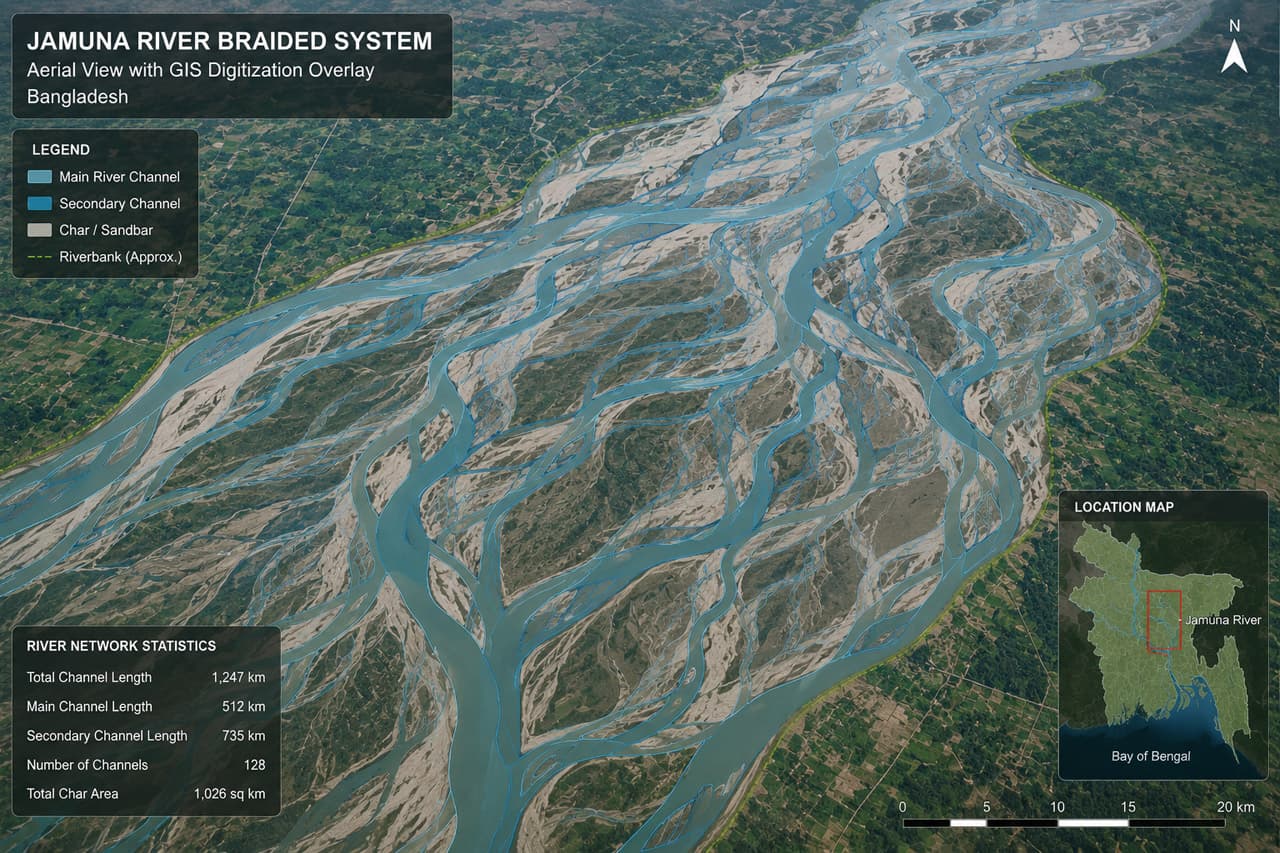
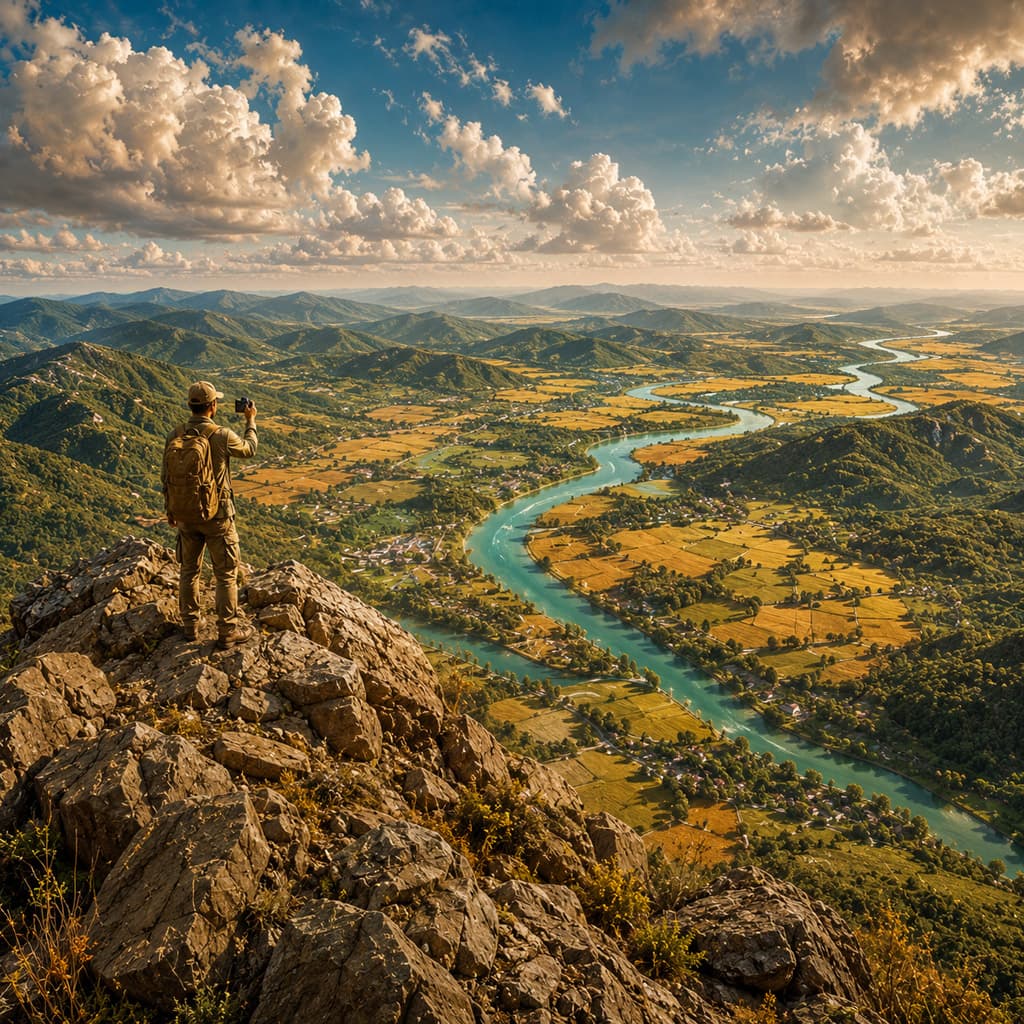
Hero image caption: An aerial view of the braided Jamuna River with GIS layers overlaid — active channels, mid-channel bars, eroding banks, chars, gauge stations, and historical channel positions shown as temporal geodatabase features.
The Jamuna braids itself into 30–60 active channels at any given moment, shifting kilometres in a single monsoon — and every geospatial analyst trying to track it faces the same challenge: how do you store a river that refuses to stay still?
A normal river database assumes stability. It stores a centerline, a bankline, a few cross-sections, perhaps some water-level stations. The Brahmaputra–Jamuna laughs at that simplicity. It is one of the world’s great sand-bed braided rivers, carrying enormous water and sediment loads, splitting into multiple threads, eroding floodplain land, creating and destroying chars, and changing its planform from year to year. Studies of the Jamuna describe it as a highly dynamic braided system where bank erosion consumes thousands of hectares of floodplain annually, displacing many people and reshaping the river corridor. (<a href="https://www.academia.edu/30063090/MorphodynamicsoftheBrahmaputraJamunaRiverBangladesh?utmsource=chatgpt.com”>Academia)
Designing a hydrological geodatabase for such a river is not just a storage problem. It is a scientific model of change.
The Challenge of a Braided River
The Jamuna is the downstream continuation of the Brahmaputra inside Bangladesh. After entering the country, the river flows south through a wide alluvial corridor before joining the Padma near Goalundo. Its planform is not a single stable channel but a shifting network of interlacing channels, bars and islands. NASA’s Earth Observatory notes that the Brahmaputra’s high sediment load helps explain its abrupt change in shape as it leaves the Himalayas and reaches flatter terrain. (NASA Science)
In a braided river, “the river” is not one object. It is a family of objects: primary channels, secondary channels, chute cutoffs, abandoned channels, chars, banklines, erosion fronts, accretion zones, confluences, bifurcations, cross-sections, gauge stations, and sediment sampling points. Some features exist for decades. Others appear after one flood season and disappear the next.
This creates a database-design problem. If we store only the 2024 channel line, we lose history. If we store every year as a separate shapefile, we lose structure. If we store only raster classifications, we lose feature identity. The solution is a temporal geodatabase: a system that treats river features as time-aware objects.
Geodatabase Design Principles
A hydrological geodatabase for the Brahmaputra–Jamuna should follow five design principles.
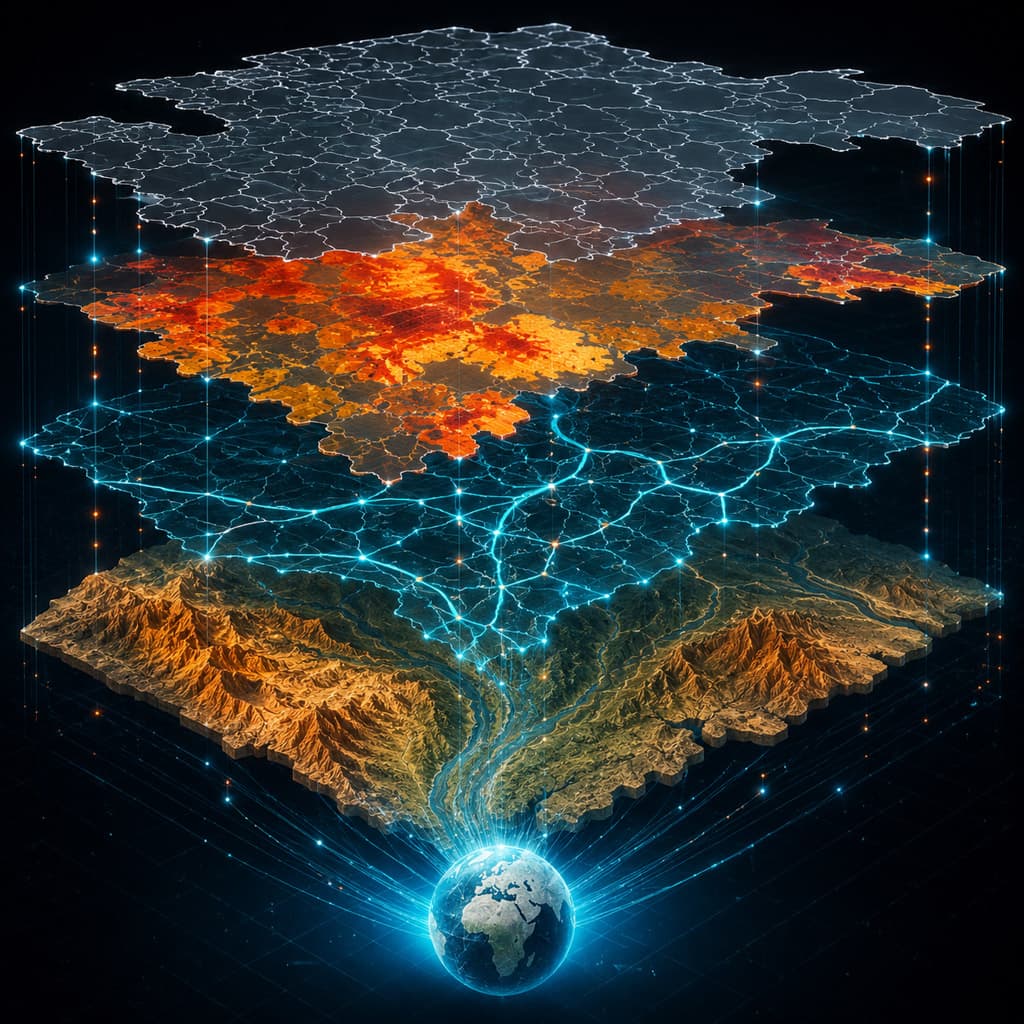
First, separate stable reference layers from dynamic river layers. District boundaries, gauge stations, bridge locations and administrative units change slowly. Channels, bars and banklines change frequently. They should not be mixed in one flat layer.
Second, store time explicitly. Every river feature should carry validfrom, validto, surveydate, imagedate, or hydrological_year. A channel mapped from a January dry-season Sentinel-2 image is not equivalent to a channel mapped from a peak-monsoon radar image.
Third, keep source metadata. Was the feature digitised from Sentinel-2, Landsat, UAV imagery, historical survey maps, or field GPS? What was the image resolution? What water level was recorded at Bahadurabad or Sirajganj on that date? Without metadata, apparent channel migration may simply reflect different water stages.
Fourth, use topology and relationships. A channel belongs to a river reach. A char lies between channel threads. A bank erosion polygon relates to a previous bankline. A gauge station measures a named river at a fixed location but may become hydraulically disconnected from a channel thread over time.
Fifth, design for analysis, not just display. The database should answer questions: Which bankline retreated fastest? Which chars persisted for five years? Which channels shifted more than 500 m? Which villages are within the active migration corridor?
The Schema
A practical implementation can be built in PostgreSQL/PostGIS, with raster products stored either in PostGIS raster, cloud object storage, or a catalog table referencing GeoTIFFs. Vector layers should use a projected coordinate system suitable for Bangladesh so that distance, area and migration rates are meaningful.
| Layer name | Geometry type | Key attributes | Update frequency | |
|---|---|---|---|---|
| ——————– | ———————— | ———————————————————————————————- | ————————————- | |
river_reaches | LineString / Polygon | reachid, rivername, upstreamkm, downstreamkm, management_unit | Rarely; when reach definitions change | |
active_channels | LineString / Polygon | channelid, reachid, order, widthm, imagedate, validfrom, validto, source | Seasonal or annual | |
banklines | LineString | banklineid, bankside, imagedate, waterlevel_m, source, confidence | Seasonal or annual | |
chars_bars | Polygon | barid, bartype, areaha, vegetationstatus, persistenceyears, imagedate | Seasonal or annual | |
erosion_accretion | Polygon | changeid, changetype, areaha, periodstart, periodend, ratem_yr | Annual or post-monsoon | |
cross_sections | LineString | sectionid, chainagekm, surveydate, bedlevelmin, bedlevel_mean | Survey cycle dependent | |
gauge_stations | Point | stationid, stationname, river, datum, operator, status | As needed | |
water_levels | Point / table | stationid, datetime, waterlevelm, dangerlevel_m, source | Daily to sub-daily | |
historical_maps | Polygon / raster catalog | mapid, year, scale, georefrmse, source_archive | When new historical data is added | |
migration_corridor | Polygon | corridorid, period, confidence, method, maxwidth_km | Multi-year revision |
The schema should avoid the temptation to put everything into one “Jamuna layer.” A braided river is relational. The database should be relational too.
Temporal Versioning
Temporal versioning is the heart of the design. One simple approach is to create annual tables such as jamunachannels2020 and jamunachannels2024. That is easy for analysts, but it becomes messy after many years. A better long-term model stores all channel records in one table with date fields:
active_channels(channel_id, reach_id, geom, image_date, valid_from, valid_to, source, confidence)If the same named channel thread can be tracked across years, it keeps a stable channelid. If it splits, merges, or becomes untraceable, a relationship table can record lineage: parentchannelid, childchannelid, eventtype, and event_date.
Still, year-based tables are useful for teaching and quick analysis. A temporal query for channel migration might look like this:
-- Find channels that existed in 2020 but shifted by >500m in 2024
SELECT c2020.channel_id,
       ST_Distance(c2020.geom, c2024.geom) AS shift_metres
FROM jamuna_channels_2020 c2020
JOIN jamuna_channels_2024 c2024
  ON c2020.channel_id = c2024.channel_id
WHERE ST_Distance(c2020.geom, c2024.geom) > 500
ORDER BY shift_metres DESC;
In production, analysts should use projected geometries, compare equivalent feature types, and consider whether ST_HausdorffDistance, centerline displacement, nearest-bank retreat, or polygon overlap is the better measure. For braided channels, a simple distance between two geometries may hide important details: a channel may widen, split, rotate, or abandon one thread while another becomes dominant.
A useful descriptive metric is the sinuosity index:
SI = L_channel / L_straightHere, Lchannel is the length along the channel path and Lstraight is the straight-line valley or reach length. A perfectly straight channel has SI close to 1.0. Meandering rivers often have much higher values. The Jamuna’s individual threads are typically low-to-moderately sinuous — often around 1.1 to 1.3 for active braided threads — but the whole river belt is complex because multiple channels, bars and shifting confluences create planform instability even when individual threads are not highly meandering.
Integration with Remote Sensing
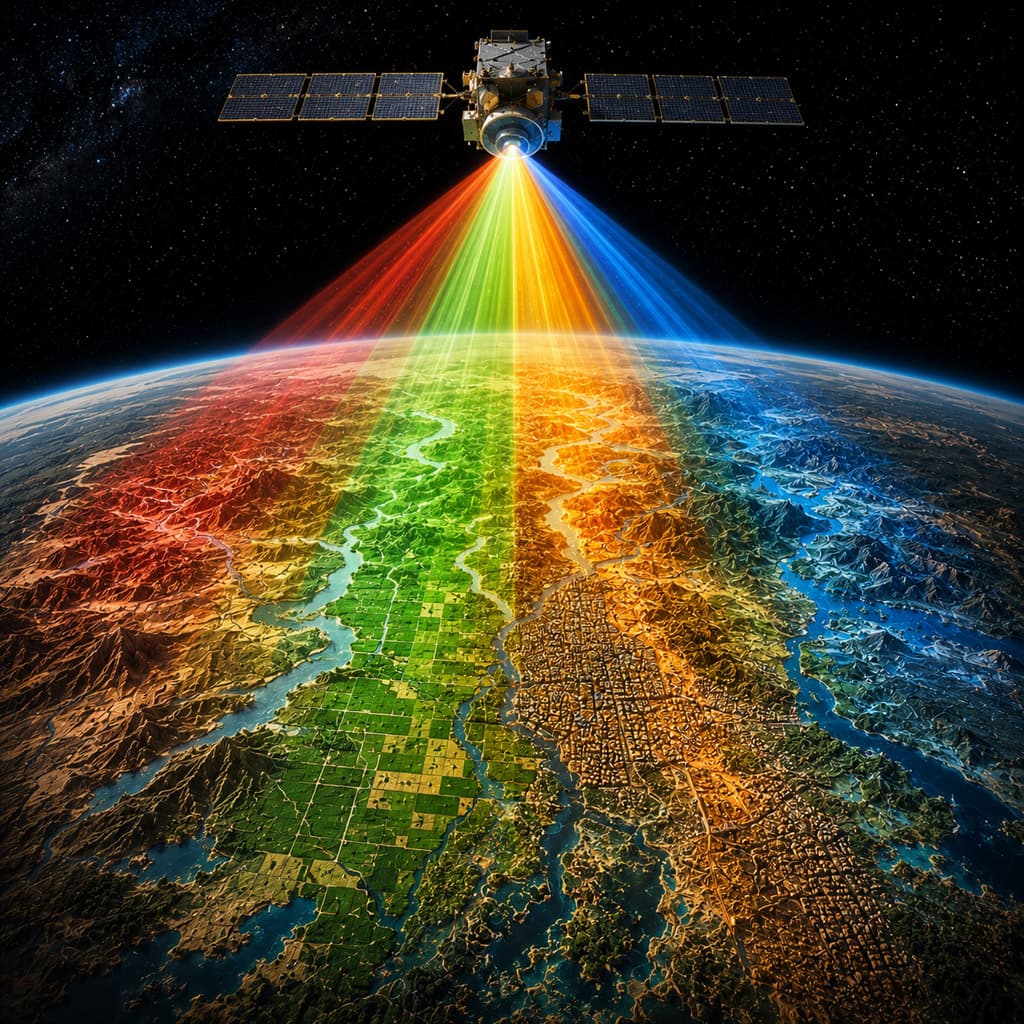
Remote sensing is the main engine feeding the geodatabase. Field surveys are essential, but no field team can map the full Jamuna corridor after every monsoon at the speed satellite imagery allows. The most useful data sources include:
- Sentinel-2 imagery — 10 m optical imagery for dry-season water, sandbar, vegetation and channel mapping.
- BWDB gauge records — water levels, discharge records, danger levels and station histories for hydrological context.
- SRTM DEM — elevation context, floodplain surface, drainage setting and broad terrain analysis.
- Historical survey maps — long-term channel migration, avulsion history and pre-satellite river positions.
Satellite-derived classifications should be stored with processing metadata: index used, threshold, cloud mask, water level, date, sensor and analyst. For water extraction, analysts may use NDWI, MNDWI, automated classification, or machine-learning models. For bars and chars, seasonal timing matters: a dry-season image shows exposed sand and vegetated bars differently from a monsoon image.
Recent research has shown that the Brahmaputra–Jamuna’s channel migration may be more coherent and predictable than it appears at first glance. A 2025 study used satellite data and dynamic time warping to analyse migration patterns across braided channel threads, suggesting that even apparently chaotic braided rivers can show organized motion. (agupubs.onlinelibrary.wiley.com) That makes a well-structured temporal geodatabase even more valuable: it becomes the foundation for prediction, not just documentation.
“Every monsoon gives us a new Jamuna. The gauges may stay in place, but the channels, chars and erosion fronts move. After the flood season, we are not just updating a map — we are re-learning the river.” — BWDB hydrologist
A hydrological geodatabase will not make the Jamuna stable. It will make its instability measurable. For river scientists, planners and disaster managers, that is the point. If the river refuses to stay still, the database must be designed to move with it.
Sources / References
- Sarker, M. H., Thorne, C. R., Aktar, M. N., and Ferdous, M. R. “Morpho-dynamics of the Brahmaputra–Jamuna River, Bangladesh.” Geomorphology, 2014. (<a href="https://www.academia.edu/30063090/MorphodynamicsoftheBrahmaputraJamunaRiverBangladesh?utmsource=chatgpt.com”>Academia)
- Best, J. L. et al. “The Jamuna-Brahmaputra River, Bangladesh.” Book chapter / research review, 2020. (<a href="https://cris.brighton.ac.uk/ws/files/32748114/BestetalRevisedJamunaChapterFinalDraftv3.pdf?utm_source=chatgpt.com”>Cris Brighton)
- NASA Earth Observatory. “The Braided Brahmaputra,” 2020. (NASA Science)
- Li, Y. and Limaye, A. “Coherent Motion of Channel Threads in the Braided Brahmaputra-Jamuna River.” Journal of Geophysical Research: Earth Surface, 2025. (agupubs.onlinelibrary.wiley.com)
- EOS Research Spotlights. “Coherent, Not Chaotic, Migration in the Brahmaputra-Jamuna River,” 2025. (EOS)
- Wahiduzzaman, M. et al. “An Observation of the Changing Trends of a River Channel: A Case Study of the Padma and Jamuna Rivers.” Applied Sciences, 2022. (mdpi.com)









Responses (0 )