

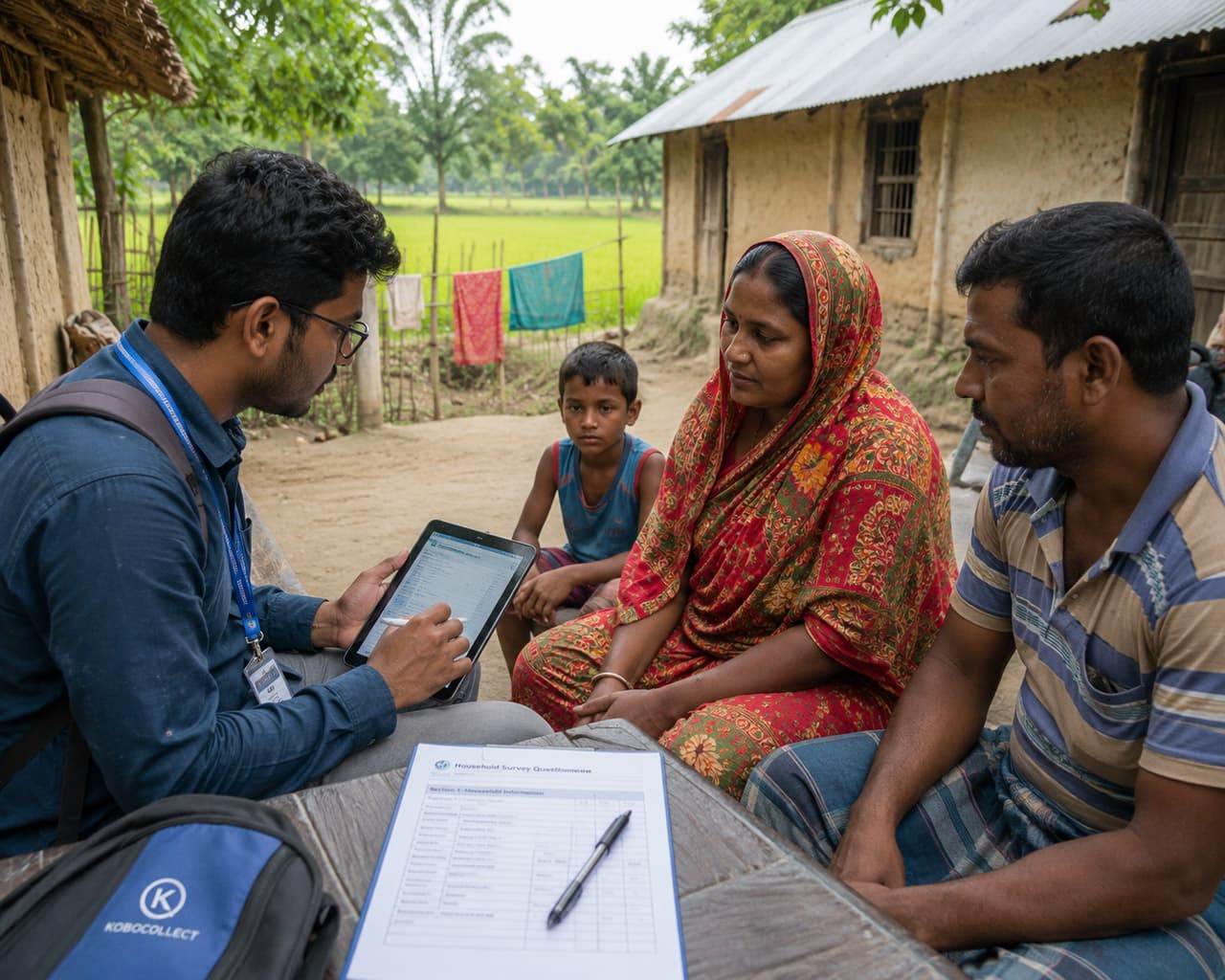
Hero image caption: A field researcher with a tablet interviewing a household in a rural Bangladesh village, while local leaders and community members observe near a courtyard.
The most accurate map of rural poverty starts not with satellite data but with a researcher, a tablet, and the trust of a village headman.
Remote sensing can show roofs, roads, ponds, cropland, vegetation, and flood extent. But it cannot reliably tell you whether a household has secure income, whether girls are dropping out of school, whether a family borrows during lean months, or whether a tube well is socially accessible to everyone. For socioeconomic mapping in rural Bangladesh, field survey remains essential. The challenge is to design a method that is statistically defensible, locally respectful, and practical under real field conditions: monsoon mud, weak mobile signal, local politics, language variation, and respondent fatigue.
Designing the Survey Instrument
A good survey starts with a clear research question. Are you mapping poverty, livelihood vulnerability, food insecurity, education access, sanitation, climate adaptation, or service coverage? Do not begin by listing every question you are curious about. Begin by defining what decisions the map should support.
For rural Bangladesh, a socioeconomic mapping questionnaire usually has five sections: household identification, demographics, livelihood and income, housing and assets, and service access. Depending on the study, you may add migration, health, education, disaster loss, credit, land tenure, or women’s mobility. Keep questions simple, locally understandable, and measurable. For example, “monthly household income” may be difficult to answer accurately, but asset ownership, occupation, landholding, remittance, food shortage months, and school attendance may be more reliable.
Digital tools such as KoboToolbox, ODK, SurveyCTO, or ArcGIS Survey123 are commonly used for field data collection. KoboToolbox is widely used in humanitarian and development contexts and supports offline data collection, which is important in rural areas where connectivity is unreliable. Its documentation notes that data can be collected offline using KoboCollect or web forms, stored on the device first, and uploaded when connectivity returns. (KoboToolbox Support)
Before field deployment, translate the form into Bangla and, where needed, local terms. Test it with 10–15 households outside the sample area. Watch for questions that create confusion, embarrassment, or long explanations. A survey that looks perfect in Dhaka may fail in a char village, haor settlement, hill community, or coastal union.
Sampling Strategy in Rural Bangladesh
Sampling is where many socioeconomic maps become weak. If you only survey households near the road, near the bazar, or near a cooperative local contact, the map will be biased. Rural Bangladesh has strong spatial variation: river islands, embankment-side settlements, floodplain villages, remote haor areas, peri-urban villages, and cyclone-prone coastal communities may differ sharply even within the same upazila.
A common approach is cluster sampling, where villages or enumeration areas are selected first, then households are selected within those clusters. Cluster sampling is practical because households within a village are geographically close, reducing travel time and cost. UNICEF’s MICS sampling guidance describes cluster sampling as a logical choice when selecting groups of geographically close households. (<a href="https://mics.unicef.org/sites/mics/files/chap04.pdf?utmsource=chatgpt.com”>UNICEF MICS) The UN household survey sampling handbook also emphasizes probability sampling at each stage for sound survey design. (<a href="https://unstats.un.org/unsd/demographic/sources/surveys/handbook23june05.pdf?utmsource=chatgpt.com”>UNSD)
The basic sample size formula often introduced for village or household selection is:
n = (Z² × p × q) / e²
where Z is the confidence-level z-score, p is the estimated proportion, q = 1-p, and e is the margin of error. For example, if you assume p = 0.5, use 95% confidence (Z = 1.96), and accept a 5% margin of error, the initial sample size becomes about 384. In cluster surveys, you may increase this using a design effect because households within the same village may be similar.
If your goal is mapping, also think spatially. Stratify by division, district, agro-ecological zone, flood exposure, coastal risk, or poverty category. Bangladesh survey design literature has used Bangladesh as a case study for master sample design, discussing stratification, domain estimates, and sample allocation in developing-country household surveys. (Survey Insights)
Here is a simple Python example for randomly selecting villages from a GIS layer:
import geopandas as gpd
import random

villages = gpd.read_file("bangladesh_villages.shp")
sample_size = 120
random.seed(42)
sampled = villages.sample(n=sample_size, random_state=42)
sampled.to_file("survey_sample_villages.shp")
print(f"Sampled {len(sampled)} villages from {len(villages)} total")
In real projects, you would usually stratify first, then sample proportionally or deliberately across strata.
Data Collection in the Field
Fieldwork begins before the first interview. Contact local administration, union parishad representatives, community leaders, school teachers, health workers, or respected elders. Explain the purpose of the survey, what data will be collected, how privacy will be protected, and what the study will not do. Do not create expectations of direct cash support unless the project truly includes it.
Enumerator training is critical. Train the team on consent, neutral questioning, GPS capture, skip logic, household selection, and handling sensitive questions. Practice mock interviews. Make sure every enumerator understands that speed is not the only target; consistency and respect matter more.
Field challenges in Bangladesh surveys often include:
- Language diversity: local dialects, ethnic languages, and terminology differences.
- Monsoon season access: flooded roads, broken embankments, boat dependency, and slippery paths.
- Community trust building: suspicion about land, taxation, political affiliation, or aid eligibility.
- Mobile connectivity: delayed sync, failed uploads, and difficulty checking forms in real time.
- Data loss from hardware failure: damaged phones, battery drain, corrupted storage, or lost devices.
“At first the villagers thought we had come to verify land ownership. The elder listened quietly, asked three questions about confidentiality, then told everyone, ‘They are here to understand our situation, not take anything from us.’ After that, the interviews became possible.” — Field researcher, northern Bangladesh
Quality Control
Quality control should happen daily, not after the survey ends. Each evening, supervisors should check submissions for missing values, impossible ages, duplicate households, GPS points outside the village, unusually short interview times, and repeated answer patterns. Digital forms help because validation rules can prevent many errors at entry.
Use constraints: age cannot be negative, household size cannot be zero, GPS must be captured, and required questions cannot be skipped. Use choice lists instead of open text where possible. But do not over-constrain the form; rural reality often has exceptions.
Back-check at least 5–10% of interviews by phone or revisit. For sensitive surveys, do not repeat all questions; confirm that the interview happened, household identity was correct, and key non-sensitive responses match. Supervisor spot checks can identify enumerators who are rushing, leading respondents, or selecting convenient households.
Spatial quality control is also important. Load GPS points into QGIS or ArcGIS and inspect them over village boundaries, roads, rivers, and satellite imagery. Points in rivers, markets, or one repeated coordinate may indicate GPS capture problems.
Turning Data into Maps
After cleaning, join survey records to geographic units: village, mauza, union, ward, upazila, or district. Household-level points can be mapped for internal analysis, but public maps should aggregate or anonymize data to protect privacy. Never publish exact household locations for poverty, debt, health, disability, gender-based vulnerability, or sensitive livelihood information.
Common socioeconomic indicators include:
| Indicator | Data source | Scale | Mapping method | |
|---|---|---|---|---|
| —————————– | ——————————— | ————————– | —————————————— | |
| Poverty or deprivation score | Household survey | Household to village/union | Index calculation, aggregation, choropleth | |
| Literacy or school attendance | Household roster / BBS comparison | Village to upazila | Percentage mapping | |
| Drinking water access | Household survey / DPHE records | Household to union | Point density or service access map | |
| Sanitation type | Household survey | Village/union | Classified choropleth | |
| Livelihood category | Household survey / focus group | Village/union | Dominant livelihood map | |
| Disaster loss | Household survey / local records | Village/upazila | Graduated colour or hotspot map | |
| Health facility travel time | Survey + road network | Village/union | Network accessibility surface | |
| Migration or remittance | Household survey | Village/upazila | Proportional symbols or choropleth |
For poverty mapping, Bangladesh has a strong tradition of combining household surveys and census data for small-area estimates. The World Bank’s Bangladesh poverty maps provide zila and upazila-level socioeconomic indicators, including poverty, demographics, education, employment, water, sanitation, and energy access. (<a href="https://www.worldbank.org/en/data/interactive/2016/11/10/bangladesh-poverty-maps?utmsource=chatgpt.com”>World Bank) Poverty mapping is used to identify geographic variation and target policy interventions more effectively. (<a href="https://www.worldbank.org/en/news/press-release/2014/08/27/latest-bangladesh-poverty-maps-launched?utmsource=chatgpt.com”>World Bank)
Finally, document everything: sampling frame, sample size, date of fieldwork, questionnaire version, GPS accuracy, cleaning rules, aggregation method, classification scheme, and limitations. A good socioeconomic map is not just colourful; it is defensible.
Sources / References
- United Nations Statistics Division. Designing Household Survey Samples: Practical Guidelines. (UNSD)
- UNICEF MICS. Choosing the Sample — cluster sampling guidance. (UNICEF MICS)
- Maligalig, D. S. Developing a Master Sample Design for Household Surveys in Developing Countries: A Case Study in Bangladesh. (Survey Insights)
- KoboToolbox Documentation. Collecting Data Offline and Data Collection Tools. (KoboToolbox Support)
- Harvard Humanitarian Initiative. KoBoToolbox. (Harvard Humanitarian Initiative)
- World Bank. Bangladesh Interactive Poverty Maps. (World Bank)
- World Bank Blog. Interactive poverty maps at your fingertips: The case of Bangladesh. (World Bank Blogs)
- World Bank. Poverty Maps of Bangladesh 2010: Technical Report. (Open Knowledge Repository)
- Bangladesh Forest Inventory. Socio-Economic Survey Design of the Bangladesh Forest Inventory. (bfis.bforest.gov.bd)















Responses (0 )