


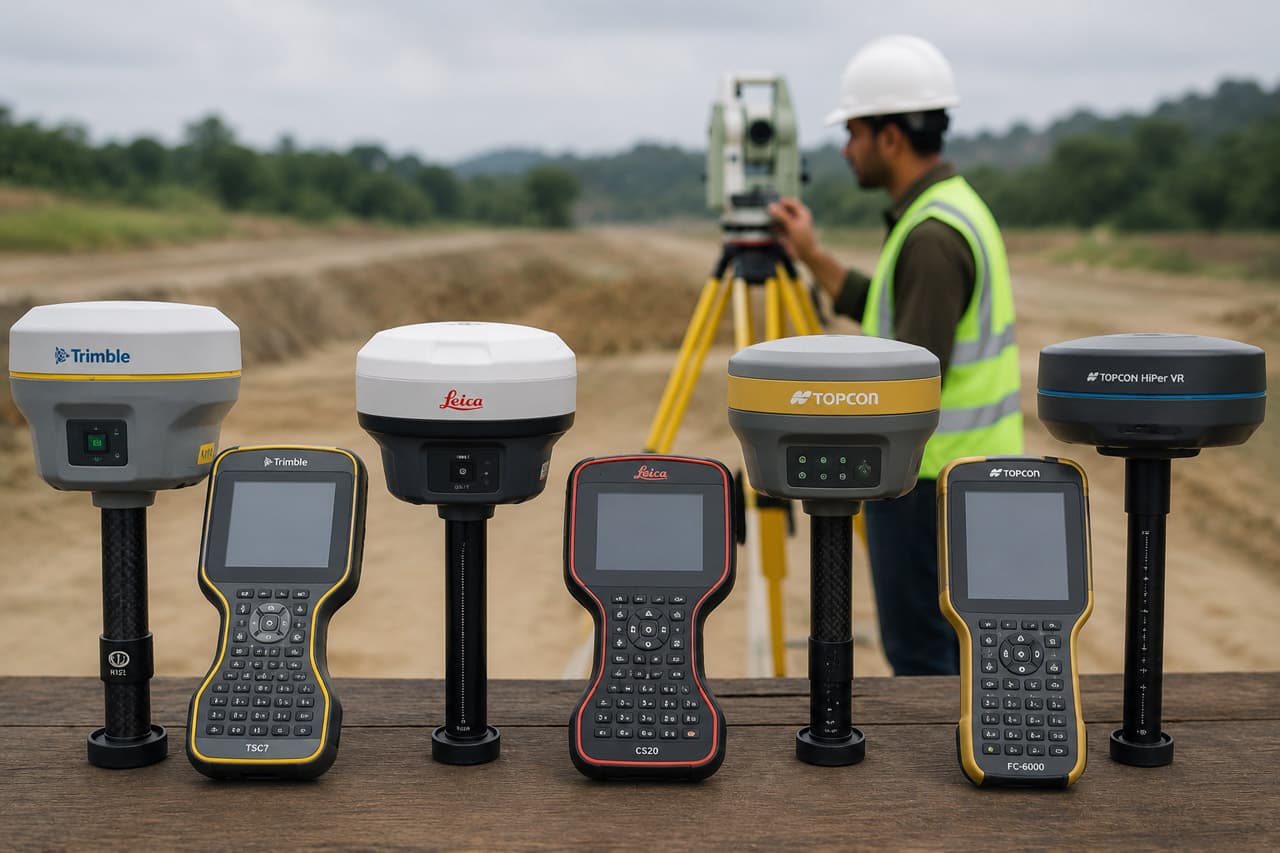
Hero image caption: A lineup of survey-grade GNSS receivers mounted on tripods and rover poles beside a field surveyor, ready for cadastral, riverbank, archaeological, and infrastructure mapping work.
A consumer GPS phone gives you 3–5 metre accuracy. A survey-grade GNSS receiver gives you 1–2 centimetres. When your work involves property boundaries, embankment levels, or archaeological sites — that difference matters enormously.
For field geoscientists in Bangladesh, the choice of GNSS equipment is not just about brand prestige. It affects whether your riverbank erosion line is defensible, whether a road centreline matches design drawings, whether an archaeological mound is mapped precisely, and whether a cadastral resurvey can survive technical scrutiny. A phone GPS is fine for navigation and quick site photos. It is not enough when centimetres matter.
Understanding GNSS Accuracy Levels
GNSS means Global Navigation Satellite System. GPS is only one constellation; modern receivers also use GLONASS, Galileo, BeiDou, QZSS, NavIC/IRNSS and SBAS depending on hardware support. More constellations and more frequencies generally improve satellite availability and reliability, especially in difficult environments.
Accuracy has levels. A normal smartphone may give a few metres under open sky and worse under trees or near buildings. Mapping-grade receivers may achieve sub-metre accuracy. Survey-grade RTK GNSS can reach centimetre-level accuracy when it receives correction data from a base station, CORS network, radio link, or NTRIP service.
A useful horizontal accuracy expression is:
HRMS = √(σN² + σE²)
where σN is the standard deviation of the north component and σE is the standard deviation of the east component. In simple terms, HRMS combines northing and easting uncertainty into one horizontal accuracy value. If both components are small and stable, your position is reliable. If one component jumps because of multipath, weak satellite geometry, or poor corrections, the final point becomes questionable.
What to Look for in Survey-Grade Equipment
A good survey-grade GNSS receiver should be evaluated by field workflow, not only by datasheet numbers. Look for multi-frequency support, full-constellation tracking, fast RTK initialization, reliable IMU tilt compensation, good battery life, rugged build quality, IP rating, local service support, controller software, export formats, and compatibility with your correction source.
Tilt compensation is now a major productivity feature. It allows you to measure points without keeping the pole perfectly vertical, useful near walls, embankments, trees, culverts, buildings, or busy roads. But do not treat tilt as magic. It still needs calibration or initialization rules depending on model, and quality control remains essential.
Also consider the software ecosystem. Trimble and Leica have mature professional workflows but are expensive. Emlid is attractive for small teams because it is affordable and easy to use. CHCNAV and South are popular mid-range choices in many Asian markets because they offer strong specifications at lower cost. The best receiver is the one your team can actually maintain, configure, and use correctly in the field.
Top Receivers for Field Geoscientists
The high-end benchmark is the Trimble R12i. It offers 8 mm horizontal and 15 mm vertical RTK precision, IMU-based tilt compensation, and Trimble’s ProPoint GNSS technology. Trimble also lists CenterPoint RTX precision around 2 cm horizontal and 3 cm vertical for the R12i, making it attractive for serious survey teams working in mixed conditions. (geospatial.trimble.com)
The Leica GS18 T is another premium receiver, well known for tilt compensation and strong integration with Leica Captivate and Infinity workflows. Leica highlights multi-frequency signal tracking, 20 Hz position update rate, and reliable measurement quality. (leica-geosystems.com)
For cost-conscious professionals, the Emlid Reach RS3 is one of the most interesting options. It supports RTK, PPK, and PPP workflows, works as base or rover, and provides IMU tilt compensation up to 60 degrees. Emlid lists RTK accuracy at 7 mm + 1 ppm horizontal and 14 mm + 1 ppm vertical, with tilt compensation of RTK + 2 mm + 0.3 mm/degree. (emlid.com)
The CHCNAV i93 is a modern high-spec receiver with IMU-RTK and visual surveying. CHCNAV lists full GNSS, 200 Hz IMU, maximum precision of 0.8 cm horizontal and 1.5 cm vertical, plus dual cameras for visual staking and surveying. (geospatial.chcnav.com)
The South Galaxy G7 is a strong mid-range option, especially where budget matters. South lists support for GPS, GLONASS, BeiDou, Galileo, SBAS, IRNSS/NavIC, QZSS and other signals, with RTK workflows designed for centimetre-level positioning. (<a href="https://www.southinstrument.com/product/details/protid/1/id/203.html?utmsource=chatgpt.com”>southinstrument.com)
| Model | Manufacturer | Accuracy | Constellations | Price USD | Bangladesh availability | |
|---|---|---|---|---|---|---|
| ————— | —————- | ———————————— | ———————————————— | —————————————————- | ——————————————————— | |
| Trimble R12i | Trimble | RTK 8 mm H / 15 mm V | GPS, GLONASS, Galileo, BeiDou, QZSS and others | $18,000–$30,000+ | Usually via authorized survey equipment dealers/importers | |
| Leica GS18 T | Leica Geosystems | cm-level RTK; tilt-enabled | Multi-frequency GNSS, major constellations | $16,000–$28,000+ | Available through premium survey equipment suppliers | |
| Emlid Reach RS3 | Emlid | RTK 7 mm + 1 ppm H / 14 mm + 1 ppm V | GPS, GLONASS, Galileo, BeiDou, QZSS, NavIC | $2,999 receiver price before accessories/import cost | Often imported; check reseller/support availability | |
| CHCNAV i93 | CHCNAV | up to 0.8 cm H / 1.5 cm V | Full GNSS | $7,000–$13,000 approx. | Increasingly available through regional distributors | |
| South Galaxy G7 | South Surveying | centimetre-level RTK | GPS, GLONASS, BeiDou, Galileo, SBAS, IRNSS, QZSS | $4,000–$9,000 approx. | Common in South Asian survey equipment market |
Prices vary heavily by controller, radio, pole, tripod, software license, warranty, tax, and local dealer support. Always request a full kit quotation, not just receiver price.
RTK vs PPP: Which Mode?
RTK, or Real-Time Kinematic positioning, is the standard for field surveying when you need centimetre accuracy immediately. It requires correction data from a base station or network. If you have a base-rover setup or access to NTRIP/CORS corrections, RTK is usually the fastest choice.
PPP, or Precise Point Positioning, uses precise satellite orbit and clock corrections. It can be useful where no local base station is available, but convergence time and service availability matter. Premium services such as Trimble RTX can provide centimetre-level positioning without a local base in some regions, but cost and coverage should be checked carefully.
For Bangladesh, RTK is usually the more practical choice for cadastral, engineering, road, embankment, and construction surveys. PPP can be useful for remote geoscience campaigns, coastal studies, or reconnaissance where local corrections are not available.
Bangladesh-Specific Considerations
Bangladesh is a difficult but fascinating GNSS environment. Open-sky paddy fields are easy. Dense urban streets, riverbanks, mangroves, hill forests, and monsoon fieldwork are not.
Five factors affecting GNSS accuracy in Bangladesh fieldwork:
- Tree canopy in CHT: hill forests and plantation cover reduce sky visibility and increase signal loss.
- River delta multipath: water surfaces, boats, embankments, and metal structures can reflect signals.
- Monsoon humidity and weather exposure: equipment must handle rain, mud, heat, and long field days.
- Lack of local CORS stations: correction availability may be inconsistent outside major project areas.
- Power supply: long surveys need spare batteries, power banks, vehicle charging, and rugged cables.
“For cadastral resurvey, professional GNSS changed the conversation. Before, we argued over sketch alignment and local references. With centimetre-grade observations tied to control, boundary verification became faster, cleaner, and easier to defend.” — Survey of Bangladesh officer
If your work is general mapping, do not overspend. A reliable mapping-grade receiver or Emlid-style RTK setup may be enough. If your work affects land ownership, engineering levels, bridge alignment, or legal boundaries, invest in premium equipment, training, calibration procedures, and quality assurance.
The receiver is only half the system. The other half is method: control points, observation time, correction source, metadata, coordinate reference system, field notes, and repeat checks. A poorly used premium GNSS can produce bad data. A carefully used mid-range receiver can produce excellent results. Buy the equipment your team can operate professionally.
Sources / References
- Trimble R12i GNSS System specifications: https://geospatial.trimble.com/en/products/hardware/trimble-r12i
- Leica GS18 T GNSS RTK Rover: https://leica-geosystems.com/products/gnss-systems/smart-antennas/leica-gs18-t
- Emlid Reach RS3 product page: https://emlid.com/reachrs3/
- Emlid Reach RS3 store specifications: https://store.emlid.com/products/reach-rs3
- CHCNAV i93 GNSS receiver specifications: i93: IMU-RTK GNSS Receiver with Visual Surveying | CHCNAV
- South Galaxy G7 specifications: https://www.southinstrument.com/product/details/pro_tid/1/id/203.html
- Emlid guide to GNSS accuracy and precision: https://blog.emlid.com/simple-intro-to-accuracy-and-precision/
Responses (0 )