


Earth’s gravity is not uniform — and that unevenness is a geological treasure map. We feel gravity as a constant pull, but a sensitive instrument can detect tiny changes from place to place: a little stronger over dense basement rocks, a little weaker above thick piles of soft sediment, slightly distorted by buried ridges, faults, basins, and crustal blocks. In a landscape like Bangladesh, where rivers, floodplains, wetlands, and delta mud hide almost everything from view, those invisible variations become a way of seeing underground.
The Bengal Basin is one of the world’s great sedimentary basins, filled by material eroded from the Himalaya and carried south by the Ganges, Brahmaputra, and Meghna river systems. At the surface, it looks deceptively flat. Beneath that flatness lies a deep geological architecture: old continental crust, rifted margins, buried basement highs and lows, folded belts, thick sedimentary wedges, and possible crustal thinning toward the Bay of Bengal. Gravity surveys help geoscientists trace this hidden geometry without drilling every kilometre of the delta.
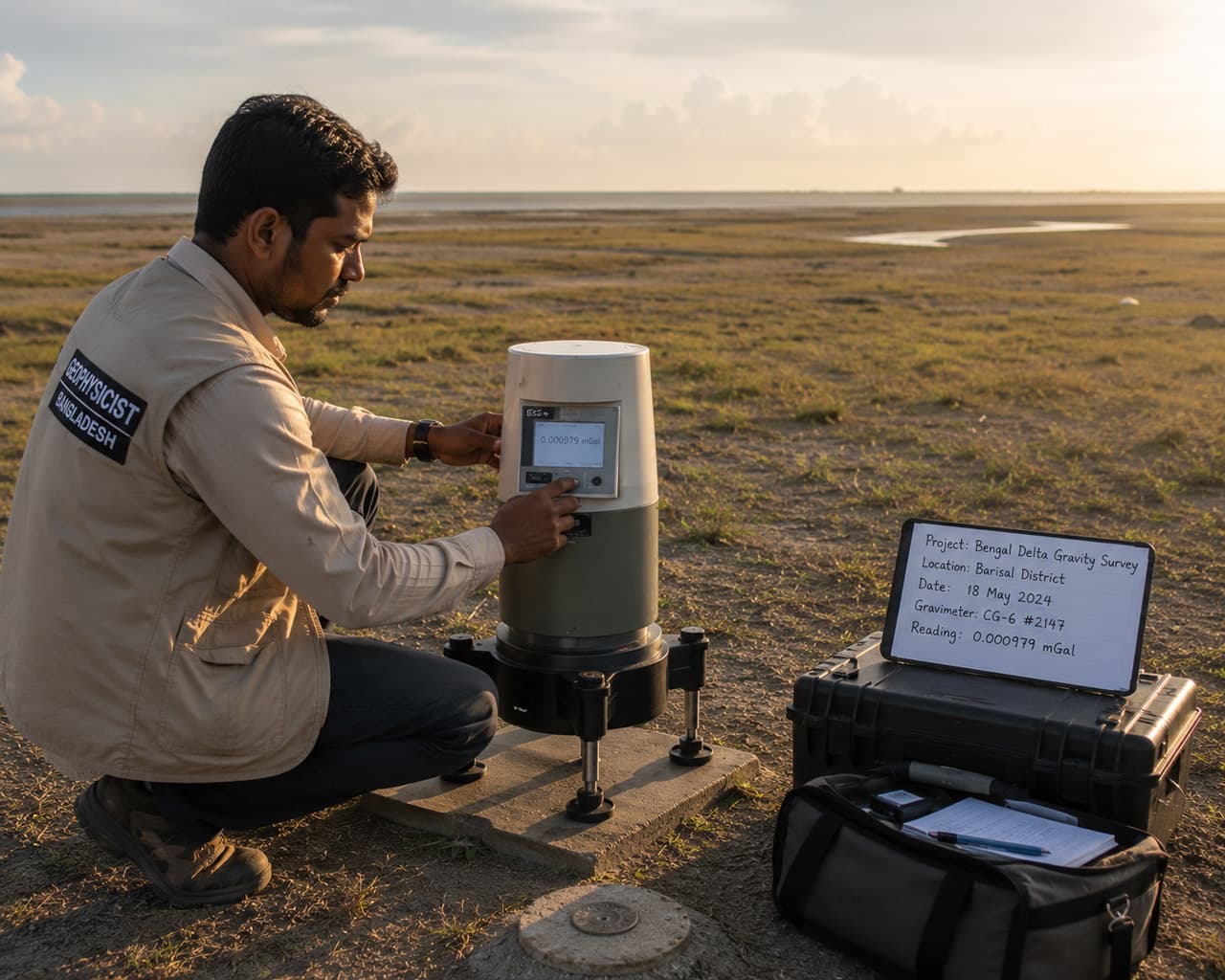
Photo caption: A field gravimeter set up on the Bengal delta, where tiny variations in Earth’s pull help map buried faults, basement highs, and sediment-filled depressions.
What Is a Gravity Anomaly?
A gravity anomaly is the difference between the gravity we observe at a location and the gravity we would expect from a smooth, idealized Earth. The difference is tiny — often measured in milligals — but geologically meaningful. Dense rocks such as basalt, mafic intrusions, or uplifted crystalline basement tend to produce gravity highs. Thick, low-density sediments tend to produce gravity lows. Faults can appear as sharp gradients where gravity values change rapidly across short distances.
The Bouguer anomaly is one of the most widely used forms because it corrects for elevation and the gravitational effect of rock between the measurement point and a reference level. A simplified form is:
Δg_B = g_obs - g_theoretical + 0.3086·h - 2πGρhInline glossary: ΔgB = Bouguer anomaly; gobs = observed gravity measured by the instrument; g_theoretical = predicted gravity for an ideal Earth at that latitude; 0.3086·h = free-air correction for elevation, in mGal per metre; 2πGρh = Bouguer slab correction for the attraction of rock between the station and datum; G = gravitational constant; ρ = assumed rock density; h = station elevation.
In simple terms, scientists first remove the predictable effects — latitude, elevation, and topography — so the remaining signal is more likely to reflect subsurface density contrasts. That remaining pattern is where the exploration begins.
The Bengal Basin’s Hidden Geometry
The Bengal Basin is not a single smooth bowl. It is a complex tectonic and sedimentary system bounded by the Indian Shield to the west, the Shillong Plateau and Rangpur Platform to the north, and the Indo-Burman ranges to the east. Its history includes rifting, passive-margin development, Himalayan collision, massive sediment loading, and deformation along the eastern fold belt.
Gravity data have long been used to investigate this architecture. Studies of western Bangladesh from gravity data suggest that the platform part of the Bengal Basin is underlain by continental crust and contains synthetic and antithetic fault systems — the kind of buried structures that can influence basin development and sediment thickness. (<a href="https://www.sciencedirect.com/science/article/pii/004019519390182J?utmsource=chatgpt.com”>ScienceDirect) Other integrated gravity and seismic work across the basin describes a large gravity low trending roughly north-northeast to south-southwest, branching toward the Dauki fault area and toward depressions in the northwest, consistent with major sediment-filled structural lows. (<a href="https://spgindia.org/10biennialform/P038.pdf?utmsource=chatgpt.com”>SPG India)
In northwest Bengal Basin studies, Bouguer anomaly patterns have been linked to basement highs and lows, with gravity highs associated with horst-like uplifted blocks and gravity lows associated with graben-like depressions. This matters because buried basement structure can influence surface landforms, drainage, sediment thickness, groundwater systems, and even seismic hazard interpretation. (arXiv)
Farther south and offshore, the picture becomes even more intriguing. The Bengal Basin and Bay of Bengal preserve clues to the tectonic origin of the northeastern Indian Ocean, the transition from continental to oceanic crust, and the enormous sediment load delivered from the Himalaya. Gravity and magnetic anomalies are central to this detective work because they respond to crustal thickness, basement composition, and buried volcanic or mafic bodies. (<a href="https://drs.nio.res.in/drs/bitstream/handle/2264/5018/JGeophysResBSolid%20Earth1214836a.pdf?sequence=1&utm_source=chatgpt.com”>Drs Nio)
Survey Methods
A gravity survey sounds simple: place an instrument, measure gravity, move to the next station. In reality, it is careful field science. Each station needs accurate coordinates, elevation control, instrument drift correction, tidal correction, and repeat readings at base stations. In the delta, the practical challenges are memorable: soft ground, boat crossings, monsoon humidity, traffic vibration, and the need to keep a sensitive gravimeter level and stable.
“On the delta, setting up a gravimeter feels like asking the Earth to whisper while the world keeps moving — boats pass, trucks rumble, the soil flexes, and you wait for the needle to settle.”
Gravity is rarely used alone. Basin exploration works best when several geophysical methods are integrated:
- Gravity surveys — map density contrasts, basement highs/lows, sediment thickness, and crustal structure.
- Magnetic surveys — detect magnetic basement, volcanic rocks, mafic bodies, and structural trends.
- Seismic reflection surveys — image sedimentary layers, folds, faults, and hydrocarbon traps.
- Seismic refraction / receiver-function studies — estimate crustal thickness, velocity structure, and deeper basin architecture.
Different instruments serve different purposes:
| Gravimeter type | Typical precision | Field use | |
|---|---|---|---|
| —————————————— | ——————- | ——————————————————————————– | |
| Spring relative gravimeter | ~0.01–0.1 mGal | Common land surveys; portable and practical for station networks | |
| Scintrex-style digital relative gravimeter | ~0.005–0.01 mGal | High-resolution exploration and repeatable field campaigns | |
| Absolute gravimeter | ~1–10 µGal | Calibration, reference stations, long-term monitoring | |
| Airborne / shipborne gravimeter | ~0.5–2 mGal or more | Regional coverage over offshore areas, rivers, coastlines, and difficult terrain |
What We’ve Found
Gravity mapping has revealed that the Bengal Basin is shaped by strong density contrasts beneath its soft surface. Regional gravity lows generally point to thick sedimentary accumulations, while highs may indicate shallower basement, denser crustal blocks, basaltic units, or buried ridges. The U.S. Geological Survey’s Bouguer Gravity Anomaly Map of Bangladesh, published as a digital dataset, remains an important reference layer for regional interpretation and GIS-based analysis. (data.usgs.gov)
In southwestern parts of the Bengal Basin, gravity and magnetic surveys have identified concealed high-density litho-units and magnetic features beneath sediment cover, with residual gravity anomalies corresponding to exposed and buried dense rocks. (<a href="https://link.springer.com/article/10.1007/s12594-019-1196-7?utmsource=chatgpt.com”>Springer) More recent gravity-magnetic appraisal of the southern basin has described concealed ridge-basin structures and gravity highs/lows that suggest deeper crustal or basement controls on basin evolution. (<a href="https://www.frontiersin.org/journals/earth-science/articles/10.3389/feart.2023.1190106/full?utmsource=chatgpt.com”>Frontiers)
The deeper story is still being refined. Newer seismic studies using broadband stations and receiver functions emphasize that the Bengal Basin contains very thick sedimentary layers over complex crustal structure, making it difficult but essential to distinguish sediment effects from crustal effects. (agupubs.onlinelibrary.wiley.com) This is where gravity remains powerful: it provides an independent constraint. If seismic velocities suggest a deep basin and gravity shows a broad low, the interpretations reinforce each other. If they disagree, the puzzle becomes more interesting.
For Bangladesh, gravity anomaly surveys are not only academic. They support hydrocarbon exploration, groundwater basin understanding, mineral and basement mapping, seismic hazard assessment, and infrastructure planning. They help answer questions that surface mapping cannot: Where is the basement shallow? Where are the major buried faults? How thick are the sediments? Where might crustal blocks change character beneath the delta?
The Bengal Basin’s surface is written in rivers. Its subsurface is written in gravity. By measuring tiny changes in Earth’s pull, scientists turn invisible forces into maps — and those maps reveal that beneath the calm floodplains of Bangladesh lies a dynamic, layered, and still-evolving geological world.
Sources / References
- U.S. Geological Survey. “Bouguer Gravity Anomaly Map of Bangladesh (grav8bg).” (data.usgs.gov)
- Khan, A. A. “The crustal structure of western Bangladesh from gravity data.” Tectonophysics, 1993. (ScienceDirect)
- Lakra, M. N., et al. “Integrated study of gravity and seismic data of Bengal Basin.” SPG India. (<a href="https://spgindia.org/10biennialform/P038.pdf?utm_source=chatgpt.com”>SPG India)
- Ahamed, S., Hossain, D., & Alam, J. “Exploring Basement Surface relationship of north-west Bengal Basin using satellite images and tectonic modeling.” 2020. (arXiv)
- Ganguli, S. S., et al. “Gravity-magnetic appraisal of the southern part of the Bengal Basin.” Frontiers in Earth Science, 2023. (Frontiers)
- Ganguli, S. S., et al. “Gravity and Magnetic Survey in Southwestern Part of Bengal Basin.” Journal of the Geological Society of India, 2019. (Springer)
- Talwani, M., et al. “The tectonic origin of the Bay of Bengal and Bangladesh.” Journal of Geophysical Research: Solid Earth, 2016. (<a href="https://drs.nio.res.in/drs/bitstream/handle/2264/5018/JGeophysResBSolid%20Earth1214836a.pdf?sequence=1&utm_source=chatgpt.com”>Drs Nio)
- Sadler, B., et al. “Nature of the crust in the superdeep Bengal Basin using broadband seismic data.” Journal of Geophysical Research: Solid Earth, 2026. (agupubs.onlinelibrary.wiley.com)














Responses (0 )