


The black streaks on Cox’s Bazar Beach are not pollution — they are mineral wealth. Walk along the wet sand after a retreating tide and you may see dark ribbons tracing the beach like brushstrokes. To a tourist, they are simply beautiful. To a geologist, they are clues: dense grains sorted by waves, tides, rivers, and time.
Cox’s Bazar is famous as one of the world’s longest natural sea beaches, but beneath its postcard surface lies a working geological laboratory. Every wave acts like a miniature mineral separator. Light quartz grains are pushed, lifted, and scattered. Heavier grains settle into dark bands. Over thousands of tidal cycles, the shore concentrates minerals that began their journey in distant hills, river valleys, and coastal cliffs. These grains are small enough to slip through fingers, yet important enough to interest mineralogists, economic geologists, environmental scientists, and planners.
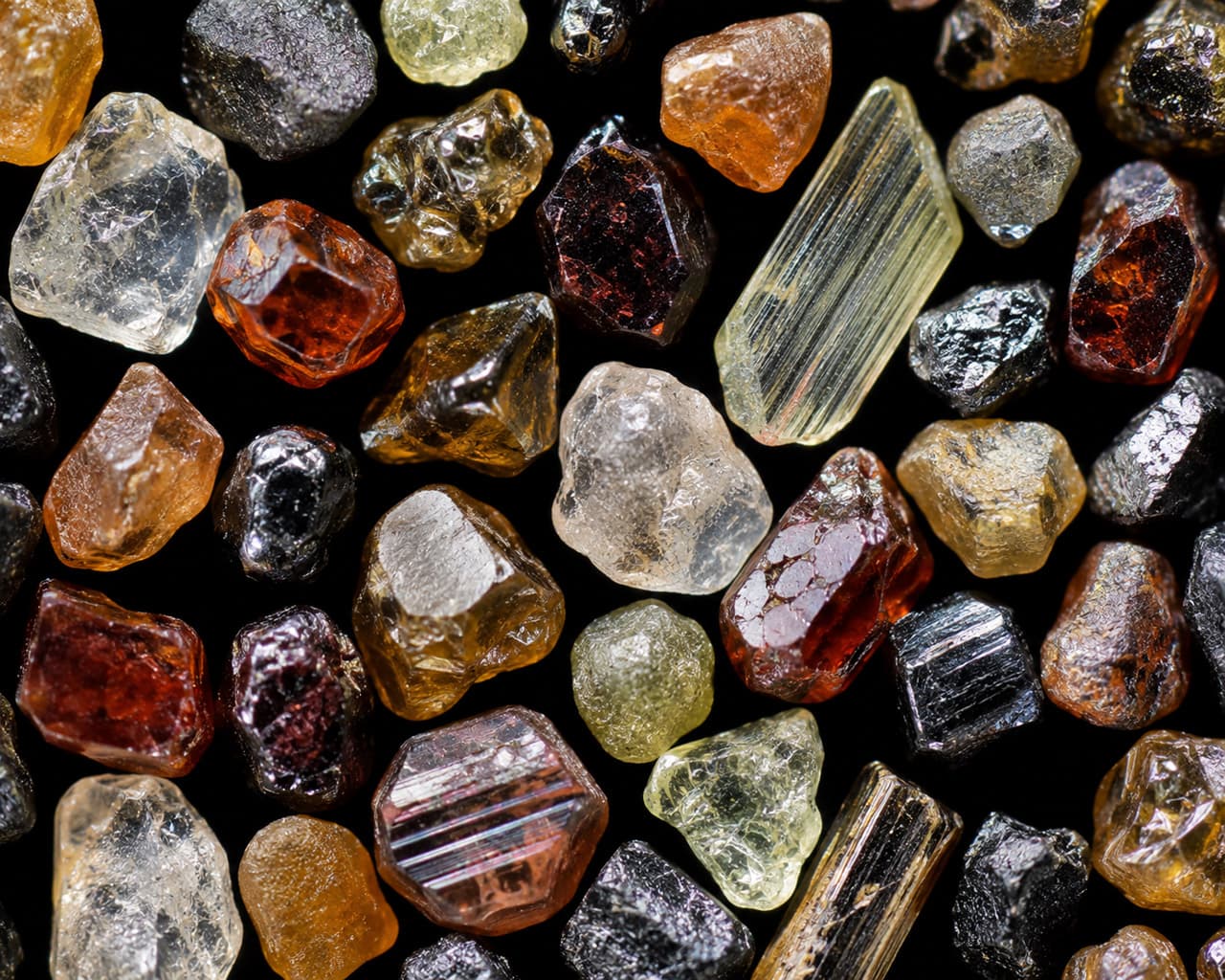
Photo caption: Macro mineral photography of Cox’s Bazar beach sand, showing dark ilmenite and magnetite grains mixed with zircon, garnet, monazite, and pale quartz fragments.
Reading the Sand
Beach sand is not just broken rock. It is a travel record. Each grain carries information about its parent rock, the river that transported it, the energy of the coast, and the chemistry of weathering. In Cox’s Bazar, the heavy mineral story is tied to the eastern and southeastern coastal belt of Bangladesh, where placer deposits have been recognized since early investigations around the 1960s. Banglapedia notes that work around the Cox’s Bazar sea beach area identified valuable heavy minerals including zircon, ilmenite, rutile, magnetite, leucoxene, kyanite, garnet, and monazite. (<a href="https://en.banglapedia.org/index.php/BeachSandHeavyMineral?utmsource=chatgpt.com”>Banglapedia)
A “heavy mineral” is usually defined as a detrital mineral with a specific gravity greater than about 2.9. That means it is denser than common quartz and feldspar. When waves wash back and forth across the beach, they naturally sort grains by size, shape, and density. The darker, heavier minerals tend to lag behind as lighter grains are removed. This is why black sand often appears in streaks, patches, or thin layers rather than as a uniform blanket.
“The first thing you notice is the shine — black grains flashing under the hand lens, with tiny red garnets and pale zircons hidden among them. It looks like ordinary beach sand until the minerals start naming themselves.”
The Heavy Mineral Suite
The Cox’s Bazar heavy mineral suite is valuable because it contains both industrial minerals and minerals that can carry rare earth elements or naturally occurring radioactive elements. Scientific studies of Cox’s Bazar beach sands report important Ti- and Zr-rich minerals, including ilmenite, rutile, and zircon; one study notes average heavy-mineral fractions containing zircon, ilmenite, and rutile in measurable proportions and used XRF, XRD, SEM, and EPMA to examine their chemistry and mineralogy. (<a href="https://www.sciencedirect.com/science/article/pii/S0169136821007137?utmsource=chatgpt.com”>ScienceDirect) Another classic mineralogical study found that heavy minerals in Cox’s Bazar sands are dominated by hornblende, opaque minerals, garnet, and epidote, with opaque grains consisting mainly of ilmenite, magnetite, rutile, pyrite, and hydroxides. (<a href="https://www.sciencedirect.com/science/article/abs/pii/003707389290129F?utmsource=chatgpt.com”>ScienceDirect)
Inline chemical callout: FeTiO₃ — ilmenite, a titanium ore used in pigment production, paint, welding materials, and high-performance alloys for aerospace applications.
| Mineral name | Chemical formula | Density (g/cm³) | Typical colour | Economic use | |
|---|---|---|---|---|---|
| ———— | ———————————————– | ————— | ——————————- | ——————————————————————– | |
| Ilmenite | FeTiO₃ | ~4.7–4.8 | Black to steel-grey | Titanium dioxide pigment, synthetic rutile, titanium metal feedstock | |
| Zircon | ZrSiO₄ | ~4.6–4.7 | Colourless, pink, brown, yellow | Ceramics, foundry sand, zirconium chemicals, geochronology | |
| Garnet | Commonly Fe-Mg-Al silicate group | ~3.5–4.3 | Red, brown, pink, black | Abrasives, waterjet cutting, filtration media | |
| Magnetite | Fe₃O₄ | ~5.1–5.2 | Black, strongly magnetic | Iron ore, dense media separation, magnetic applications | |
| Monazite | Rare-earth phosphate, commonly (Ce,La,Nd,Th)PO₄ | ~4.9–5.3 | Yellow-brown, reddish-brown | Rare earth elements; also contains Th/U requiring careful handling |
The beauty of this mineral suite is not only economic. It is also diagnostic. Zircon is tough and chemically resistant, often surviving long transport. Garnet can hint at metamorphic source rocks. Ilmenite and magnetite reveal opaque oxide components. Monazite can point toward high-grade metamorphic or granitic sources and may carry thorium and uranium, making environmental assessment essential. Research on Cox’s Bazar-area heavy mineral-rich deposits has highlighted elevated natural radioactivity along parts of the coastal section, especially where monazite and zircon are enriched. (HERO)
What the Provenance Tells Us
Provenance is the science of origin. In beach sand studies, it asks: where did these grains come from before the sea sorted them?
For Cox’s Bazar, the answer is likely mixed. Sediments may be supplied by erosion of nearby coastal and hill formations, reworking of older beach and dune deposits, and longshore transport along the Bay of Bengal margin. Regional studies note that Bangladesh’s heavy mineral sands occur in shoreline and fluvial placer deposits, including the southern and eastern coastlines and river systems. (<a href="https://www.sciencedirect.com/science/article/abs/pii/S0169136819305621?utmsource=chatgpt.com”>ScienceDirect) A 2024 study on Bangladesh coastal heavy mineral resources reports that deposits are concentrated along eastern and southern coasts as placer deposits, with heavy mineral concentration in recent foredune deposits varying substantially. (<a href="https://link.springer.com/article/10.1007/s44288-024-00073-7?utmsource=chatgpt.com”>Springer)
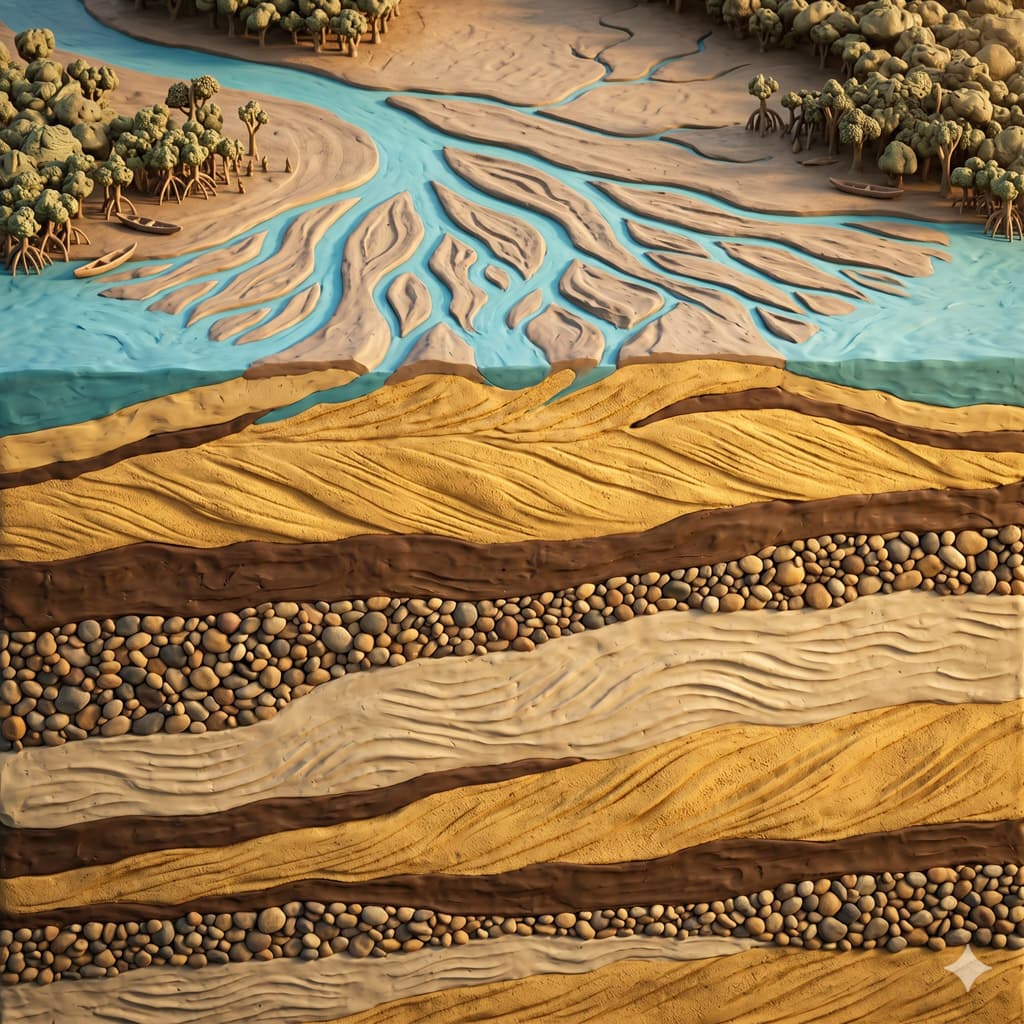
This is what makes Cox’s Bazar scientifically exciting. The beach is not only receiving sediment; it is processing it. Waves, storms, tides, and seasonal currents repeatedly rework the same grains, upgrading some layers and dispersing others. A storm can erase one black-sand band and create another. A monsoon season can shift the sediment budget. A river mouth can change the mixture. The shoreline becomes a natural laboratory where geology is visible in motion.
Laboratory techniques help separate and identify these minerals:
- Panning — uses water and motion to concentrate dense grains, much like traditional gold panning.
- Heavy liquid separation — separates minerals by density using liquids denser than common sand minerals.
- Magnetic separation — divides magnetic minerals such as magnetite from weakly magnetic or non-magnetic grains.
- X-ray diffraction — identifies crystalline minerals by their diffraction patterns.
Economic Significance
Heavy mineral sands matter because they sit at the intersection of geology, industry, and environmental responsibility. Ilmenite and rutile are titanium sources. Zircon is important for ceramics and high-temperature industrial uses. Garnet is valuable as an abrasive. Monazite can contain rare earth elements used in electronics, magnets, renewable energy technologies, and defense-related industries — but its thorium and uranium content means extraction must be tightly regulated.
Bangladesh’s coastal mineral sands have long attracted attention. Reports have described multiple deposits and economically interesting minerals, while also noting that environmental sensitivity, population pressure, and processing quality affect development prospects. One study comparing Bangladesh ilmenites from Cox’s Bazar and Brahmaputra placer deposits notes that Cox’s Bazar deposits are high-grade but located in populated and environmentally sensitive areas, making future exploitation uncertain. (ScienceDirect)
That uncertainty is important. Cox’s Bazar is not an empty mining frontier. It is a living coast — a tourism zone, fishing landscape, ecological corridor, storm buffer, and community space. Any mineral development would need careful environmental impact assessment, radiation monitoring, coastal erosion analysis, community consultation, and transparent benefit-sharing.
The black streaks on the beach therefore tell two stories at once. One is a story of natural abundance: rivers, waves, and time concentrating valuable minerals grain by grain. The other is a story of responsibility: how to study, protect, and possibly use those resources without damaging the coast that created them. Cox’s Bazar beach is beautiful because it is alive with motion. Its sands reveal not only what Bangladesh’s shore contains, but how carefully that shore must be understood.
Sources / References
- Banglapedia. “Beach Sand Heavy Mineral.” <a href="https://en.banglapedia.org/index.php/BeachSandHeavyMineral?utmsource=chatgpt.com”>Banglapedia article
- Hasan, A. S. M. M., et al. “Chemistry and mineralogy of Zr- and Ti-rich minerals from Cox’s Bazar beach sands.” Ore Geology Reviews, 2022. ScienceDirect abstract
- Mitra, S., et al. “Mineralogy and chemistry of the opaques of Cox’s Bazar beach sands, Bangladesh.” Sedimentary Geology, 1992. ScienceDirect abstract
- Rahman, A., et al. “Comparison of the chemistry and mineralogy of ilmenite from Bangladesh fluvial and shoreline placer deposits.” Ore Geology Reviews, 2020. ScienceDirect abstract
- Seddique, A. A., et al. “Sources of U and Th in groundwater of the paleobeach aquifer, Cox’s Bazar.” Groundwater for Sustainable Development, 2020. ScienceDirect abstract
- Zaman, M., et al. “Elevated radionuclide concentrations in heavy mineral-rich beach sands in the Cox’s Bazar region, Bangladesh.” EPA HERO record
- Hossain, M. S., et al. “Geochemical characterization and reserve estimation of the heavy mineral sand deposits of Bangladesh.” 2024. Springer article











Responses (0 )