


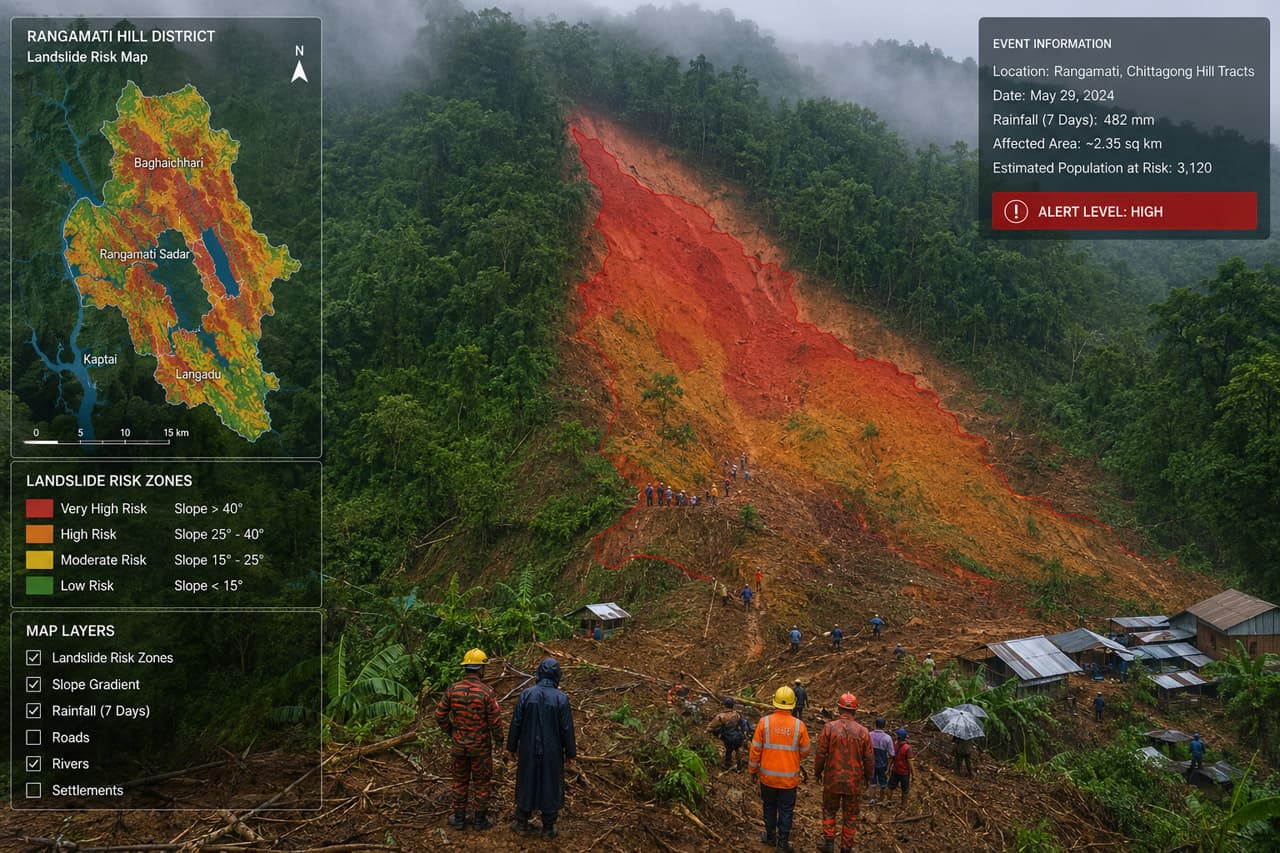
Hero image caption: A landslide-scarred hillside in Rangamati after intense monsoon rainfall — exposed soil, broken vegetation, damaged roads, and settlements built close to unstable slopes.
On 13 June 2017, Rangamati woke to a disaster that GIS analysts had, in some sense, predicted on paper. The Chittagong Hill Tracts had long been known as Bangladesh’s most landslide-prone region: steep slopes, weak sedimentary rocks, intense monsoon rainfall, hill cutting, deforestation, and settlements expanding onto unstable terrain. But on that June morning, susceptibility became tragedy. The 2017 landslides across southeast Bangladesh killed at least 152 people, with Rangamati among the worst-hit districts. Studies later linked the disaster to extreme rainfall — about 510 mm over roughly 48 hours — and documented severe damage to homes, roads, and communities. (Springer)
Landslide susceptibility mapping cannot stop rain from falling. But it can show where slopes are most likely to fail, where settlements are most exposed, and where early warning, relocation, drainage, and engineering work should be prioritized. For Rangamati, this is not an academic exercise. It is a survival tool.
What Makes CHT Slopes Fail?
The Chittagong Hill Tracts are geologically and socially different from Bangladesh’s floodplains. Rangamati’s landscape is folded, dissected, and steep, with ridges, valleys, road cuts, and settlements built along hillsides. The hills are commonly formed from sedimentary rocks such as sandstone, siltstone, shale, limestone, and conglomerate; these materials can weather rapidly and become unstable when saturated. (MDPI)
Rainfall is the immediate trigger in many events. During prolonged monsoon storms, water infiltrates soil and weathered rock, increasing pore-water pressure and reducing shear strength. Slopes that were marginally stable in the dry season can fail suddenly when saturated. But rainfall alone does not explain the full pattern. Human activity often prepares the slope for failure: cutting hills for housing and roads, removing vegetation, blocking natural drainage, and placing heavy structures on unstable ground. Research on landslide causes in the Chittagong Hill Tracts repeatedly identifies heavy rainfall, hill cutting, deforestation, and weak soil or rock structure as major drivers. (<a href="https://www.researchgate.net/publication/348370746CausesofLandslidesinChittagongHillTracksBangladesh?utm_source=chatgpt.com”>ResearchGate)
This is why susceptibility mapping must combine physical and human factors. A steep forested slope may be less dangerous than a moderately steep slope that has been cut vertically for a road or settlement. A slope with good drainage may survive heavy rain, while a similar slope with blocked runoff channels may collapse.
The Mapping Method
A landslide susceptibility map begins with a landslide inventory: mapped locations of past landslides. These can be collected from field surveys, drone images, high-resolution satellite imagery, newspaper reports, government records, and post-event interpretation of scars. The inventory is then split into training and validation datasets.
Next, GIS analysts prepare conditioning factor layers. These are the variables believed to influence landslide occurrence: slope, aspect, curvature, elevation, lithology, land use, distance to road, distance to stream, rainfall, drainage density, soil type, vegetation index, and lineament density. Each layer is reclassified into meaningful classes. For example, slope may be grouped into 0–15°, 15–30°, 30–45°, and above 45°.
One common statistical method is the Frequency Ratio (FR) model. It compares how frequently landslides occur within each class of a factor against how much area that class occupies in the landscape.
FR = (Aᵢ/B) / (Nᵢ/N)Here, Aᵢ is the area of landslides in a particular class, B is the total landslide area, Nᵢ is the total area of that class, and N is the total study area. If a class has an FR greater than 1, landslides occur there more often than expected by area alone. If FR is less than 1, that class is relatively less associated with landslides.
For example, if slopes above 45° occupy only 10% of Rangamati but contain 35% of mapped landslide scars, that class receives a high FR value. The final susceptibility index is produced by overlaying FR-weighted factor maps, or by combining them with expert weights in a weighted overlay.
| Factor | Data type | Resolution | Influence | |
|---|---|---|---|---|
| ———————– | —————————————- | ————— | ———————————————————————– | |
| Slope angle | DEM-derived raster | 10–30 m | Steeper slopes generally have higher failure potential. | |
| Aspect | DEM-derived raster | 10–30 m | Controls sunlight, moisture retention, and vegetation condition. | |
| Curvature | DEM-derived raster | 10–30 m | Concave slopes can concentrate runoff and subsurface flow. | |
| Elevation | DEM-derived raster | 10–30 m | Higher dissected terrain may correlate with steeper slopes and erosion. | |
| Land use / land cover | Satellite classification | 10–30 m | Built-up, bare soil, and degraded vegetation increase susceptibility. | |
| NDVI / vegetation cover | Sentinel-2 or Landsat | 10–30 m | Dense vegetation can stabilize shallow soil through root reinforcement. | |
| Distance to road | Vector-to-raster distance | 10–30 m | Road cuts and slope modification can destabilize hillsides. | |
| Distance to stream | Vector-to-raster distance | 10–30 m | Stream erosion can undercut slopes and saturate lower hillsides. | |
| Rainfall | Gauge, satellite, or interpolated raster | 1 km or coarser | Intense rainfall is the main triggering factor. | |
| Lithology / soil | Geological and soil maps | Variable | Weak, weathered, or clay-rich materials fail more easily. |
In QGIS, a simplified weighted raster overlay can be scripted from the Python console:
from qgis.analysis import QgsRasterCalculator, QgsRasterCalculatorEntry

# Weighted overlay: slope*0.35 + aspect*0.20 + curvature*0.15 + rainfall*0.30
entries = []

# ... (set up entries for each raster layer)
# Example formula after entries are prepared:
# formula = '"slope@1" * 0.35 + "aspect@1" * 0.20 + "curvature@1" * 0.15 + "rainfall@1" * 0.30'

calc = QgsRasterCalculator(
    formula,
    output_path,
    "GTiff",
    extent,
    crs,
    cols,
    rows,
    entries
)

calc.processCalculation()
Key Risk Factors
In Rangamati, the most important risk factors are usually a combination of slope steepness, rainfall intensity, land disturbance, and drainage behavior. Event-based landslide susceptibility research in Rangamati has used GIS and remote sensing models such as Frequency Ratio, Modified Frequency Ratio, and Weights of Evidence to map post-2017 susceptibility patterns. (Taylor & Francis Online)
Steep slopes are obvious candidates for failure, but curvature and drainage are equally important. Concave hollows collect water. Roadside cuts create artificial steep faces. Settlements at slope toes are exposed to debris flows from above. Bare soil and sparse vegetation increase erosion and reduce root reinforcement. In the 2017 event, many landslides were small but numerous, and debris flows formed a significant share of observed failures. (<a href="https://www.researchgate.net/publication/343675184AninvestigationofthecharacteristicscausesandconsequencesofJune132017landslidesinRangamatiDistrictBangladesh?utmsource=chatgpt.com”>ResearchGate)
Five structural mitigation measures are especially relevant:
- Retaining walls in critical road-cut and settlement-adjacent slopes.
- Drainage channels to divert surface runoff away from unstable slopes.
- Slope re-grading to reduce over-steepened cut faces.
- Vegetation cover using deep-rooted native species for shallow slope reinforcement.
- Early warning sensors such as rain gauges, soil-moisture sensors, tiltmeters, and low-cost community sirens.
Validation and Accuracy
A susceptibility map is only useful if it is tested. Validation usually compares predicted high-risk zones with landslides not used in model training. Common methods include success-rate curves, prediction-rate curves, ROC-AUC, confusion matrices, and field verification.
For practical planning, validation should answer a simple question: did most known landslides fall inside high and very-high susceptibility zones? If yes, the model has planning value. If not, the factor weights, inventory quality, or input data resolution may need revision.
Accuracy also depends on scale. A 30 m DEM may be acceptable for district-level planning but too coarse for household-level relocation decisions. For detailed slope engineering, drone photogrammetry, LiDAR, field geotechnical tests, and local drainage surveys are far better.
From Map to Warning
The final map should not sit in a report. It should feed land-use planning, road design, emergency preparedness, and community warning. High-susceptibility zones can guide where to restrict hill cutting, where to inspect road slopes before monsoon, where to install rain thresholds, and where to prepare evacuation routes.
“Relocation is not only a technical decision. Families live near work, schools, forests, markets, and ancestral land. We can identify dangerous slopes on a map, but moving people safely requires trust, compensation, and places where they can rebuild their lives.” — CHT District Council official
For Rangamati, the path forward is clear: combine remote sensing, GIS, rainfall monitoring, local knowledge, and enforceable planning. A landslide susceptibility map is not a prediction of the exact next failure. It is a warning surface — a way of saying that some slopes are already speaking through their shape, soil, scars, and history. The responsibility is to listen before the next monsoon turns risk into loss.
Sources / References
- Abedin, J. et al. “An investigation of the characteristics, causes, and consequences of June 13, 2017 landslides in Rangamati District, Bangladesh.” Geoenvironmental Disasters, 2020. (Springer)
- Sifa, S. F. et al. “Event-based landslide susceptibility mapping using weights of evidence and modified frequency ratio model: a case study of Rangamati District, Bangladesh.” Geology, Ecology, and Landscapes, 2020. (Taylor & Francis Online)
- Ahmed, B. “The root causes of landslide vulnerability in Bangladesh.” Landslides, 2021. (Springer)
- Islam, M. A. et al. “A Geotechnical Investigation of 2017 Chattogram Landslides.” Geosciences, 2021. (MDPI)
- “2017 Bangladesh landslides.” Background summary with linked news references on fatalities and affected districts. (<a href="https://en.wikipedia.org/wiki/2017Bangladeshlandslides?utm_source=chatgpt.com”>Wikipedia)
- ICIMOD. “Landslides Induced by June 2017 Rainfall in Chittagong Hill Tracts.” (lib.icimod.org)















Responses (0 )