


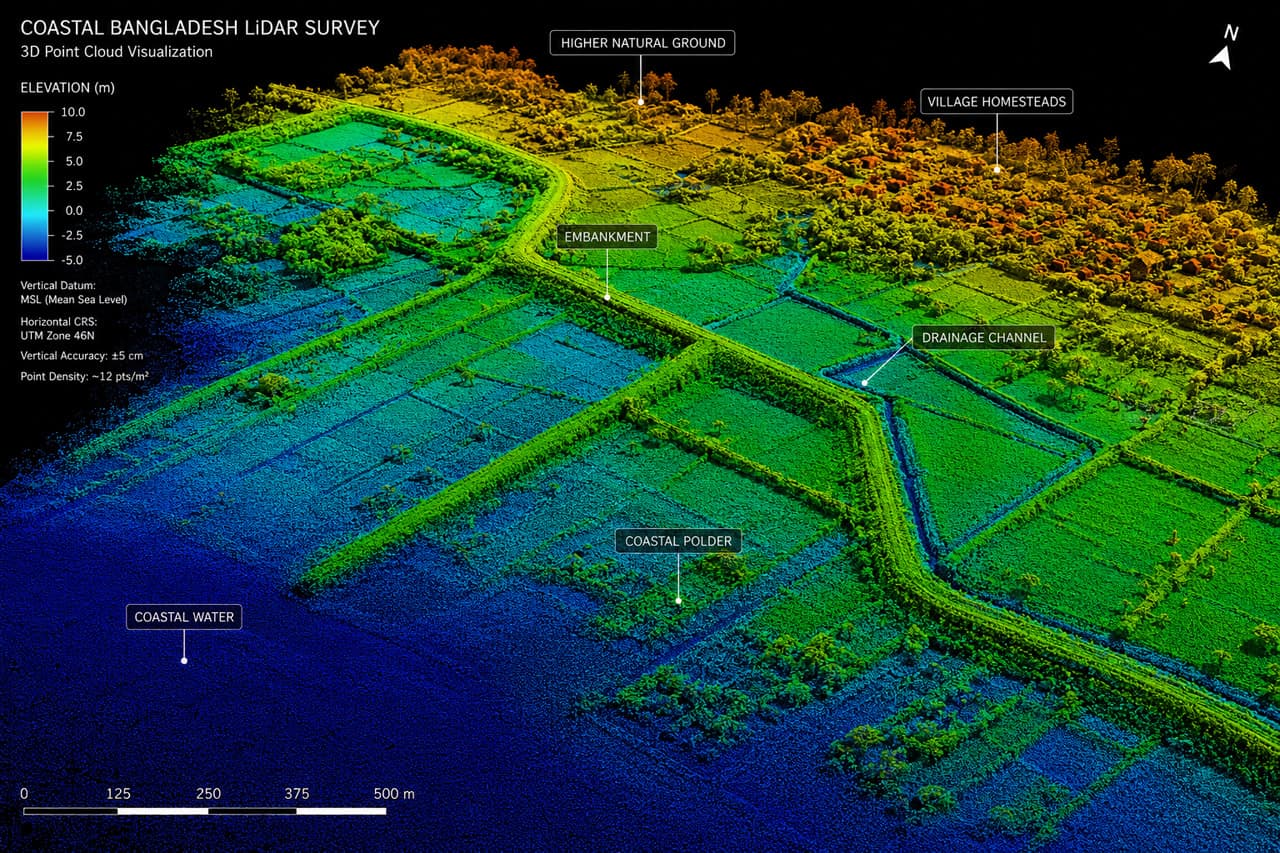
Hero image caption: 3D LiDAR terrain visualization of Bangladesh’s coastal polder landscape, showing embankment crests, tidal channels, homestead mounds, roads, and low-lying flood basins in centimetre-scale elevation detail.
The entire coastal belt of Bangladesh is less than 3 metres above sea level. A storm surge model accurate to the metre is not good enough — you need centimetres.
That is not an exaggeration. In the Bangladesh delta, a difference of 20 or 30 centimetres can decide whether a village road remains passable, whether a cyclone shelter is reachable, whether saline water crosses an embankment, or whether a homestead courtyard becomes part of a tidal floodplain. For cyclone surge modeling, elevation is not background data. It is the skeleton of the model.
Bangladesh’s coast is one of the most complex low-lying landscapes on Earth: tidal rivers, polders, embankments, shrimp ponds, mangrove edges, char lands, drainage canals, rural roads, cyclone shelters, and dense settlements all sit within a few metres of mean sea level. Studies of Bangladesh’s storm-surge risk repeatedly emphasize the country’s low elevation, dense coastal population, and exposure to tropical cyclones from the Bay of Bengal. Recent storm-tide research also warns that Bangladesh’s coastal hazard could intensify under sea-level rise and stronger cyclone scenarios. (Royal Meteorological Society)
Why Standard DEMs Fall Short
For many regional flood studies, global Digital Elevation Models such as SRTM, ASTER GDEM, or Copernicus DEM are useful starting points. They are free, consistent, and easy to use in GIS. But coastal surge modeling has a harder requirement: the model must know exactly where water can flow, where it is blocked, and when it overtops a barrier.
That is where standard DEMs struggle. A 30-metre DEM cell may average together a road, a ditch, a pond edge, and a homestead platform. A 90-metre DEM may miss an embankment entirely. Vegetation, buildings, radar scattering, interpolation artifacts, and vertical datum inconsistencies can introduce errors larger than the elevation differences that matter most in the coastal zone.
In Bangladesh, this problem is especially serious because the terrain is extremely flat. One study on SRTM-based drainage extraction noted that Bangladesh is a deltaic floodplain and that around 40% of the country’s landmass lies within 10 metres of mean sea level. In such terrain, even small vertical errors can distort drainage direction, flood depth, and inundation extent. (Springer Nature Link)
| DEM source | Resolution | Typical vertical accuracy | Suitable for surge modelling? | |
|---|---|---|---|---|
| —————— | ——————— | ———————————————————– | ————————————————————— | |
| SRTM DEM | 30 m / 90 m | Often several metres, varies by terrain and vegetation | Useful for screening, weak for local surge depth | |
| ASTER GDEM | ~30 m | Several metres; artifacts common in flat terrain | Limited, requires correction | |
| Copernicus DEM | 30 m / 90 m | Better global consistency, still not centimetre-grade | Good for regional context, not embankment-scale | |
| TanDEM-X DEM | ~12 m global product | High-quality global elevation, but access/licensing varies | Strong regional option, still may miss small hydraulic features | |
| Airborne LiDAR DEM | 0.5–2 m grid possible | Decimetre to centimetre-level after control and calibration | Best suited for detailed surge modelling |
A coupled storm surge and wave modeling study for Bangladesh noted that higher-resolution topographic data, including LiDAR, can support more accurate simulation of storm surge propagation, but such data has not always been publicly available for Bangladesh-scale modeling. (<a href="https://fhrl.vse.gmu.edu/sites/fhrl.vse.gmu.edu/files/13DebandFerreira.pdf?utmsource=chatgpt.com”>FHRL)
LiDAR: Light That Measures Terrain
LiDAR stands for Light Detection and Ranging. An airborne LiDAR system sends rapid laser pulses toward the ground and measures the time each pulse takes to return. Because the speed of light is known, the system calculates distance. Combined with GPS, inertial measurement, aircraft position, and calibration, millions or billions of laser returns become a 3D point cloud.
The magic of LiDAR is that it does not simply produce a picture. It produces measurements. Some laser pulses hit tree canopies, some hit rooftops, some hit embankment slopes, and some reach bare ground. After classification, analysts can separate ground points from vegetation, buildings, and other objects. The result is a bare-earth DEM — the terrain surface that water actually follows.
For cyclone surge modeling, this matters because the key hydraulic controls are often small: a 70-centimetre road embankment, a 1.5-metre polder crest, a low saddle between two villages, or a drainage canal hidden beneath vegetation. A coarse DEM may smooth these features away. LiDAR can preserve them.
A useful survey-planning concept is point density:
PD = (pulse rate × scan angle) / (flight speed × swath width)
In practice, point density is often expressed as points per square metre. For a coastal survey, a typical configuration might use a pulse rate of 300–800 kHz, aircraft speed of 60–90 m/s, swath width of 500–900 m, and scan settings designed to produce roughly 4–12 ground-capable points per square metre after classification. Higher density improves the chance of capturing narrow embankments, road crowns, and drainage features, but it also increases data volume and processing cost.
The Coastal Survey
A LiDAR survey of Bangladesh’s coast should be designed around the physics of flooding, not just administrative boundaries. The priority zones would include exposed polders, cyclone-prone districts, embankment corridors, tidal riverbanks, low-lying settlements, shelter access roads, and historical surge pathways from cyclones such as Sidr, Aila, Amphan, and Remal.
The survey aircraft would fly overlapping strips along planned flight lines, ideally during dry-season low vegetation and stable atmospheric conditions. Ground control points and GNSS checkpoints would be distributed across embankments, roads, open fields, and settlement platforms. Vertical datum control is critical. If the DEM is referenced incorrectly, a surge model may appear mathematically precise while being physically wrong.
The survey should also capture breaklines: embankment crests, riverbanks, road edges, canal banks, sluice gates, and drainage structures. These features define how water moves. A beautiful point cloud without hydraulic breaklines can still produce a misleading flood model.
From Point Cloud to DEM
Raw LiDAR is not a DEM. It is a dense cloud of points that must be classified, cleaned, validated, and interpolated. The usual workflow includes trajectory processing, strip adjustment, noise removal, ground classification, hydro-flattening, breakline integration, gridding, vertical accuracy assessment, and export to GIS-ready formats such as GeoTIFF.
A simple Python check using laspy can inspect ground-classified points:
import laspy
import numpy as np

las = laspy.read("coastal_bd_lidar.las")
# Filter ground points (classification = 2)
ground = las.points[las.classification == 2]
x, y, z = ground.x, ground.y, ground.z

# Basic statistics
print(f"Ground points: {len(z):,}")
print(f"Min elevation: {z.min():.3f}m  |  Max: {z.max():.3f}m")
print(f"Mean elevation: {z.mean():.3f}m")
This code does not replace professional QA/QC, but it shows the principle: once ground points are classified, the analyst can evaluate elevation ranges, detect outliers, and prepare the data for interpolation. In production, the workflow would also include tile indexing, spatial metadata, coordinate reference system validation, vertical datum transformation, and comparison against independent survey checkpoints.
Feeding the Surge Model
A cyclone surge model needs bathymetry, tide, wind, pressure, coastline geometry, roughness, river discharge, embankment conditions, and land elevation. The DEM controls the overland part of the model: where water enters, how deep it becomes, and how far it travels inland.
Four surge-model inputs depend directly on accurate DEM data:
- Overland flow paths
- Embankment heights
- Low-lying settlement extents
- Inundation thresholds
Cyclone Sidr remains a powerful reminder of the stakes. The 2008 damage, loss, and needs assessment reported that Sidr was accompanied by tidal waves up to five metres high and storm surges up to six metres in some areas, breaching coastal and river embankments. (ReliefWeb)
“In the Sidr simulations, the water level was not the only uncertainty. The terrain was also uncertain. If the DEM smooths an embankment or raises a low basin by one metre, the model can underestimate where the surge will actually go.” — SPARRSO scientist
That is the central lesson: flood models are only as truthful as the ground surface beneath them. In a steep mountain valley, a one-metre elevation error may be tolerable for some regional studies. In coastal Bangladesh, it can move the flood boundary across a road, a school, a rice field, or a settlement.
LiDAR-derived DEMs do not eliminate uncertainty. Cyclone tracks shift. Embankments fail. Land subsides. Channels silt up. But LiDAR gives modelers a far stronger terrain foundation. It turns the coastal landscape from a blurred surface into a measurable hydraulic system.
For Bangladesh, the case is clear. If the next generation of cyclone surge models is expected to guide evacuation planning, polder rehabilitation, shelter placement, road design, and climate adaptation investment, then elevation must be treated as critical infrastructure. In the low-lying coast, centimetres are not cartographic detail. They are the difference between flood and safety.
Sources / References
- M. Lewis et al., “A storm surge inundation model of the northern Bay of Bengal,” Quarterly Journal of the Royal Meteorological Society, 2013.
- J. Qiu et al., “Rising seas and cyclones amplify Bangladesh’s storm-tide hazard,” One Earth, 2025.
- M. Deb and C. M. Ferreira, “Simulation of cyclone-induced storm surges in the low-lying delta of Bangladesh using coupled hydrodynamic and wave model SWAN+ADCIRC,” Journal of Flood Risk Management, 2016.
- M. M. Rahman and B. K. Saha, “Limitation of 90 m SRTM DEM in drainage network delineation,” Journal of the Indian Society of Remote Sensing, 2010.
- World Bank / Government of Bangladesh, “Cyclone Sidr in Bangladesh: Damage, Loss, and Needs Assessment for Disaster Recovery and Reconstruction,” 2008.
- Climate and Development Knowledge Network, “Bangladesh and the Surging Sea,” 2017.











Responses (0 )