


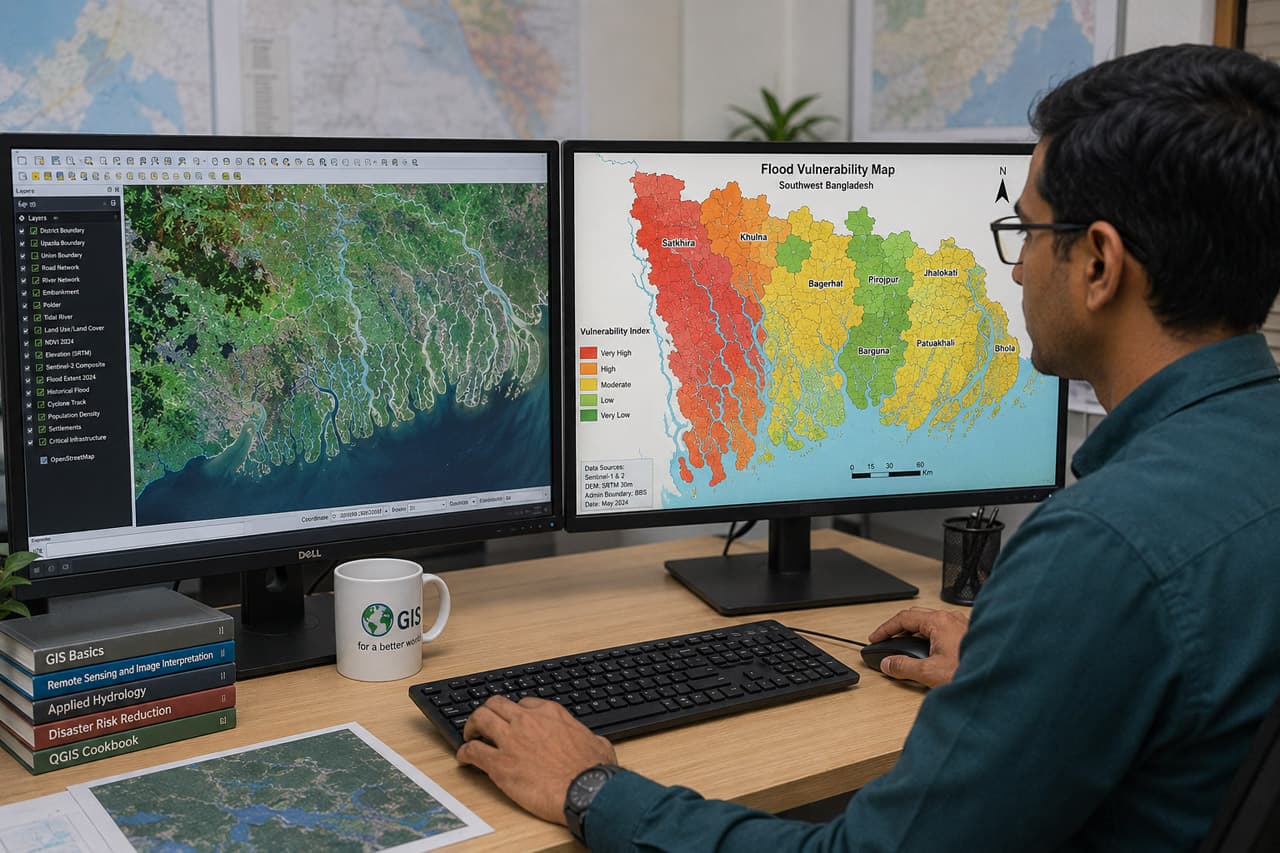
Hero image caption: A dual-screen GIS office setup showing satellite imagery, DEM layers, drainage networks, and vulnerability classes for southwest Bangladesh.
Every monsoon, half a million hectares in southwest Bangladesh go underwater — not from rivers overflowing, but from water with nowhere to drain. In places across Khulna, Jessore, Satkhira and Bagerhat, rain falls on low-lying polders, canals are choked by sediment, sluice gates cannot discharge fast enough, and tidal rivers sit higher than the land they are supposed to drain. The result is not a dramatic flood wave, but a slow, stubborn waterlogging that can remain for months.
For GIS practitioners and geography students, this problem is a powerful example of why spatial analysis matters. Waterlogging is not caused by one factor alone. It emerges from terrain, drainage, soil, rainfall, land use, river morphology, embankments and human decisions. A single map of elevation or rainfall cannot explain it. A multi-criteria GIS model can.
The Southwest Waterlogging Problem
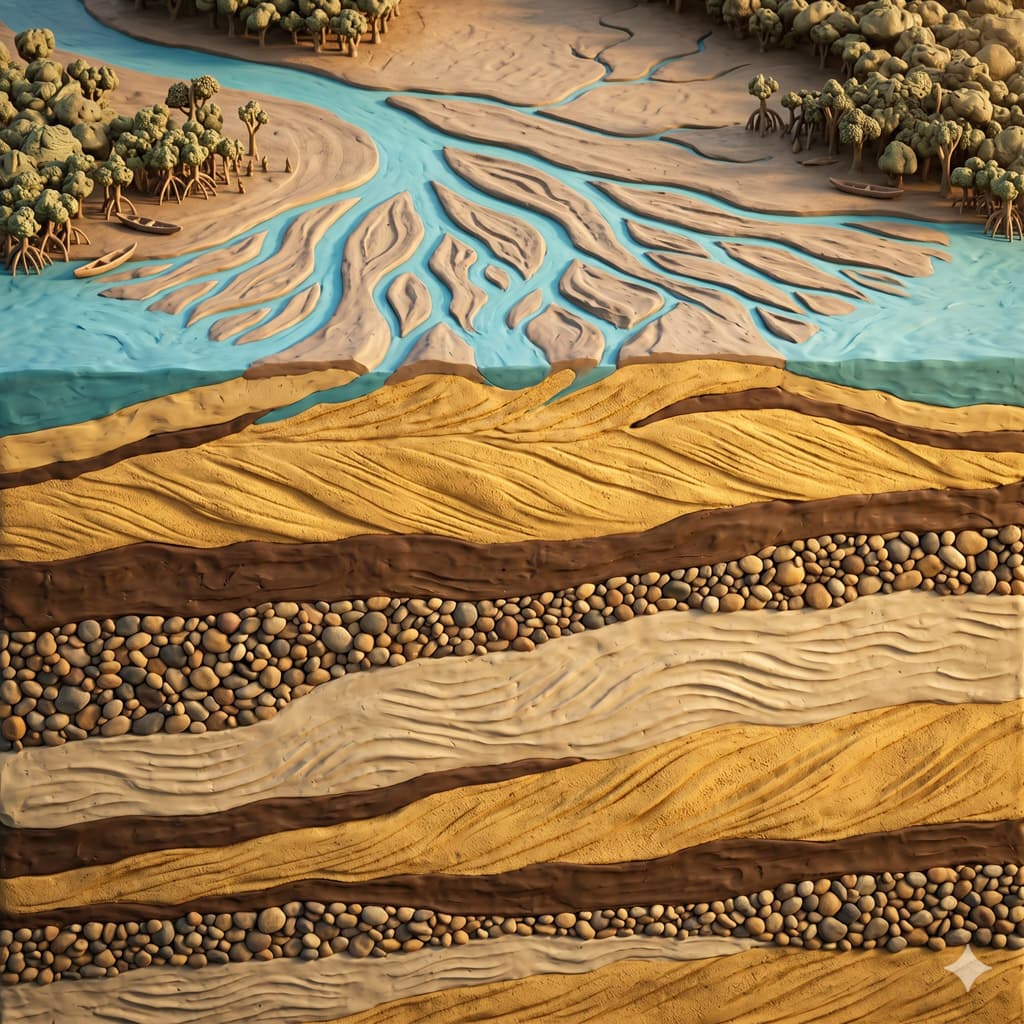
Southwest Bangladesh is part of the lower Ganges-Brahmaputra-Meghna delta, a landscape shaped by tides, sediment, monsoon rainfall and river migration. In the 1960s and later decades, polders and embankments were built to protect agricultural land from tidal flooding and salinity intrusion. Initially, this improved crop production. But over time, the embankments also interrupted natural sediment exchange between rivers and floodplains. Sediment that once spread across the land began settling inside tidal channels, raising riverbeds and reducing drainage capacity. Research on southwest Bangladesh repeatedly identifies river siltation, drainage congestion, subsidence and polder infrastructure as key drivers of chronic waterlogging. (nwo.nl)
This is why waterlogging in the southwest differs from conventional river flooding. In many cases, the problem is not that too much river water enters the land, but that rainfall cannot leave. Low gradients, blocked canals, poorly maintained sluice gates, high tidal stages and land subsidence combine to trap water inside enclosed areas. Studies of the region describe water stagnation lasting six to nine months in some settlements, with serious impacts on agriculture, roads, drinking water, sanitation and livelihoods. (journalajgr.com)
“When the monsoon begins, people do not ask whether water will come — they ask how long it will stay. Every year we repair roads, clean canals and open gates, but some villages remain like bowls with no outlet.” — Local government engineer, southwest Bangladesh
What Is Multi-Criteria Analysis?
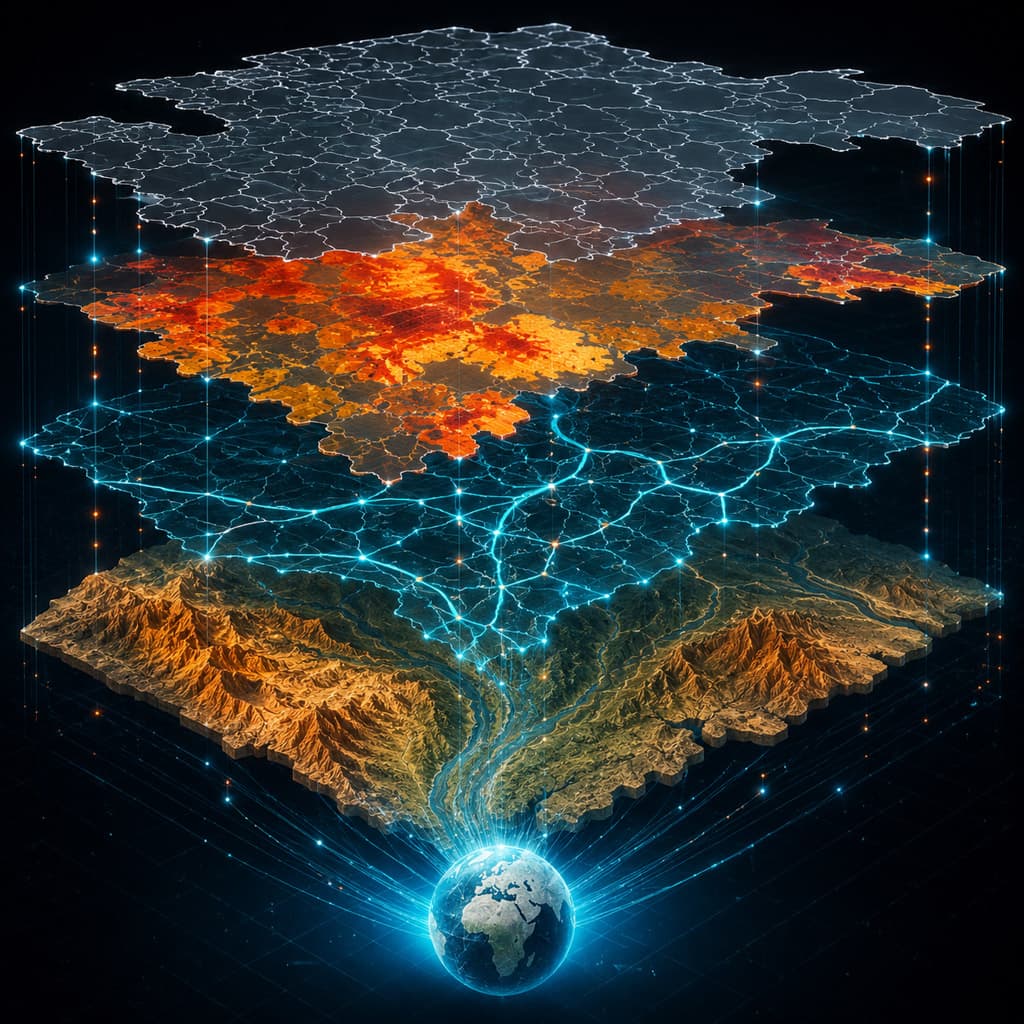
Multi-Criteria Analysis, often called MCA or MCDA, is a decision-support method that combines several influencing factors into one interpretable score. In GIS, each factor becomes a spatial layer: elevation, slope, drainage density, soil permeability, land use, rainfall and so on. Each layer is standardized to a common scale, weighted according to importance, and overlaid to produce a vulnerability or suitability map.
For waterlogging, this is especially useful because vulnerability is spatially uneven. A low-elevation agricultural plot near a blocked drainage canal may be far more vulnerable than a slightly higher settlement beside an active channel. MCA helps translate that complexity into a ranked surface: low, moderate, high and very high vulnerability.
The most common method is Weighted Linear Combination. It is simple, transparent and easy to explain to planners.
VI = Σ(wᵢ × xᵢ)where VI is the vulnerability index, wᵢ is the weight assigned to criterion i, and xᵢ is the normalized value of that criterion.
The strength of this method is clarity. The weakness is subjectivity: weights depend on expert judgment, literature review or methods such as the Analytic Hierarchy Process. For a student project, weights can be assigned from published studies and validated against observed waterlogged areas. For professional planning, weights should be reviewed with hydrologists, local engineers and community knowledge.
Building the Vulnerability Index
A practical waterlogging vulnerability model for southwest Bangladesh can begin with five core data layers:
- DEM for elevation, slope and flow accumulation
- Drainage network for distance to canals, rivers and outfalls
- Soil type for permeability and infiltration potential
- Land use / land cover for built-up areas, cropland, wetlands and aquaculture
- Rainfall for monsoon intensity and spatial variation
Each layer must be prepared carefully. DEMs should be hydrologically corrected where possible, because small vertical errors matter in flat deltaic terrain. Drainage networks should include canals, khals, sluice gate locations and tidal rivers. Land-use classification should distinguish cropland, shrimp ponds, settlements, wetlands and water bodies, because each behaves differently under prolonged inundation.
A simplified weighting scheme might look like this:
| Criterion | Data source | Weight % | Rationale | |
|---|---|---|---|---|
| —————————————— | ———————————————————- | ——– | —————————————————————————————– | |
| Slope | DEM, e.g., SRTM, ALOS, local survey DEM | 30% | Flatter areas drain slowly and retain standing water longer. | |
| Drainage congestion / distance to drainage | BWDB canal maps, OpenStreetMap, satellite-derived drainage | 25% | Areas far from functioning canals or near blocked channels are more exposed. | |
| Elevation | DEM and local benchmarks | 25% | Low-lying polders and beels are more likely to remain inundated after rainfall. | |
| Land use / land cover | Landsat, Sentinel-2, field classification | 10% | Settlements, cropland, wetlands and aquaculture ponds differ in exposure and sensitivity. | |
| Soil permeability | Soil Resource Development Institute maps or FAO soil data | 10% | Clay-rich or poorly drained soils increase surface water retention. |
The exact weights should not be treated as universal. In some polders, drainage infrastructure may matter more than slope. In others, land subsidence or tidal riverbed aggradation may dominate. The model should therefore be calibrated against historical waterlogging extents derived from Landsat or Sentinel imagery, using indices such as MNDWI or NDWI to identify persistent surface water. Recent studies have used Landsat time series and water indices to monitor drainage and waterlogging changes in the southwest coast. (PMC)
A basic GeoPandas workflow may look like this:
import geopandas as gpd

gdf = gpd.read_file("southwest_bd.shp")

gdf["vulnerability"] = (
    gdf["slope_norm"] * 0.30 +
    gdf["drainage_norm"] * 0.25 +
    gdf["elevation_norm"] * 0.25 +
    gdf["landuse_norm"] * 0.20
)

gdf.plot(column="vulnerability", cmap="RdYlGn_r", legend=True)
In a full raster workflow, the same logic would usually be implemented with raster layers in QGIS, ArcGIS Pro, GRASS GIS, WhiteboxTools or Python libraries such as Rasterio and Xarray. Vector polygons are useful for summarizing vulnerability by union, mauza, ward, polder or administrative boundary.
What the Maps Revealed
A typical vulnerability map for southwest Bangladesh would show the highest-risk zones inside low-lying polders with poor drainage connectivity, especially where canals are silted or disconnected from tidal rivers. Beel areas, enclosed agricultural basins and settlement clusters beside stagnant canals often appear as hotspots.
Moderate vulnerability zones may occur where land is low but drainage still functions seasonally. Lower vulnerability zones are generally found on slightly elevated natural levees, better-connected drainage corridors or areas with more permeable soils and shorter water residence time.
The most important lesson is that waterlogging vulnerability is not random. It follows spatial logic. It concentrates where topography, infrastructure and hydrology interact badly. That makes it mappable — and therefore manageable.
However, the map should not be read as a final truth. It is a decision-support layer. Field validation is essential: talk to local residents, compare with monsoon photographs, inspect sluice gates, check canal blockages, and compare model outputs with observed water extent from multiple years. Multi-year validation is especially important because one unusually wet or dry monsoon can mislead the model.
Policy Implications
For planners, a waterlogging vulnerability map can guide where to prioritize canal re-excavation, sluice gate repair, road culvert redesign, settlement protection and agricultural adaptation. It can also support Tidal River Management planning, where controlled tidal flow is restored to selected basins to deposit sediment and improve river conveyance. TRM has been widely discussed as a response to drainage congestion, siltation and waterlogging in southwest Bangladesh, though its success depends on governance, compensation, sediment dynamics and community acceptance. (ScienceDirect)
For geography students, the broader lesson is methodological. Good GIS is not just overlaying layers. It requires understanding the physical process behind each layer. Why does slope matter? Why does distance to drainage matter? Why does a polder change sedimentation? Why might a high riverbed make a low field impossible to drain?
For practitioners, the lesson is operational. A vulnerability map becomes useful only when it is connected to maintenance budgets, drainage plans, agricultural calendars and local government action. The best map is not the most colorful one. It is the one that helps decide which canal to clear before the monsoon, which sluice gate to repair first, and which communities need early support when the water begins to rise.
Sources / References
- Rashid, M. B. et al. “Monitoring of drainage system and waterlogging area in the human-modified Ganges-Brahmaputra tidal delta plain of Bangladesh.” Heliyon, 2023. (PMC)
- Gain, A. K. et al. “Tidal river management in the south west Ganges-Brahmaputra delta in Bangladesh.” Environmental Science & Policy, 2017. (ScienceDirect)
- “Living Polders in Bangladesh.” Netherlands Organisation for Scientific Research / NWO case study. (nwo.nl)
- “Water Logging in South-Western Coastal Region of Bangladesh: Causes and Consequences and People’s Response.” Asian Journal of Geographical Research, 2020. (journalajgr.com)
- Alam, M. S. et al. “Waterlogging, crop damage and adaptation interventions in the coastal region of Bangladesh.” Climate Risk Management, 2017. (ScienceDirect)
- Sar, N. et al. “Integrated remote sensing and GIS based spatial modelling through analytical hierarchy process for water logging hazard, vulnerability and risk assessment.” Modeling Earth Systems and Environment, 2015. (link.springer.com)












Responses (0 )