


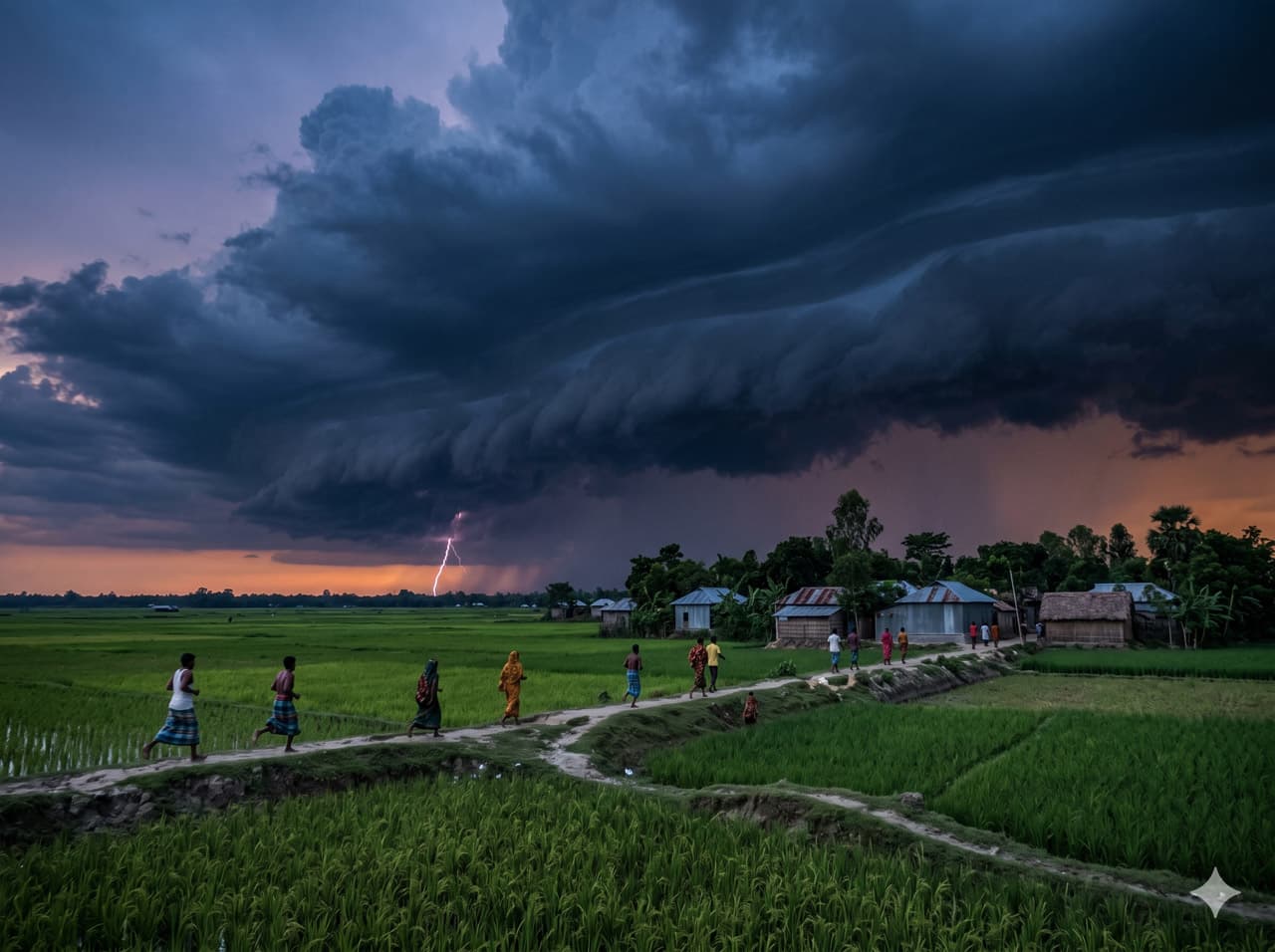
Between March and May, a nor’wester can go from clear sky to chaos in under 30 minutes. A late-afternoon bazaar in Rajshahi may be glowing in heat; a farmer in Tangail may still be in the field; a launch terminal near the Padma may feel windless and heavy. Then the western sky darkens. A shelf cloud rolls forward like a low black wall. Dust lifts. Mango leaves turn their pale undersides to the wind. Within minutes, the Bengal Delta becomes a theatre of pressure, heat, moisture, lightning, and violent air.
In Bangladesh, these pre-monsoon storms are known as nor’westers because they often approach from the northwest, and locally as Kalbaishakhi, the dark storm of Baishakh. They are not just weather events. They are geological-meteorological moments: storms born from land heating, riverine humidity, Himalayan foothill influences, dryline contrasts, and the flat openness of the delta.
What Is a Nor’wester?
A nor’wester is a severe local convective storm that commonly develops during Bangladesh’s hot pre-monsoon season, from March to May. Meteorological literature on Bangladesh describes pre-monsoon thunderstorms moving from the northwest as Nor’westers or Kalbaishakhi, often bringing squalls, lightning, heavy rain, hail, and sometimes tornado-like wind damage. (Bangladesh Meteorological Department)
These storms are typically mesoscale systems: larger than a single cloud, smaller than a cyclone, and fast enough to surprise communities. A mature nor’wester may include cumulonimbus towers, a gust front, intense downdrafts, lightning, hail cores, and short bursts of damaging straight-line wind. In Bangladesh’s agricultural calendar, they arrive at a dangerous time. Boro rice is nearing harvest, mangoes are young on the branch, and rural houses with tin roofs are exposed to sudden squalls.
Caption — Gallery Image 1: An approaching nor’wester over the Bengal Delta: a dark shelf cloud advancing across flat fields, dust rising ahead of the gust front, and a bright strip of pre-storm sky trapped beneath the cloud base.
The Thermodynamics of Rapid Development
The engine of a nor’wester is instability. During the day, intense solar heating warms the land surface. Moisture from rivers, wetlands, irrigated fields, and the Bay of Bengal loads the lower atmosphere. Above this hot, humid layer, cooler and drier air may move in from the northwest or west. The result is a stacked atmosphere: warm, buoyant air below; colder air above; and enough wind shear to organize rising motion.
Meteorologists often describe this stored storm energy using CAPE, or Convective Available Potential Energy. NOAA’s National Weather Service defines CAPE as the amount of energy available for convection; higher values indicate stronger potential updrafts and severe weather risk. (National Weather Service)
CAPE = ∫(T_parcel - T_env) · g / T_env · dzIn plain language, CAPE measures how much warmer a rising air parcel is compared with the surrounding air. If the parcel is warmer, it is lighter, so it accelerates upward. The integral adds up that buoyant energy through a vertical depth of the atmosphere. High CAPE does not guarantee a storm; the atmosphere still needs a trigger. But once a trigger breaks the cap — a dryline, convergence zone, outflow boundary, or local heating maximum — clouds can explode upward into cumulonimbus towers.
Bangladesh is especially vulnerable because heat and humidity can accumulate quickly over the delta. The land is low, wet, and densely cultivated; the atmosphere can become both heavy with moisture and primed for violent uplift. When the first tower punches through, the storm may grow with astonishing speed.
Reading the Sky
Before radar and satellites, people read nor’westers through the body and the horizon. The air becomes oppressive. Birds fly low. Distant thunder begins as a wooden rumble. The western or northwestern sky darkens unevenly, not like a monsoon sheet but like a moving wall. A greenish or yellow-grey tint may appear beneath the cloud base when hail or dense rain is present.
Five warning signs that a nor’wester is developing include:
- Towering cumulus or cumulonimbus clouds building rapidly in the west or northwest.
- A sudden temperature drop as the storm’s outflow boundary arrives.
- A sharp wind shift, often from calm or southerly flow to gusty west/northwesterly wind.
- A pressure fall followed by a gust-front jump, felt as the air suddenly surges.
- A humidity spike and heavy, electric air, followed by lightning and dust-laden wind.
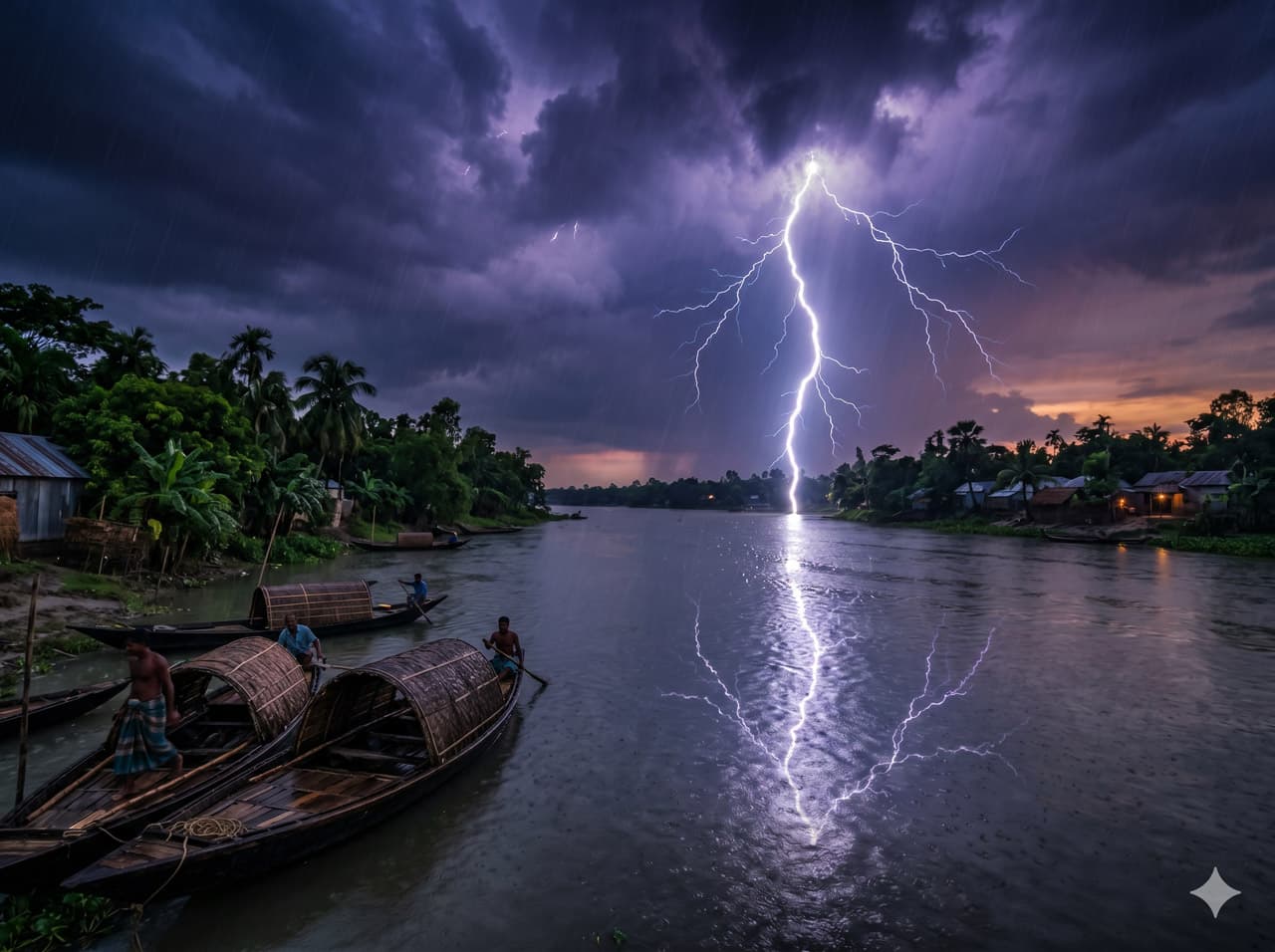
Caption — Gallery Image 2: Lightning inside a mature Kalbaishakhi cell: branching white channels illuminating rain curtains, with the flat delta below briefly exposed in silver light.
Economic and Human Toll
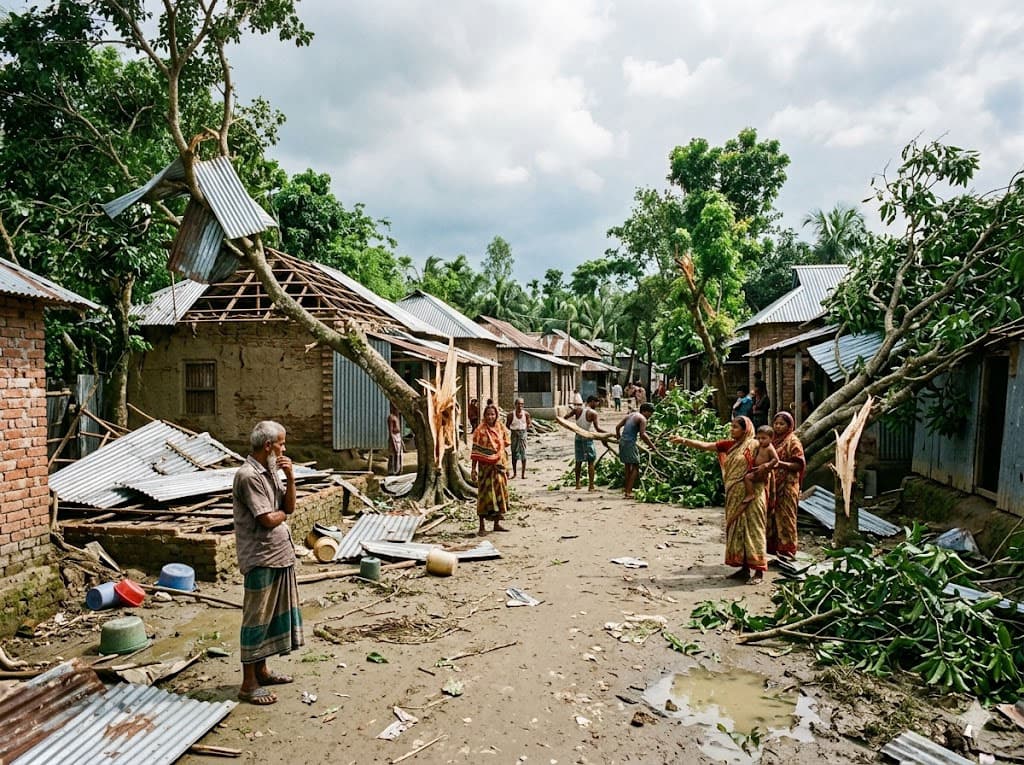
Nor’westers are short-lived, but their impacts can be severe. They damage crops, flatten houses, uproot trees, capsize boats, disrupt power lines, and kill people through lightning, falling structures, and sudden squalls. Bangladesh’s thunderstorm climatology shows that pre-monsoon thunderstorm activity is a recurring national hazard, not a rare exception. (Bangladesh Meteorological Department)
Recent humanitarian reporting also shows how destructive early-season Kalbaishakhi storms can be. A Bangladesh Red Crescent situation report for March 2026 described violent nor’westers, hailstorms, and localized tornadoes affecting multiple districts, with losses to lives, livestock, houses, infrastructure, and standing crops. (<a href="https://bdrcs.org/wp-content/uploads/2026/03/Sitrep-1-Norwester-Kalbaishakhi-Storm30-march-2026.pdf?utmsource=chatgpt.com”>BDRCS) News reports in April 2026 also recorded deaths from lightning as Kalbaishakhi storms swept several districts after heatwave conditions. (News On Air)
| Year | Reported max wind speed km/h | Fatalities | Crop damage estimate | |
|---|---|---|---|---|
| —- | ———————————————– | ——————————————————————– | ————————————————————- | |
| 1989 | ~338 tornado wind estimate | ~1,300 | Severe village and crop destruction in Manikganj–Saturia area | |
| 2015 | ~80–100 squalls reported in affected regions | 30+ reported in storm/lightning incidents | Localized damage to boro rice, mango, houses, and trees | |
| 2022 | Case-study thunderstorm over Dhaka region | Limited reported casualties in studied event | Urban disruption, localized tree/power damage | |
| 2026 | Severe squalls, hail, localized tornado reports | 14+ lightning deaths in late-April reports; additional March impacts | Standing crops, livestock, houses, and infrastructure damaged |
Note: Event statistics vary by source, reporting area, and whether lightning, tornado, hail, and squall-line impacts are counted together. Bangladesh lacks a single long, standardized public database for every nor’wester event, so figures should be treated as indicative rather than exhaustive.
The table reminds us that the storm is not only a dramatic sky. It is a social hazard. A 20-minute squall can decide whether a farmer harvests or loses a season’s income. A lightning flash can turn a field, riverbank, or open road into a fatal place.
Forecasting the Unforceable
Forecasting nor’westers is difficult because they are small, fast, and sensitive to local triggers. Numerical models can identify unstable environments, moisture convergence, wind shear, and CAPE, but predicting the exact village, hour, and intensity remains challenging. BMD research has used models such as WRF to simulate pre-monsoon thunderstorms, and recent BMD work has examined predictability of thunderstorm events over Dhaka and surrounding areas. (Bangladesh Meteorological Department)
“For convective systems, the atmosphere may show us the ingredients hours ahead,” a BMD forecaster explains, “but the exact spark — where the first tower breaks through and becomes severe — can still be a matter of kilometers and minutes.”
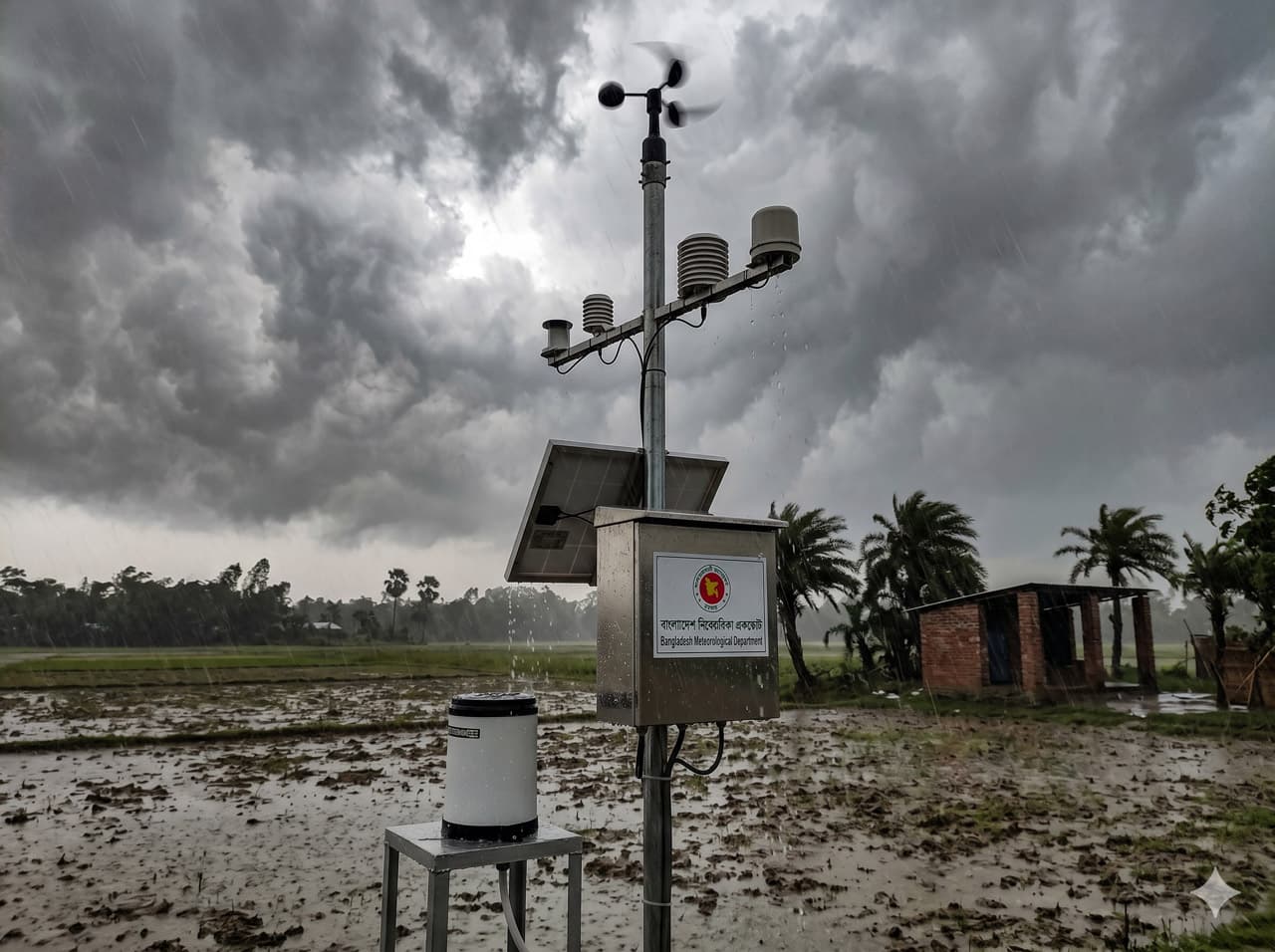
This is why nowcasting is so important. Radar, satellite imagery, lightning detection, automatic weather stations, and rapid public warnings can save lives even when a storm cannot be predicted a day in advance. For farmers, boat operators, school administrators, and outdoor workers, a 30-minute warning can be enough to move indoors, secure boats, stop fieldwork, or delay travel.
Nor’westers are part of Bangladesh’s pre-monsoon identity: feared, watched, remembered. They bring relief from heat, but also destruction. They water the land, but may tear roofs away. They are born from the same deltaic conditions that make Bangladesh fertile: heat, moisture, rivers, flat land, and seasonal atmospheric change. To understand them is to see the Bengal Delta not as passive ground beneath the sky, but as an active surface where land, water, and atmosphere meet in sudden violence.
Sources / References
- Bangladesh Meteorological Department — Recent Climatology of Thunderstorm Days over Bangladesh.
- Hoque, M. M. et al. — “An Overview of Thunderstorms over Bangladesh,” Bangladesh Journal of Physics.
- Bangladesh Meteorological Department — Simulation of Pre-monsoon Thunderstorm and its Associated Convective Parameters over Bangladesh Using WRF-ARW Model.
- Bangladesh Meteorological Department — Predictability of Pre-Monsoon Thunderstorms over Bangladesh.
- NOAA National Weather Service — CAPE glossary and severe weather education resources.
- Bangladesh Red Crescent Society — Situation Report-1, Nor’wester (Kalbaishakhi) Storm, March 2026.
- NewsOnAIR / NewsBytes — April 2026 reports on Kalbaishakhi storms and lightning deaths in Bangladesh.















Responses (0 )