


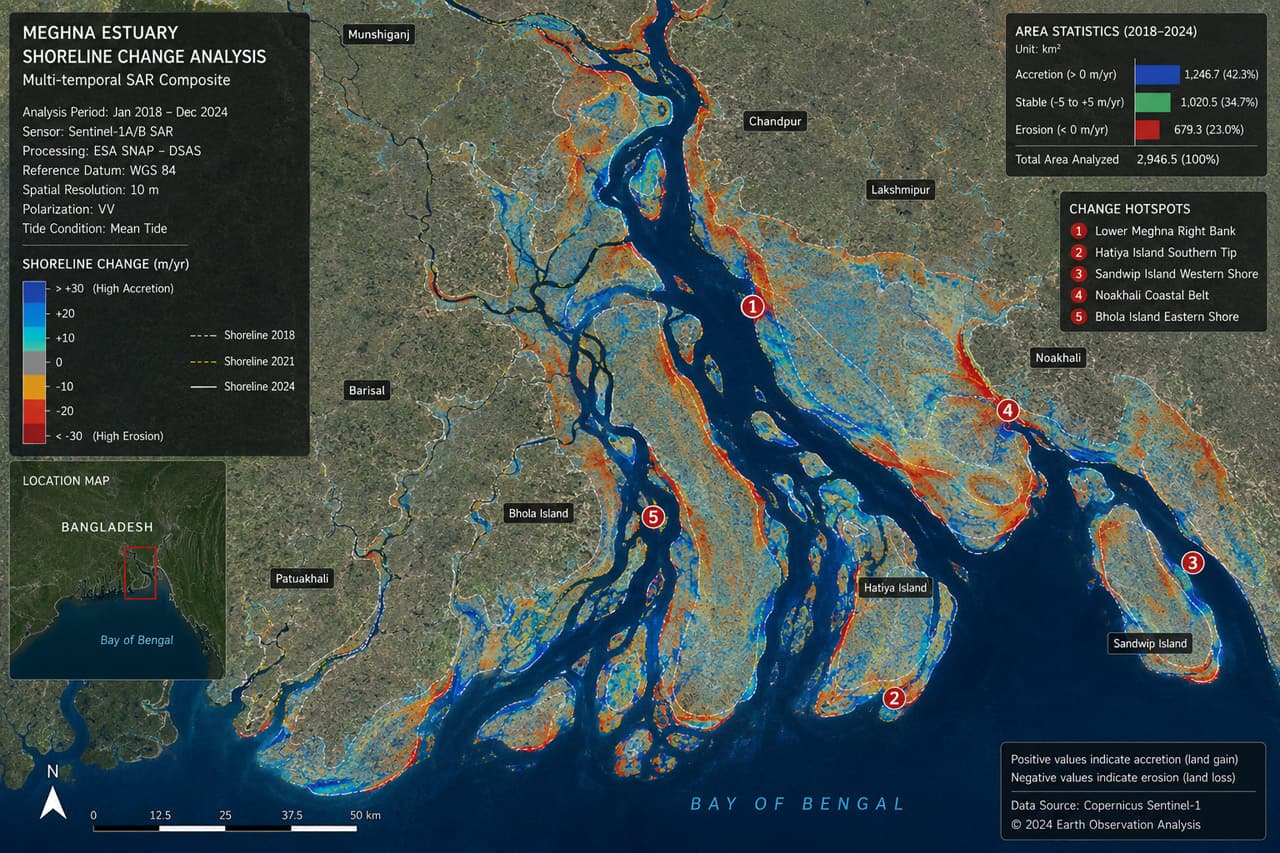
Hero image caption: Multi-temporal Sentinel-1 SAR composite of the Meghna Estuary, where dark water channels, bright exposed sandbars, and shifting island edges reveal the annual rhythm of erosion and accretion.
Every year, the Meghna estuary erases one set of villages and builds new land somewhere else — a zero-sum game of erosion and accretion that reshuffles who owns the land and who is homeless.
To a map, the estuary may look like a boundary between river and sea. To the people of Bhola, Hatiya, Manpura, Sandwip, Urir Char, and Noakhali’s coastal chars, it is not a boundary at all. It is a living machine: cutting banks, depositing silt, opening new channels, swallowing homesteads, and raising fresh sandbars from brown water. In the Meghna, land is not fixed. It is negotiated every monsoon.
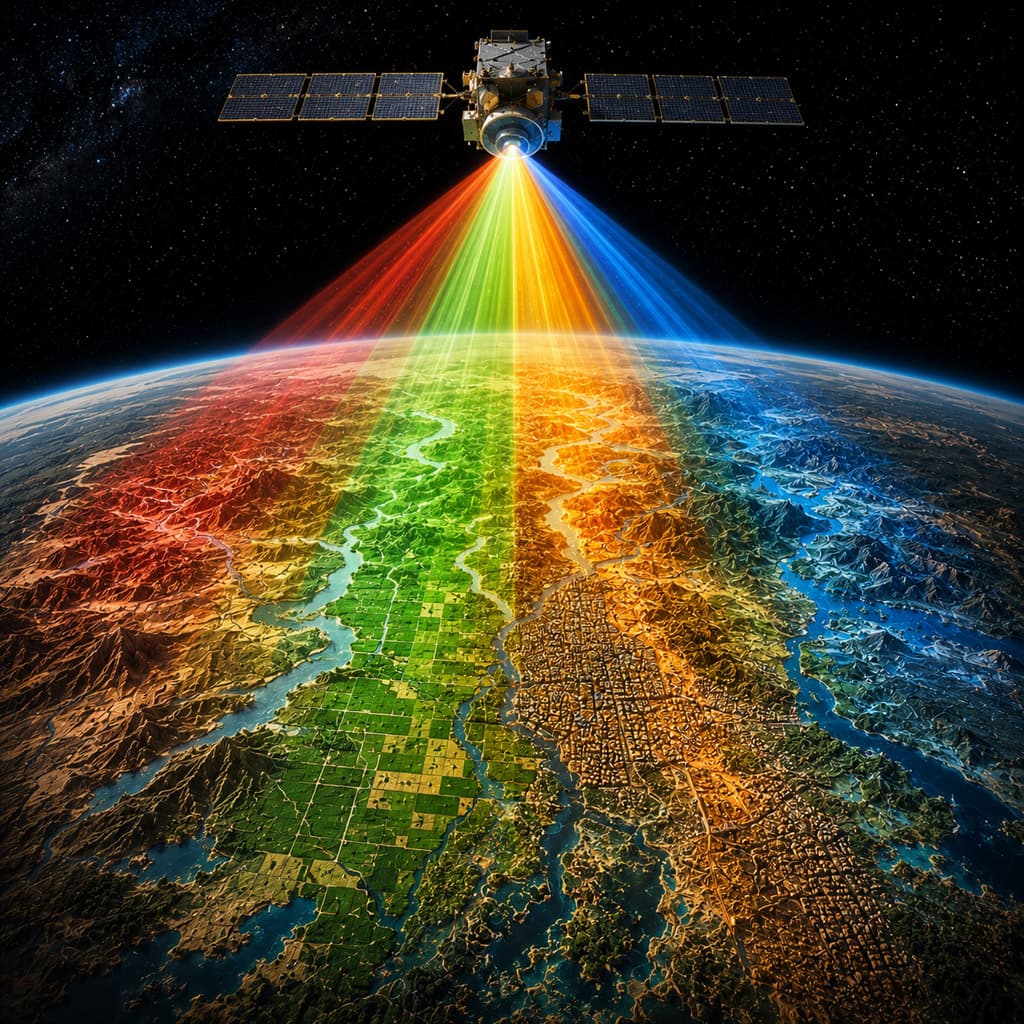
Remote sensing has become essential for understanding this restless system. Optical satellites show land and water clearly on cloud-free days, but the estuary’s most dramatic changes often happen during monsoon cloud, cyclone weather, and turbid tidal conditions. That is where Sentinel-1 Synthetic Aperture Radar, or SAR, becomes powerful. It does not wait for sunlight or clear skies. It measures the surface using microwave energy, giving coastal scientists a repeatable way to monitor shoreline movement through seasons, storms, and sediment pulses.
The Meghna Estuary: Always Moving
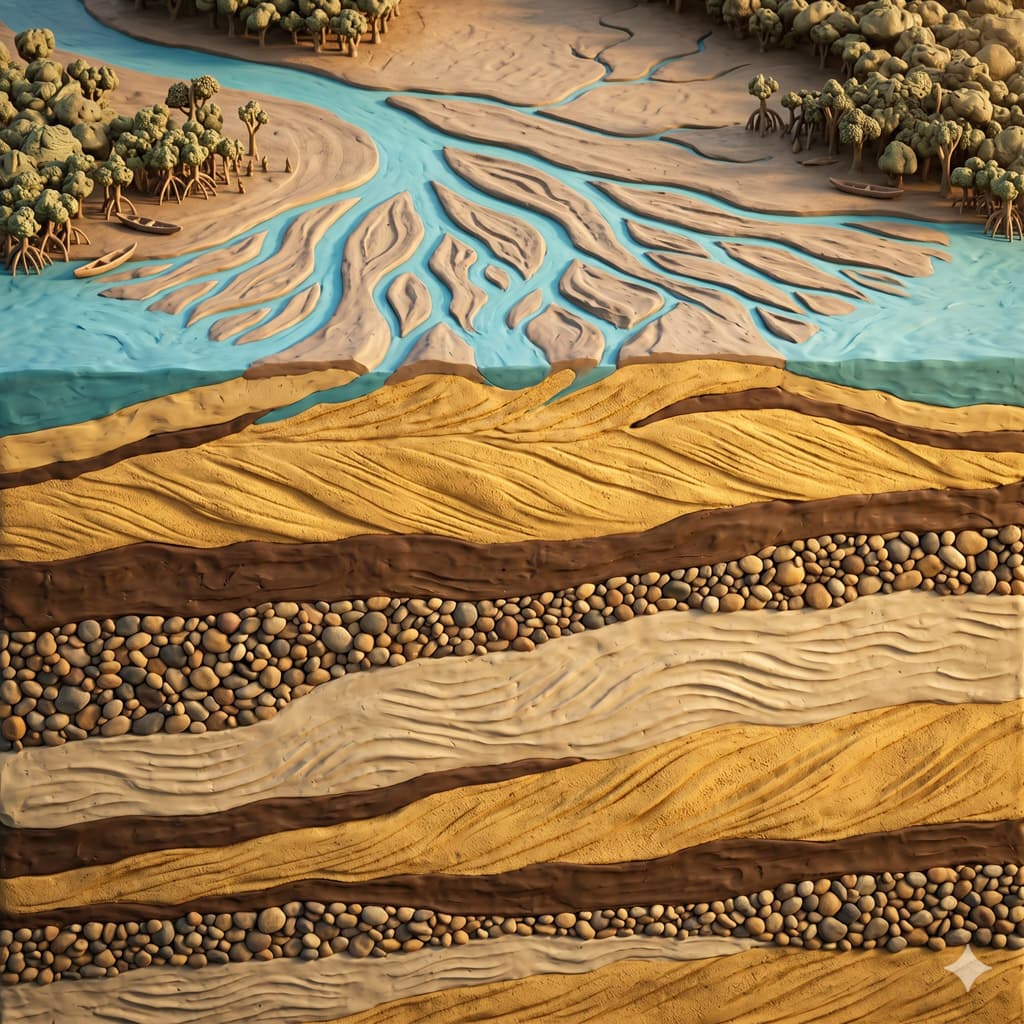
The Meghna Estuary is one of the most dynamic parts of the Ganges-Brahmaputra-Meghna delta. It receives enormous sediment loads from Himalayan-fed river systems and redistributes them through tides, waves, storm surges, and monsoon discharge. The result is a landscape of instability: islands grow, shrink, migrate, split, and merge.
Recent research on the offshore islands of the Meghna Estuary describes the area as highly vulnerable to shoreline erosion and storm-related hazards, driven by the funnel-shaped coast, seasonal river flow, and estuarine processes. A 2025 study of Meghna offshore islands highlighted that erosion and accretion are continuous and spatially uneven, affecting settlements, agriculture, and coastal planning. (ScienceDirect)
The human consequence is severe. Erosion can remove a homestead in one season, while accreted land may remain legally, physically, and politically uncertain for years. A char that appears on satellite imagery is not automatically safe land. It may be submerged during spring tides, reshaped by the next flood pulse, or contested by multiple communities.
Why SAR Where Optical Fails
Optical imagery depends on reflected sunlight. In the Meghna Estuary, clouds, haze, suspended sediment, and monsoon weather often limit optical monitoring. SAR solves part of that problem because it is an active sensor: the satellite sends microwave pulses to Earth and records the returned signal.
Sentinel-1 is especially useful because it provides C-band SAR imagery in Interferometric Wide Swath mode, with frequent repeat coverage and open data access. The European Space Agency describes Sentinel-1 as an all-weather, day-and-night radar mission, making it suitable for monitoring land, ocean, ice, and emergency conditions. (UN-SPIDER)
For shoreline mapping, the key measurement is radar backscatter. A simplified expression for the backscatter coefficient is:
σ⁰ (dB) = 10 · log₁₀(β⁰ / sin(θ))
Here, σ⁰ is the normalized radar backscatter coefficient, β⁰ is radar brightness, and θ is the incidence angle. In plain language, this correction helps compare radar returns across different viewing geometries. Smooth open water usually reflects radar energy away from the satellite, so it appears dark with low σ⁰. Land, vegetation, settlements, rough mudflats, and exposed sandbars scatter more energy back, so they appear brighter.
This land-water contrast is the foundation of SAR shoreline extraction. It is not perfect: wind-roughened water can brighten, wet mud can darken, and flooded vegetation can confuse classification. But over many images, the pattern becomes robust enough to estimate water probability, persistent land, seasonal bars, and erosion fronts.
Processing the Multi-Temporal Stack
A single SAR image captures one tide, one wind condition, and one moment in the estuary’s life. A multi-temporal stack is more powerful because it summarizes repeated observations over months or years.
The workflow usually begins with Sentinel-1 GRD scenes filtered by date, orbit direction, polarization, and geometry. Pre-processing includes orbit correction, thermal noise removal, radiometric calibration, speckle filtering, terrain correction, and conversion to decibels. In cloud platforms like Google Earth Engine, much of the data access and initial handling becomes easier, allowing analysts to build water probability layers across time.
var s1 = ee.ImageCollection("COPERNICUS/S1_GRD")
  .filterBounds(ee.Geometry.Rectangle([90.5, 22.0, 91.5, 23.0]))
  .filterDate("2024-01-01", "2024-12-31")
  .filter(ee.Filter.eq("instrumentMode", "IW"))
  .select("VV");

var waterMask = s1.map(function(img) {
  return img.lt(-15).rename("water");  // threshold in dB
}).mean();

Map.addLayer(waterMask, {min:0, max:1, palette:["white","blue"]}, "Water Probability");
The threshold of -15 dB is only a starting point. In practice, thresholds should be calibrated using known water samples, tidal stage, local wind conditions, and comparison with optical imagery. Digital Earth Africa’s Sentinel-1 water-detection guidance notes that SAR backscatter is often converted to dB because it gives a more useful distribution for analysis, and that water detection commonly relies on the contrast between low-backscatter water and higher-backscatter land. (<a href="https://docs.digitalearthafrica.org/en/latest/sandbox/notebooks/Realworldexamples/Radarwaterdetection.html?utm_source=chatgpt.com”>Digital Earth Africa)
Once water probability is generated, analysts can classify pixels into persistent water, seasonal water, persistent land, and transitional shoreline zones. The transitional zone is where erosion and accretion are most active.
Quantifying Change
Shoreline change is usually quantified by extracting shorelines for multiple dates and measuring movement along transects using tools such as the Digital Shoreline Analysis System, or DSAS. For SAR-based monitoring, a shoreline can be derived from annual or seasonal water probability layers rather than one optical image.
| Estuary segment | Erosion rate m/yr | Accretion rate m/yr | Net change | Risk level | |
|---|---|---|---|---|---|
| —————————– | —————– | ——————- | ———————— | ———- | |
| Northern Hatiya coast | 40–90 | 10–25 | Net erosion | Very high | |
| Manpura western margin | 25–60 | 15–35 | Mixed, erosion-dominant | High | |
| Sandwip eastern shoreline | 20–50 | 20–45 | Highly variable | High | |
| Urir Char–Swarna Dweep zone | 10–30 | 40–100 | Net accretion | Medium | |
| Subarnachar–Companiganj coast | 30–80 | 20–60 | Mixed, hotspot-dependent | High |
These values are indicative ranges for science communication, not official engineering design rates. Published studies show that different islands and shoreline segments in the Meghna system behave very differently. For example, Manpura Island has been studied using DSAS to identify shoreline and areal changes from 1990 to 2020, while coastal vulnerability studies identify the Meghna estuarine coast as a major erosion-prone and hazard-exposed zone. (ScienceDirect)
The drivers of change are multiple and interacting:
- Himalayan sediment load
- Tidal range
- Monsoon discharge variability
- Embankment construction
Sediment builds chars, but tides and channels redistribute them. Monsoon discharge pushes freshwater and sediment seaward, while dry-season tidal action can rework bars and banks. Embankments protect some areas but can also alter drainage, sediment deposition, and local erosion patterns.
“The satellite says our village is now a sandbank, but for us it was a school, a mosque, mango trees, and the place where our parents are buried. A new char somewhere else does not replace that.” — Bhola Island resident
Implications for Coastal Planning
The Meghna Estuary forces planners to think in probabilities rather than fixed lines. A cadastral map may show a plot boundary. A SAR time series may show that the same plot has been water in six months out of twelve. That difference matters for land settlement, embankment design, disaster risk reduction, shelter planning, and climate adaptation.
SAR-derived erosion and accretion maps can support three practical decisions. First, they can identify erosion hotspots where relocation, embankment reinforcement, or setback planning is urgent. Second, they can help classify newly accreted land by stability: temporary sandbar, seasonal char, or persistent land. Third, they can guide infrastructure investment away from zones where shoreline retreat is already measurable.
The technology is not a replacement for field knowledge. Fishers, farmers, boat operators, and local residents understand currents, shoals, and erosion scars in ways satellites cannot. But Sentinel-1 adds a consistent, repeatable, all-weather evidence layer. It turns the estuary’s motion into measurable change.
In the Meghna, land is both resource and risk. SAR helps us see that land not as a static shape on a map, but as a living surface — dark water, bright sediment, disappearing banks, and emerging chars. For coastal Bangladesh, that view from orbit is not just scientific. It is planning intelligence for a landscape that refuses to stand still.
Sources / References
- Khatun et al. 2025 — “Morphological changes in the offshore islands of Meghna estuary: Analysis of the erosion and accretion dynamics.” (ScienceDirect)
- Roy et al. 2021 — “Coastal erosion risk assessment in the dynamic estuary: The Meghna estuary of Bangladesh.” (ScienceDirect)
- Akhter et al. 2024 — “Geospatial analysis of shoreline and areal dynamics in the Manpura Island of Bangladesh.” (ScienceDirect)
- Mahmood et al. 2020 — “Coastal vulnerability assessment of Meghna estuary coast of Bangladesh using geospatial techniques.” (ScienceDirect)
- Digital Earth Africa — “Water detection with Sentinel-1.” (<a href="https://docs.digitalearthafrica.org/en/latest/sandbox/notebooks/Realworldexamples/Radarwaterdetection.html?utm_source=chatgpt.com”>Digital Earth Africa)
- UN-SPIDER — “Recommended Practice: Flood Mapping with Sentinel-1 and Sentinel-2.” (UN-SPIDER)








Responses (0 )