


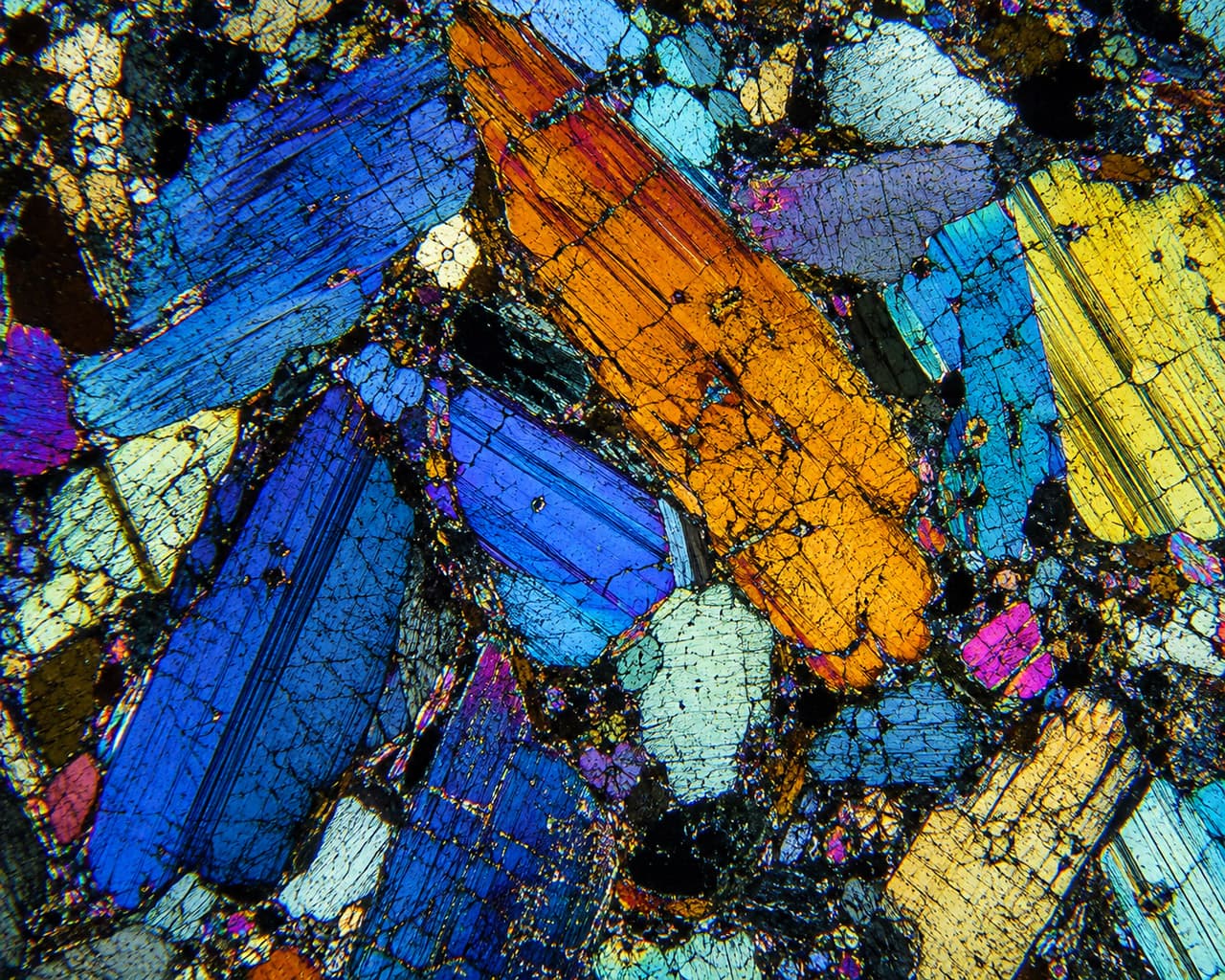
Photo caption: A petrographic microscope view of a rock thin section, where minerals reveal their identity through colour, cleavage, twinning, extinction, and interference patterns.
What Is a Thin Section?
A thin section is a slice of rock so thin that light can pass through most of its minerals. In standard petrography, the rock chip is usually ground to about 30 micrometres thick, mounted on a glass slide, and examined under a polarizing microscope. At that thickness, common minerals such as quartz and feldspar show predictable interference colours, making identification much easier. Thin sections are widely used in petrology because they reveal both mineral composition and texture — the two things you need to name a rock and understand how it formed. (Field Museum)
Think of a thin section as a geological “page” cut from a rock. In hand specimen, a basalt may look like a dark fine-grained block. Under the microscope, it becomes a miniature landscape of plagioclase laths, pyroxene grains, volcanic glass, opaques, and perhaps tiny vesicles. A gneiss that looks banded in the field becomes a story of quartz ribbons, mica alignment, feldspar porphyroclasts, and deformation.
A basic thin-section preparation workflow looks like this:
- Select a representative chip from the rock sample, avoiding weathered surfaces unless alteration is the target.
- Cut a small slab using a diamond saw.
- Grind one face flat so it bonds evenly to the slide.
- Attach the slab to a glass slide using epoxy or resin.
- Trim excess rock from the mounted chip.
- Grind and polish the rock down to approximately 30 µm.
- Check thickness optically, often using quartz interference colours as a guide.
- Label and document the slide with sample ID, location, rock type, and orientation if relevant.
The Petrographic Microscope
A petrographic microscope is not just a magnifying glass. It is designed to control light. The key components are the lower polarizer, rotating stage, objective lenses, analyzer or upper polarizer, Bertrand lens, and sometimes accessory plates such as gypsum or mica plates.
In plane-polarized light (PPL), you usually observe colour, relief, cleavage, pleochroism, grain shape, alteration, and opaque minerals. In cross-polarized light (XPL), with the analyzer inserted, you observe interference colours, twinning, extinction behaviour, birefringence, and zoning. Open educational mineralogy texts emphasize that PPL is especially useful for grain size, shape, colour, and cleavage, while XPL reveals anisotropy, interference colours, twinning, and extinction angles. (<a href="https://geo.libretexts.org/Bookshelves/Geology/Mineralogy%28Perkinsetal.%29/05%3AOpticalMineralogy?utmsource=chatgpt.com”>Geosciences LibreTexts)
The rotating stage is your best friend. Do not stare at a mineral from one angle and decide too quickly. Rotate it. Watch how it changes. Does it go dark every 90 degrees? Does extinction sweep smoothly or in waves? Does it show lamellar twinning? Does colour change in PPL? Minerals identify themselves through behaviour, not just appearance.
Key Optical Properties
The physics behind petrography begins with light moving through minerals. When light passes from one material to another, it bends according to refractive index. This is summarized by Snell’s Law:
n₁ sin θ₁ = n₂ sin θ₂Here, n₁ and n₂ are refractive indices of two materials, while θ₁ and θ₂ are the angles of the light ray before and after refraction. In thin sections, differences in refractive index help create relief — the apparent sharpness or “standing out” of a mineral grain against the mounting medium or neighbouring minerals.
Here are the optical properties you should log systematically:
- Colour in PPL: Is the mineral colourless, brown, green, yellow, or opaque?
- Pleochroism: Does colour change as you rotate the stage in PPL?
- Relief: Does the grain boundary look low, moderate, or high?
- Cleavage: Are there one, two, or more cleavage directions? What angle?
- Interference colour in XPL: First-order grey? Bright second-order colours?
- Extinction: Straight, inclined, symmetrical, undulose?
- Twinning: Polysynthetic, tartan, simple, or absent?
- Habit and texture: Lath-shaped, prismatic, flaky, equant, interlocking, aligned?
| Mineral | Colour in PPL | Colour in XPL | Cleavage | Key identifier | |
|---|---|---|---|---|---|
| ————- | ———————————– | ————————————————— | ————————— | ——————————————————— | |
| Quartz | Colourless, low relief | Low first-order grey/white | None | Undulose extinction common in deformed rocks; no twinning | |
| Plagioclase | Colourless, low relief | Low first-order grey/white | Poor to indistinct | Polysynthetic/albite twinning; zoning common | |
| K-feldspar | Colourless, low relief | Low first-order grey/white | Poor | Tartan twinning in microcline; perthitic texture possible | |
| Biotite | Brown to green, pleochroic | Bright second-order colours, often masked by colour | One perfect cleavage | Strong pleochroism and flaky habit | |
| Muscovite | Colourless to pale | Bright second/third-order colours | One perfect cleavage | High birefringence, clear mica flakes | |
| Hornblende | Green to brown, pleochroic | Moderate second-order colours | Two cleavages at ~56°/124° | Amphibole cleavage angles and pleochroism | |
| Clinopyroxene | Colourless to pale green/brown | First to second-order colours | Two cleavages near 90° | Short prismatic habit; inclined extinction | |
| Olivine | Colourless, high relief | Bright second-order colours | Poor/none, fractures common | High relief, irregular fractures, no cleavage | |
| Garnet | Colourless to pale, high relief | Black/isotropic in XPL | None | Isotropic, high relief, often rounded porphyroblasts | |
| Calcite | Colourless, very high birefringence | Very high-order pastel colours | Rhombohedral cleavage | Extreme birefringence; reacts with acid in hand sample |
Igneous vs Metamorphic — What to Look For
When identifying igneous rocks, start with texture. Is it phaneritic, aphanitic, porphyritic, glassy, vesicular, or pyroclastic? Then estimate mineral proportions. A gabbro may show interlocking plagioclase and pyroxene. A granite may show quartz, K-feldspar, plagioclase, and mica. A basalt may contain fine plagioclase microlites, clinopyroxene, opaque oxides, and glass.
Igneous textures often preserve crystallization history. Euhedral phenocrysts suggest early crystal growth in magma. Zoning in plagioclase can record changing melt chemistry. Ophitic texture in dolerite or gabbro shows pyroxene enclosing plagioclase laths. Graphic texture in granitic rocks may show quartz and feldspar intergrowth.
Metamorphic rocks require a slightly different mindset. Look for fabric. Are minerals aligned? Is there foliation, schistosity, gneissic banding, or a granoblastic mosaic? Metamorphic minerals are not just ingredients; they are pressure-temperature clues. Garnet, staurolite, kyanite, sillimanite, chlorite, biotite, and muscovite can indicate metamorphic grade and reaction history.
In a schist, mica alignment may define foliation, while garnet porphyroblasts may preserve inclusion trails. In a quartzite, quartz grains may show sutured boundaries and undulose extinction. In marble, calcite crystals may form a sugary mosaic with high-order interference colours. In gneiss, alternating quartz-feldspar and mica-rich bands record segregation during deformation and recrystallization.
A simple digital note can help you log observations consistently:
minerals = []
minerals.append({"name": "Quartz", "colour_xpl": "grey", "extinction": "straight"})
print(f"Logged {len(minerals)} minerals")
Common Pitfalls
The first common mistake is identifying a mineral from colour alone. Many minerals are colourless in PPL. Quartz, feldspar, cordierite, and some pyroxenes can look deceptively similar at first glance. Use a combination of properties. Open mineralogy guides stress that mineral identification depends on combining optical properties rather than relying on one feature. (<a href="https://geo.libretexts.org/Bookshelves/Geology/Mineralogy%28Perkinsetal.%29/05%3AOpticalMineralogy?utmsource=chatgpt.com”>Geosciences LibreTexts)
The second mistake is ignoring the stage. Extinction, pleochroism, and twinning only reveal themselves when you rotate. A mineral that looks plain at one angle may show decisive evidence at another.
“When in doubt, check the extinction angle.”
The third mistake is forgetting alteration. Feldspar may be cloudy from sericitization. Olivine may alter to serpentine or iddingsite. Pyroxene may be replaced by amphibole or chlorite. In metamorphic rocks, retrograde minerals can overprint earlier assemblages. Always ask: is this the original mineral, or a replacement?
The fourth mistake is naming the rock too early. First describe: mineral percentages, grain size, texture, fabric, alteration, and relationships. Only then interpret. A thin section rewards patience. The best petrographers are not the fastest identifiers; they are the most careful observers.
Sources / References
- OpenGeology / LibreTexts. “Optical Mineralogy.” (opengeology.org)
- LibreTexts. “Plane Polarized Light and Cross Polarized Light.” (<a href="https://geo.libretexts.org/Bookshelves/Geology/Mineralogy%28Perkinsetal.%29/05%3AOpticalMineralogy/5.04%3APetrographicMicroscopes/5.4.02%3APlane%28PP%29PolarizedLightandCrossPolarized%28XP%29Light?utmsource=chatgpt.com”>Geosciences LibreTexts)
- The Field Museum. “Optical Mineralogy.” (Field Museum)
- OpenLearn, The Open University. “An introduction to minerals and rocks under the microscope.” (The Open University)
- Mineralogical Society of America. Guide to Thin Section Microscopy. (<a href="https://www.minsocam.org/msa/OpenAccesspublications/GuideThinSctnMcrscpy/ThinSctnMcrscpy2prnteng.pdf?utmsource=chatgpt.com”>minsocam.org)
- McNamee & Gunter. Mineralogy and Optical Mineralogy Lab Manual. Mineralogical Society of America. (<a href="https://www.minsocam.org/msa/OpenAccesspublications/McNameeGunterLabManual/McNameeGunterLabManual.pdf?utmsource=chatgpt.com”>minsocam.org)
- Virtual Microscope, Open University. “Manual of Minerals.” (virtualmicroscope.org)








Responses (0 )