


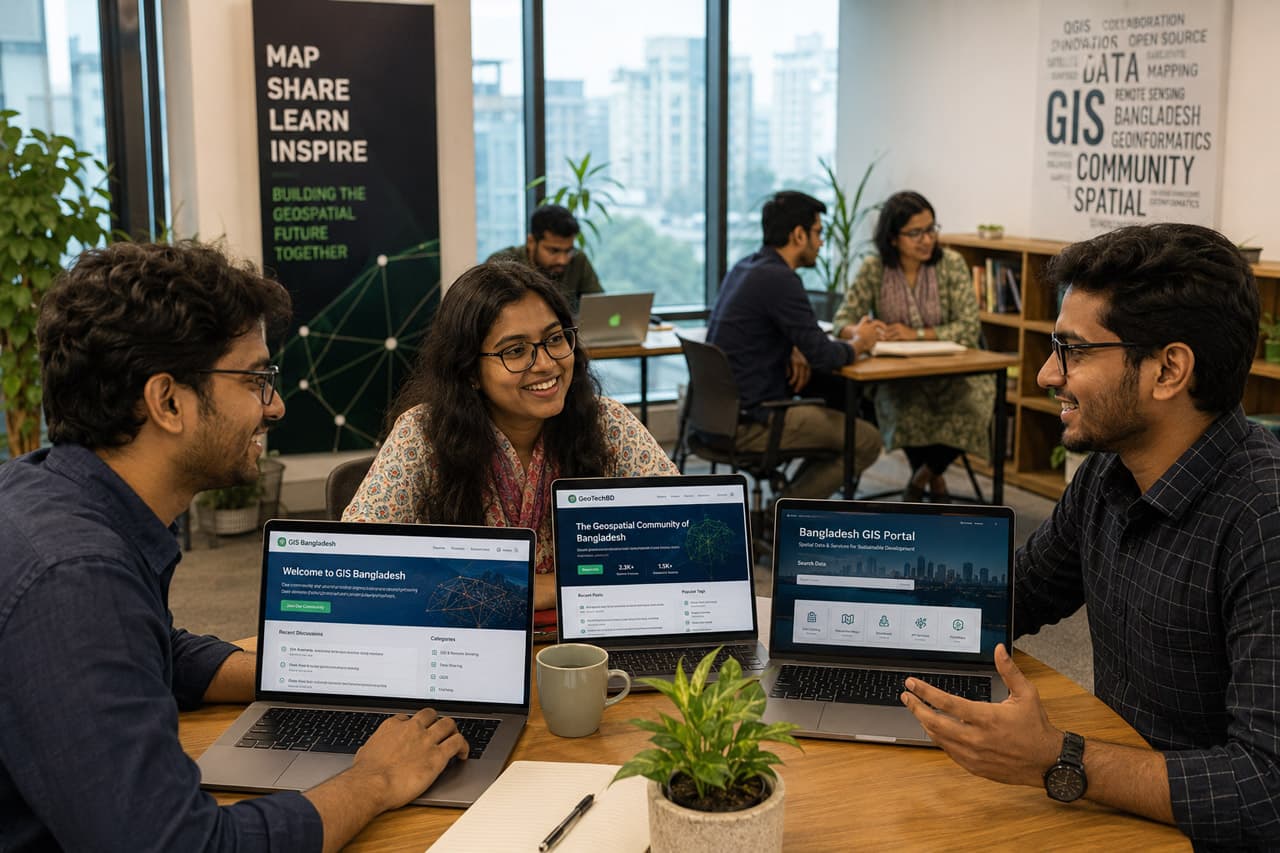
Hero image caption: A modern co-working space where young GIS professionals compare maps, code snippets, satellite imagery, and community forum threads on shared screens.
The best GIS skill you develop in isolation; the best career is built in community. Here’s where Bangladesh’s geo professionals should be showing up online.
GIS is one of those fields where no one knows everything. One day you are cleaning GPS tracks, the next day you are debugging a PostGIS query, publishing a web map, processing Sentinel imagery, fixing a projection mismatch, or explaining flood exposure to a non-technical decision-maker. Books and courses help, but communities are where real-world GIS problems get solved.
For Bangladeshi geo professionals—whether you work in government, telecom, disaster management, NGOs, academia, urban planning, or private geospatial services—online communities can become your extended technical team.
Why Community Matters in GIS
GIS is practical by nature. A textbook may explain coordinate reference systems, but a forum thread will tell you why your shapefile from one agency does not align with your satellite image. A course may teach QGIS processing tools, but a community member may share the exact model builder workflow that saves your project deadline.
Community also helps professionals in Bangladesh stay connected to global practice. Many local GIS teams work with limited budgets, mixed data quality, and tight deadlines. Online communities provide access to people who have already solved similar problems in Nepal, Indonesia, Kenya, the Netherlands, or Brazil.
The other benefit is career visibility. When you answer questions, share workflows, publish small tutorials, or contribute to open data, people start recognizing your expertise. In GIS, reputation is built not only through job titles but through visible problem-solving.
Global Communities Worth Joining
The first global space every technical GIS professional should know is GIS Stack Exchange. It is the go-to platform for technical problem-solving: QGIS errors, PostGIS queries, GeoServer configuration, PyQGIS scripting, raster processing, CRS issues, and web mapping bugs. A simple but important tip: when asking a question, always include your software version—especially QGIS version, Python version, plugin name, operating system, sample error message, and a small reproducible example. This increases your chance of getting a useful answer quickly.
The OSGeo ecosystem is another must-follow space. OSGeo supports open-source geospatial software and promotes collaborative development through projects, events, and local chapters. If your work touches QGIS, GeoServer, GDAL, PostGIS, GRASS GIS, MapServer, or OpenLayers, OSGeo is not just a community—it is the backbone of much of the open geospatial world. OSGeo describes itself as an inclusive software foundation that fosters global adoption of open geospatial technology. (OSGeo)
The QGIS community is essential for desktop GIS users. QGIS is a free and open-source GIS project owned by its contributors, and its ecosystem includes documentation, plugins, user groups, issue trackers, and training materials. For Bangladeshi professionals who need cost-effective GIS capacity, QGIS community knowledge is extremely valuable. (QGIS)
For professionals using ArcGIS, the Esri Community is highly useful. It is a global community of Esri users where people exchange ideas, solve problems, and collaborate around ArcGIS products. If your organization uses ArcGIS Enterprise, ArcGIS Online, Survey123, Field Maps, Experience Builder, or ArcGIS Pro, this community can save many hours of troubleshooting. (Esri Community)
Open mapping professionals should also join the OpenStreetMap Community Forum and follow Humanitarian OpenStreetMap Team (HOT). HOT works globally to support OpenStreetMap use by local communities and build local open mapping movements, especially around disaster risk, humanitarian response, and sustainable development. (hotosm.org)
Bangladesh-Specific Spaces
Bangladesh has a growing geospatial community, but much of it is distributed across Facebook groups, LinkedIn networks, university circles, NGO mapping projects, and informal Messenger or WhatsApp groups. Search for Bangladesh-focused groups around GIS, remote sensing, urban planning, OpenStreetMap Bangladesh, disaster management, drone mapping, and geospatial jobs.
For students and early-career professionals, university-based GIS and remote sensing groups can be very helpful. Departments of geography, urban planning, environmental science, civil engineering, and disaster management often have alumni networks where job posts, training links, and project opportunities circulate.
OpenStreetMap-related Bangladesh spaces are especially useful for people interested in road networks, POIs, field mapping, disaster response, and community mapping. Even if you are not a full-time OSM contributor, learning how local volunteers map roads, buildings, schools, clinics, and flood-prone areas will improve your understanding of open geodata quality.
| Community name | Platform | Focus area | Language | Link/handle | |
|---|---|---|---|---|---|
| ————————————— | ———————————- | ————————————– | ——————— | ——————————— | |
| GIS Stack Exchange | Q&A forum | Technical GIS problem-solving | English | gis.stackexchange.com | |
| OSGeo Community | Website, mailing lists, events | Open-source geospatial software | English, multilingual | osgeo.org | |
| QGIS Community | Website, docs, plugins, forums | QGIS desktop, plugins, PyQGIS | English, multilingual | qgis.org | |
| Esri Community | Online forum | ArcGIS products and workflows | English | community.esri.com | |
| OpenStreetMap Community Forum | Forum | OSM mapping and data use | English, multilingual | community.openstreetmap.org | |
| Humanitarian OpenStreetMap Team | Website, Tasking Manager, training | Humanitarian and disaster mapping | English, multilingual | hotosm.org | |
| OpenStreetMap Bangladesh groups | Facebook/OSM networks | Local mapping, roads, POIs, field data | Bangla, English | Search “OpenStreetMap Bangladesh” | |
| LinkedIn GIS Bangladesh networks | Jobs, professional networking | English, Bangla | Search “GIS Bangladesh” | ||
| Remote Sensing & GIS student groups | Facebook/University groups | Learning, jobs, tutorials | Bangla, English | University/community groups | |
| GeoServer/PostGIS/QGIS developer groups | GitHub, forums, mailing lists | Advanced open-source GIS development | English | Project-specific communities |
Getting the Most Out of Forums
Joining a community is easy. Getting value from it requires good habits.
- Ask good questions: include context, software version, error message, screenshots, sample data structure, and what you already tried.
- Contribute answers: even if you are not an expert, share what worked for you in a real project.
- Share datasets carefully: publish open datasets only when licensing, privacy, and organizational permission are clear.
- Attend virtual meetups: webinars, mapathons, FOSS4G sessions, and OSM events expose you to global practice.
- Follow key people: track GIS developers, cartographers, remote sensing researchers, open-data advocates, and local professionals on LinkedIn, GitHub, YouTube, and X.
“I spent almost a week trying to fix a QGIS processing model that failed every time I changed the input layer. One short forum reply explained that my field type was changing during export. That answer saved the project—and reminded me not to struggle silently.” — A Bangladeshi GIS professional
Contributing Back
The best way to grow in GIS communities is to stop being only a reader. Answer one beginner question. Share a Bangla tutorial on CRS basics. Document how you cleaned a ward boundary dataset. Report a QGIS plugin bug. Improve an OpenStreetMap road classification. Publish a small PostGIS query example. Mentor a student who is learning remote sensing.
Bangladesh needs more visible geospatial knowledge. We have serious mapping challenges: river erosion, urban growth, road safety, disaster preparedness, climate risk, land administration, logistics, health access, and financial inclusion. Many of these problems cannot be solved by one organization alone. They require shared standards, shared datasets, shared workflows, and shared learning.
So join the forums. Ask better questions. Share what you know. The next time you solve a GIS problem online, remember: someone in Bangladesh may face the same issue next month—and your answer could save them a week.
Sources / References
- GIS Stack Exchange — technical GIS Q&A forum: gis.stackexchange.com
- OSGeo — open-source geospatial foundation and community: osgeo.org
- OSGeo About page: OSGeo About
- QGIS official website and community project information: qgis.org
- QGIS download/community contribution note: QGIS Download
- Esri Community: community.esri.com
- Humanitarian OpenStreetMap Team: hotosm.org
- HOT “Who We Are”: HOT Who We Are
- OpenStreetMap Community Forum: community.openstreetmap.org











Responses (0 )