


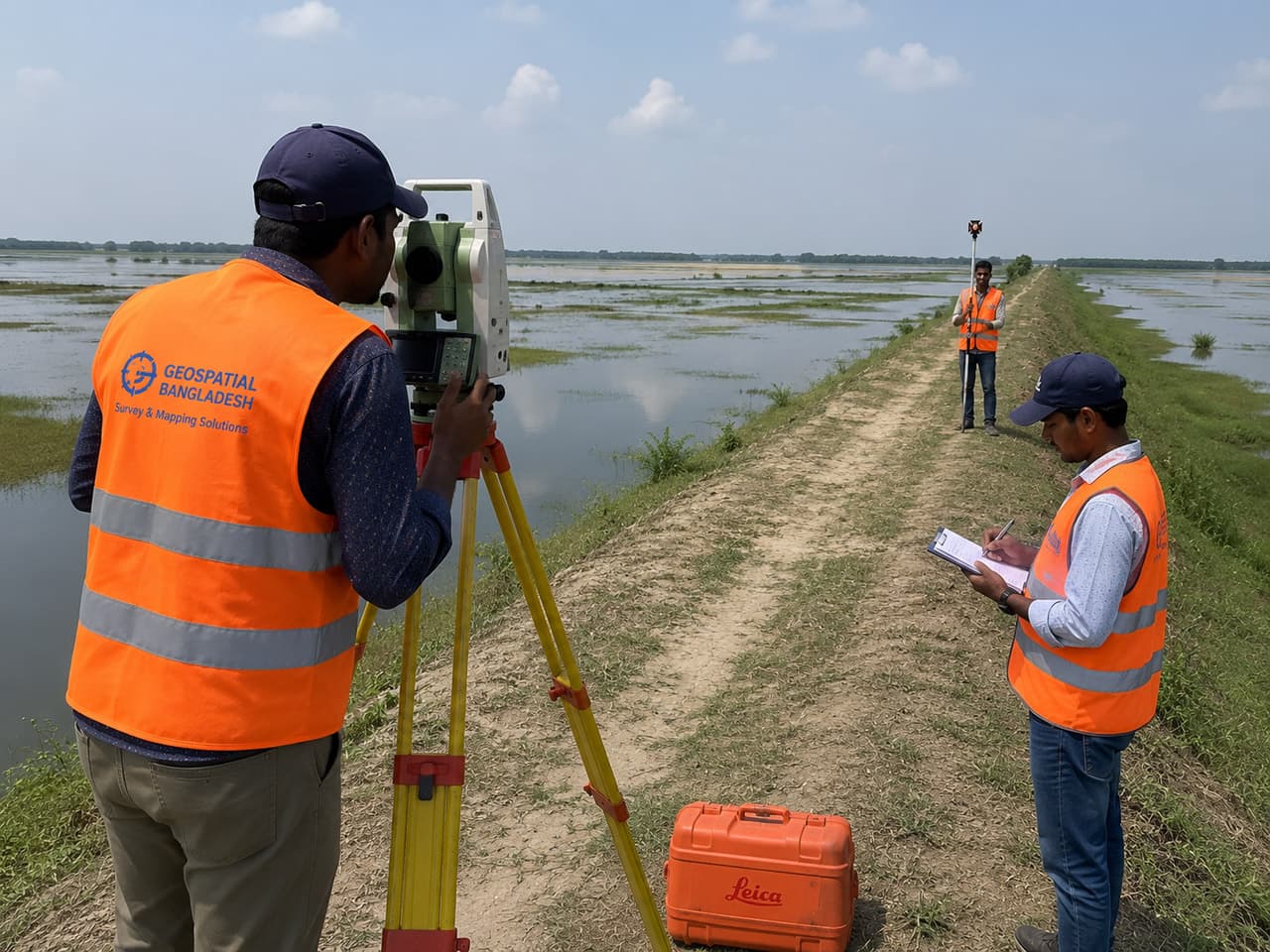
Hero image caption: A survey crew setting up a total station on a raised river embankment in rural Bangladesh, with soft floodplain soil, waterlogged fields, and a prism pole team working along the alignment.
Setting up a total station on flat Bangladeshi floodplain looks easy until you discover there are no stable benchmarks, the ground is soft, and a boat is your instrument transport.
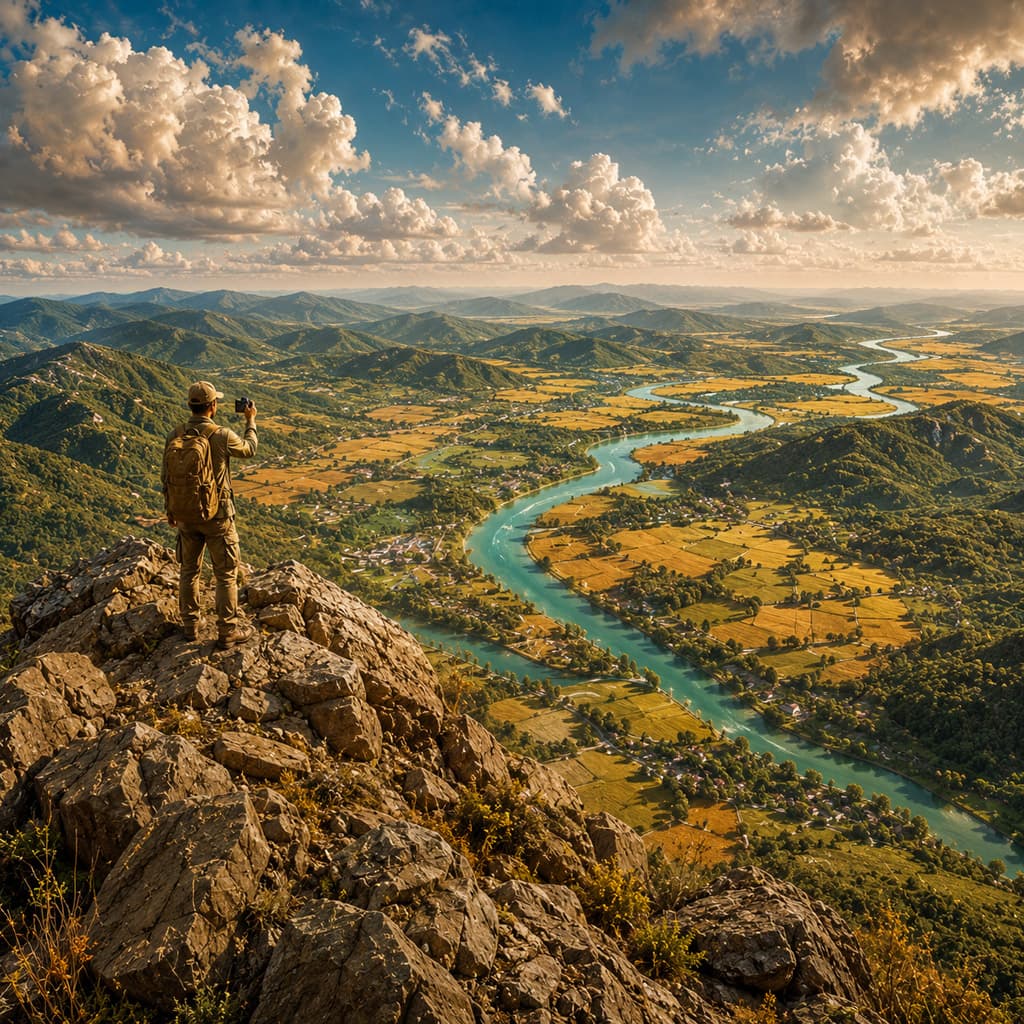
Anyone who has worked along the Jamuna, Padma, Meghna, Teesta, Arial Khan, or coastal polders knows the feeling. On paper, floodplain surveying should be simple: open land, long visibility, little relief. In the field, it becomes a test of patience. Tripod legs sink. Heat shimmer distorts long sights. Benchmarks disappear under seasonal water. Local paths become canals. A station that looked stable in January may be gone after monsoon erosion. This is where total station surveying becomes less about pressing buttons and more about field judgement.
The Total Station Explained
A total station combines an electronic theodolite, electronic distance measurement (EDM), onboard computation, and data storage. In practical terms, it measures horizontal angle, vertical angle, and slope distance to a prism or reflectorless target. From those observations, it calculates coordinates and elevations.
For floodplain work, the total station remains valuable because it provides precise relative measurements over construction sites, embankments, canals, roads, settlement boundaries, and local control networks. GNSS is excellent under open sky, but a total station is still preferred where line work, local control, vertical checks, and engineering detail are required. Most total stations measure angles electronically and use EDM to determine distance; high-grade instruments may measure angles to sub-second precision, while construction-grade instruments commonly fall in the 2–10 arc-second class. Typical EDM specifications are often expressed as millimetres plus parts per million, such as ±(2 mm + 2 ppm). (<a href="https://en.wikipedia.org/wiki/Totalstation?utmsource=chatgpt.com”>Wikipedia)
| Spec | Typical range | Notes | |
|---|---|---|---|
| ———————- | ———————————————————– | ——————————————————————————————————— | |
| Angular accuracy | 1″–5″ for survey instruments; 5″–10″ for construction-grade | For cadastral, control, and embankment work, 2″–5″ is common; higher precision matters on long traverses. | |
| Prism range | 2,000–5,000 m depending on model and prism | Long range is useful on embankments, but atmospheric conditions often limit practical sight length. | |
| Reflectorless range | 300–1,500 m depending on target and instrument | Useful for inaccessible points, culverts, structures, or opposite bank features. | |
| EDM accuracy | Around ±(1–3 mm + 2 ppm) | Always check whether accuracy is prism, reflectorless, fine mode, or tracking mode. | |
| Waterproof/dust rating | IP54 to IP66 commonly | In Bangladesh, rain, mud, humidity, and dust make sealing more important than many buyers expect. | |
| Battery life | 6–12 hours typical | Carry spare batteries; remote char and embankment work rarely has charging access. |
Why Flat Terrain Is Deceptively Hard
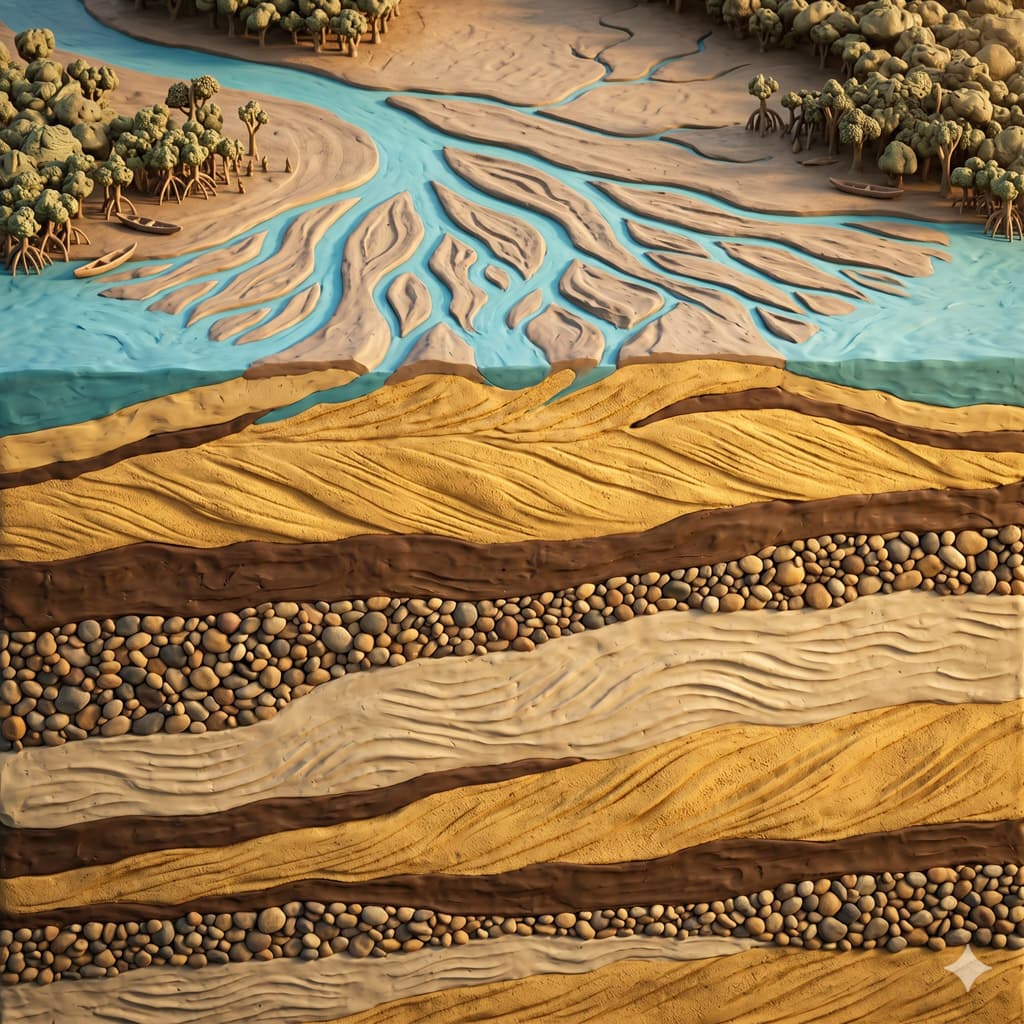
Flat land does not mean easy surveying. In Bangladesh’s floodplain, the lack of relief can make it harder to identify stable reference points. A small vertical error may matter greatly when designing drainage, road levels, irrigation channels, flood shelters, or embankment crest profiles.
Soft ground is the first problem. A total station needs a stable setup. On saturated clay, recently deposited silt, paddy bunds, or riverbank sand, tripod legs slowly settle. The instrument may remain level for the first backsight and drift by the time the foresight is taken. Experienced crews push tripod legs deep, use wider foot plates or timber pads, and recheck the bubble frequently.
Long sights are another trap. Floodplains invite long observations because the land is open. But long lines over hot, wet fields suffer from shimmer and refraction. The prism appears to dance. The crosshair never feels steady. A 700 m sight at noon over wet paddy can be worse than a 250 m sight in the morning. Shorter, balanced sights often produce better results than heroic long shots.
Four total station challenges specific to Bangladesh floodplain are:
- Soft instrument setups: tripod settlement on wet clay, sandbars, paddy bunds, and embankment shoulders.
- Long sights over flat terrain: tempting but vulnerable to shimmer, refraction, and poor target definition.
- Heat shimmer: strong in dry season and over exposed riverbanks, roads, and waterlogged fields.
- Flooding of benchmarks: permanent marks may be submerged, damaged, buried, or eroded after monsoon.
Establishing Control Points
Good total station work begins with control. In floodplain Bangladesh, control points must be chosen for survival, visibility, and accessibility. A convenient point is not necessarily a good point. Avoid loose embankment edges, active erosion scarps, temporary bamboo platforms, soft pond banks, and recently filled ground.
Where possible, connect your survey to known national control, GNSS-observed points, or project benchmarks. If no reliable benchmark exists nearby, establish temporary control using GNSS and then run a local traverse from it. Mark control points with concrete pillars, iron pins in stable structures, painted marks on culverts, or well-documented temporary stations. Photograph every point, record descriptions, and include offset sketches. In rural Bangladesh, a “permanent” point is only permanent if someone can find it after a flood, road repair, or crop season.
For elevation work, do not rely on one benchmark. Use at least two independent height references when available. If the work affects drainage or embankment design, run check levels or reciprocal observations where practical.
Running Traverse Surveys
A traverse is a chain of connected survey lines where each station observes angles and distances to the next. In floodplain terrain, traverses are often run along embankments, roads, canal banks, village paths, or project boundaries. The goal is to create a reliable framework from which detail points can be surveyed.
Start with a strong backsight. Observe face left and face right if the job requires higher accuracy. Keep foresight and backsight distances reasonably balanced. Record instrument height and prism height carefully; many vertical errors come from simple height mistakes. If working along an embankment, avoid placing stations too close to the crest edge where vibration, settlement, and erosion are likely.
Closed traverses are preferred because they allow error checking. An open traverse without independent check points is risky, especially when field conditions are poor. After completing a closed traverse, compute closure error and relative precision. The Bowditch, or compass, rule is a common adjustment method. It distributes closure error across traverse legs in proportion to their lengths; Esri’s GIS dictionary describes it as a rule that changes northings and eastings of traverse points in proportion to distance from the beginning of the traverse, while Trimble documentation similarly notes that the compass rule adjusts departures and latitudes in proportion to course lengths. (Esri Support)
The simplified Bowditch adjustment idea is:
correction per point = (total closure error) × (partial traverse length / total traverse length)
More formally, latitude and departure corrections are applied to each traverse leg according to the ratio of that leg length to the total traverse length. (Jerry Mahun)
Here is a simple Python calculation for traverse closure:
import numpy as np

bearings_deg = [45.2, 134.8, 225.3, 315.6]  # traverse bearings
distances_m  = [120.5, 95.3, 118.7, 101.2]   # leg distances

bearings_rad = np.radians(bearings_deg)
delta_e = np.array(distances_m) * np.sin(bearings_rad)
delta_n = np.array(distances_m) * np.cos(bearings_rad)

closure_e = delta_e.sum()
closure_n = delta_n.sum()
linear_closure = np.sqrt(closure_e**2 + closure_n**2)
total_distance = sum(distances_m)
precision = total_distance / linear_closure

print(f"Closure error: E={closure_e:.3f}m  N={closure_n:.3f}m")
print(f"Linear closure: {linear_closure:.3f}m  |  Precision: 1:{precision:.0f}")
Processing and Adjusting the Data
Processing should begin the same day as fieldwork. Download observations, back them up, and check station names, instrument heights, prism heights, point codes, and duplicate point IDs. Plot the traverse immediately. If a leg is reversed, a bearing is wrong, or a prism height was entered incorrectly, it is much easier to fix while the crew still remembers the site.
For engineering work, compare closure precision against project requirements. A village road topographic survey, an embankment profile, and a cadastral boundary survey do not need the same tolerance. If the closure is poor, do not hide it with adjustment. Find the cause: unstable setup, wrong backsight, poor centering, prism height error, long shimmer-affected sight, or station misidentification.
“We reached the embankment after two hours by boat and found every old benchmark under water. We had to start from a GNSS control point on a school veranda, run a short traverse along the crest, and recheck everything before sunset. That day taught the whole crew that floodplain surveying is never routine.” — Survey crew leader, river embankment project
The best total station crews in Bangladesh are not the ones with the most expensive instruments. They are the ones who control setup stability, observe carefully, check closure honestly, document benchmarks, and understand how water changes the landscape. In floodplain terrain, precision is not only a specification. It is a field discipline.
Sources / References
- Esri GIS Dictionary — Compass Rule definition: Esri Support GIS Dictionary: Compass Rule
- Trimble Business Center Help — Traverse adjustment methods: Trimble TBC Traverse Adjustment
- Jerry Mahun — Traverse Computations, Compass/Bowditch Rule explanation: Traverse Computations: Compass Rule
- CHCNAV CTS-M100 Total Station datasheet, example specifications: <a href="https://geospatial.chcnav.com/dam/jcr%3A72aee8d3-c586-4ee8-a617-ad50c3bb2dea/CTSM100EN.pdf?utm_source=chatgpt.com”>CHCNAV CTS-M100 Total Station PDF
- Total station overview and typical measurement concepts: <a href="https://en.wikipedia.org/wiki/Totalstation?utmsource=chatgpt.com”>Total Station Overview









Responses (0 )