


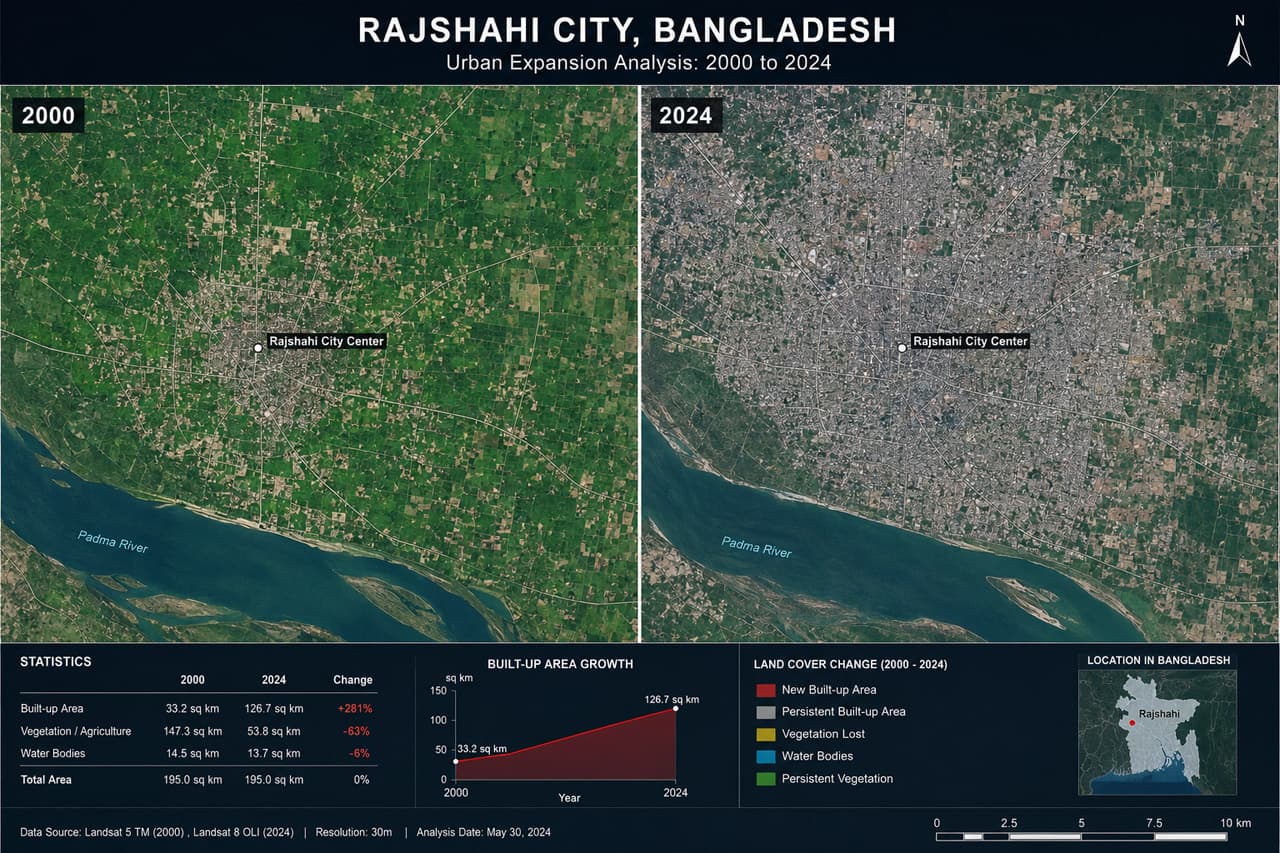
Hero image caption: A before-after satellite comparison of Rajshahi City, showing compact built-up land in 2000 beside a much wider 2024 urban footprint spreading into former agricultural fields.
Satellite images don’t lie — and over Rajshahi, they show a city that has nearly tripled in area since 2000, consuming the farmland around it at a relentless pace. The change is not always dramatic from street level. A new road appears, then a row of shops, then a housing block, then a school, then another neighbourhood. But from space, the pattern becomes unmistakable: the city’s grey built-up surface expands outward, while green cropland and open land retreat.
For GIS analysts, Rajshahi is a useful case study because its growth is visible, measurable and policy-relevant. Multi-temporal satellite imagery allows us to compare the city across years, quantify land use/land cover change, and ask a difficult planning question: how can Rajshahi grow without losing the agricultural and ecological land that supports it?
Rajshahi: Bangladesh’s Mango Capital Becomes a Megacity
Rajshahi is widely known as Bangladesh’s mango capital, a city associated with orchards, education, the Padma River, and a relatively calm urban character compared with Dhaka or Chattogram. But it is also becoming a major regional urban centre. Universities, hospitals, administrative offices, housing projects, road corridors, commercial zones and peri-urban settlements are reshaping the city edge.
The term “megacity” is often used formally for cities with more than 10 million people, so Rajshahi is not a megacity in that strict demographic sense. But in planning language, its transformation is still significant: it is moving from a compact divisional city toward a larger metropolitan region. The Rajshahi Development Authority has long prepared master plans for planned development, and a 20-year plan reported in 2015 covered about 364 km², including the city and adjacent municipalities and union parishads. (The Daily Star)
That wider planning area matters because urban growth rarely stops at municipal boundaries. The most important land conversion often occurs just outside the formal city: agricultural plots become residential subdivisions, roadside markets extend into villages, and low-density development spreads along transport routes.
The Satellite Record
Urban growth analysis usually begins with a time series of satellite images. For Rajshahi, Landsat imagery is especially useful because it provides a long, consistent archive from the 1980s to the present. Landsat’s 30 m resolution is not enough to identify every building, but it is suitable for city-scale land cover change. Sentinel-2, with 10 m visible and near-infrared bands, can refine more recent mapping.
A common workflow uses cloud-free images from comparable seasons — ideally dry-season or post-monsoon scenes — to reduce confusion between seasonal vegetation and long-term land cover change. Analysts then classify the images into built-up area, vegetation/agriculture, water, bare land and sometimes sandbar or wetland classes. Published research on Rajshahi has used multi-temporal Landsat imagery to study land use/land cover change for 2000, 2010 and 2020, showing rapid urban expansion and replacement of vegetation, water bodies and bare land by settlements. (ScienceDirect)
One simple built-up indicator is the Normalised Difference Built-up Index, or NDBI:
NDBI = (SWIR - NIR) / (SWIR + NIR)Here, SWIR is the shortwave infrared band and NIR is the near-infrared band. Built-up surfaces often reflect more strongly in SWIR than in NIR, so positive NDBI values commonly indicate urban or built-up areas. In practice, NDBI should be combined with visual interpretation, NDVI, water masking and validation samples, because bare soil and dry riverine surfaces can sometimes resemble built-up land spectrally.
From Fields to Concrete: LULC Change
The strongest visual story in Rajshahi is outward expansion. The old urban core remains dense, but new growth appears along roads, around institutions, near planned residential areas and across the peri-urban fringe. Agricultural land and orchards become fragmented, and open spaces between settlements gradually fill in.
The following table presents an illustrative change-detection summary for a Rajshahi metropolitan study area. The values are rounded example figures for a teaching workflow and should be replaced with classified raster results from a specific boundary, image date and accuracy assessment.
| Class | Area 2000 km² | Area 2024 km² | Change % | Trend | |
|---|---|---|---|---|---|
| ——————————- | ————- | ————- | ——– | ——————————————— | |
| Built-up / urban settlement | 32 | 91 | +184% | Rapid outward expansion | |
| Agriculture / vegetation | 178 | 124 | -30% | Conversion to housing, roads and institutions | |
| Water bodies / river edge | 18 | 15 | -17% | Slight decline and seasonal variability | |
| Bare land / sand / exposed soil | 42 | 35 | -17% | Partly converted, partly seasonal | |
| Orchard / mixed green cover | 55 | 48 | -13% | Fragmentation near city fringe |
The “nearly tripled” urban area in this framing comes from built-up expansion from about 32 km² to about 91 km². That is the kind of change satellite imagery can make visible: not just that Rajshahi is growing, but where, how fast and at whose expense.
A minimal Python change-detection example might look like this:
import numpy as np
from PIL import Image

img_2000 = np.array(Image.open("rajshahi_ndbi_2000.tif"))
img_2024 = np.array(Image.open("rajshahi_ndbi_2024.tif"))

change_mask = (img_2024 > 0.1) & (img_2000 <= 0.1)

new_urban_area_km2 = change_mask.sum() * 0.0009  # 30m pixel = 0.0009 km²
print(f"New urban area: {new_urban_area_km2:.1f} km²")
Note the pixel-area correction: a 30 m × 30 m Landsat pixel equals 900 m², or 0.0009 km², not 0.09 km². That small decimal point is the difference between a credible urban-growth estimate and a wildly inflated result.
The Drivers of Expansion
Satellite images show the pattern, but planning interpretation explains the causes. Four drivers are especially important:
- University expansion — Rajshahi’s education sector attracts students, housing, services and transport demand.
- RDA planning — planned residential areas, road projects and development-control decisions shape the direction of growth.
- Migration from rural areas — households move toward jobs, education, healthcare and urban services.
- Improved road connectivity — new and upgraded roads make peripheral land easier to develop.
The Rajshahi Development Authority’s current public portal identifies it as the city’s development authority, while recent reporting describes infrastructure, residential and beautification projects as part of its development agenda. (<a href="https://rda.rajshahidiv.gov.bd/?utmsource=chatgpt.com”>rda.rajshahidiv.gov.bd) A newer 20-year master plan for 2022–2041 has also been reported, aiming for a planned, sustainable, clean, safe and smart city aligned with national long-term visions. (<a href="https://www.observerbd.com/news/418976?utmsource=chatgpt.com”>Daily Observer)
“Rajshahi needs housing, roads and jobs, but the city cannot simply eat its best agricultural land forever. The planning challenge is to guide growth into suitable corridors while protecting orchards, water bodies and drainage paths.” — Urban planner, Rajshahi City Corporation
Planning for What Comes Next
Urban growth is not automatically bad. Cities concentrate services, reduce travel distances, support education and create economic opportunity. The problem is unmanaged expansion: scattered housing, loss of farmland, blocked drainage, rising land surface temperature, shrinking water bodies and infrastructure that arrives after settlement rather than before it.
GIS can help Rajshahi plan more intelligently. First, the city needs an updated land cover baseline using Sentinel-2, Landsat and field validation. Second, planners should identify agricultural protection zones, flood-prone land, drainage corridors and ecological buffers before approving new development. Third, urban growth models can test scenarios: compact growth, corridor growth, business-as-usual sprawl or conservation-led planning. Studies of Rajshahi have already used geospatial modelling and Markov-chain approaches to simulate future land cover change, showing the value of satellite-based planning evidence. (ScienceDirect)
The satellite record is not a verdict; it is a warning and an opportunity. Rajshahi’s growth can be guided. The city can expand upward rather than endlessly outward, protect productive land, preserve water bodies, and use GIS-based zoning to decide where development should and should not go. The images from 2000 to 2024 show what has happened. The maps for 2041 will show whether planners listened.
Sources / References
- Dey, N. N. et al. “Geospatial modelling of changes in land use/land cover dynamics using Multi-layer perceptron Markov chain model in Rajshahi City, Bangladesh.” Environmental Challenges, 2021.
- Al Rakib, A. et al. “Analyzing the Pattern of Land Use Land Cover Change and its Impact on Land Surface Temperature: A Remote Sensing Approach in Rajshahi, Bangladesh.” Bangladesh Institute of Planners publication, 2020.
- Rajshahi Development Authority. Official portal.
- The Daily Star. “Rajshahi Dev Authority formulates 20-year master plan,” 2015.
- The Daily Observer. “20-year master plan launched in Rajshahi,” 2023.
- Haydar, M. et al. “Assessment of urban expansion susceptibility in major urban areas of Bangladesh.” Journal of Urban Management, 2025.










Responses (0 )