


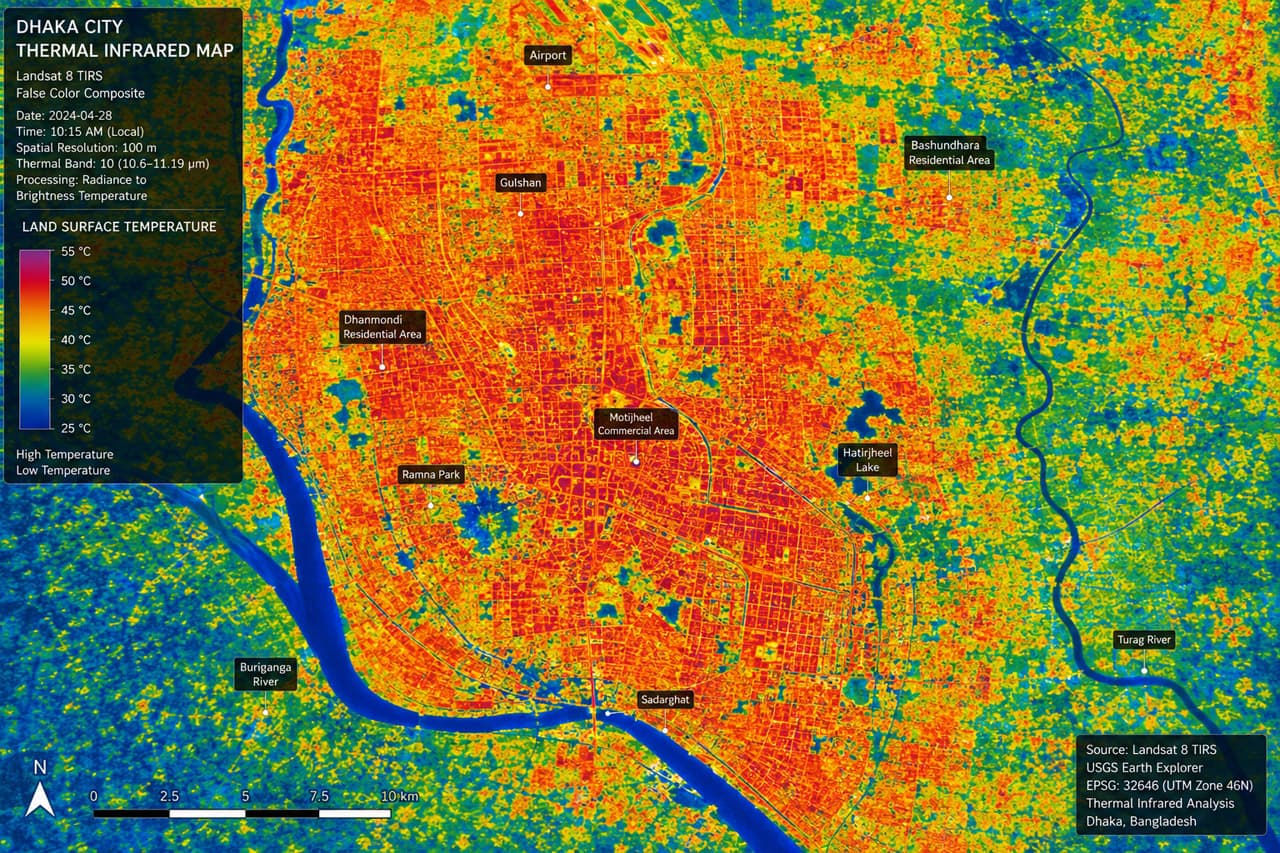
Hero image caption: Thermal infrared Dhaka map showing high land surface temperature over dense built-up corridors such as Motijheel, Tejgaon, Mirpur, and industrial zones, contrasted with cooler vegetation and water bodies around Ramna, lakes, wetlands, and river edges.
On a June afternoon in Motijheel, the surface temperature of the concrete road reaches 58°C. Three kilometres away in Ramna Park, it’s 28°C. Same city. Same hour.
That contrast is the urban heat island in its most visible form: not just a hot day, but a city that stores, reflects, traps, and re-radiates heat differently from the landscapes around it. In Dhaka, the difference is not abstract. It is felt in rickshaw seats too hot to touch, metal shutters radiating heat after sunset, footpaths without shade, overheated buses, and apartment blocks that remain warm long after evening prayer.
Satellite thermal remote sensing gives us a way to see this heat trap from above. With Landsat thermal bands, we can convert infrared radiation into Land Surface Temperature (LST), then compare hot built-up zones with cooler parks, lakes, wetlands, and tree-covered neighbourhoods. The result is a city-scale heat map — a physical fingerprint of urbanization.
What Is the Urban Heat Island?
An urban heat island occurs when built-up areas become warmer than surrounding rural or vegetated areas. The causes are familiar but powerful: concrete and asphalt absorb solar energy; narrow streets reduce ventilation; buildings trap longwave radiation; vehicles and air conditioners release waste heat; and vegetation is replaced by roofs, roads, parking lots, and paved courtyards.
There are different kinds of heat islands. Atmospheric UHI refers to warmer air temperatures in cities. Surface UHI refers to hotter land surfaces measured by thermal sensors. Landsat mainly captures the surface version: the temperature of rooftops, roads, bare soil, water, vegetation, and other materials at the time of satellite overpass.
This distinction matters. A 58°C road surface does not mean the air temperature is 58°C. But it does mean the surface is radiating heat into the street environment, increasing pedestrian discomfort, raising building cooling demand, and contributing to night-time heat retention.
Studies of Dhaka consistently show that urbanization and land-cover change are closely linked to rising LST. Research using Landsat imagery found that built-up expansion and loss of vegetation significantly increased surface temperature across the Dhaka metropolitan area, while another study reported summer mean LST rising from about 34.58°C to 37.66°C over the study period. (ScienceDirect)
Landsat Thermal Bands and Land Surface Temperature
Landsat is one of the most important satellite programs for urban climate analysis because it provides decades of consistent Earth observation data. NASA describes Landsat as the longest continuous space-based record of Earth’s land surface, with thermal infrared capability added to the program in 1982. (NASA Science)
For Dhaka, Landsat 8 and Landsat 9 are especially useful. Their Thermal Infrared Sensor records emitted thermal radiation, commonly using Band 10 for LST retrieval. USGS notes that Landsat surface temperature is an important geophysical parameter for energy balance, hydrologic modeling, crop and vegetation monitoring, extreme heat events, and urban heat island analysis. (USGS)
A common single-channel LST retrieval formula is:
LST = TB / (1 + (λ·TB/ρ) · ln(ε))
where TB is brightness temperature in Kelvin, λ is wavelength in micrometres or metres depending on unit consistency, ρ = h·c/σ is approximately 1.438×10⁻² m·K, and ε is surface emissivity.
In plain language, the satellite first measures thermal radiation and converts it into brightness temperature — the temperature a perfect blackbody would have. But real surfaces are not perfect emitters. Concrete, water, vegetation, tin roofs, and bare soil emit thermal energy differently. The emissivity correction adjusts the brightness temperature so the result better represents the actual land surface temperature.
import rasterio
import numpy as np

with rasterio.open("LC08_B10_Dhaka.tif") as src:
    b10 = src.read(1).astype(float)

# Convert DN to brightness temperature (Kelvin)
ML, AL = 3.3420e-4, 0.1  # multiplicative, additive rescaling factors
K1, K2 = 774.89, 1321.08  # calibration constants for Band 10
radiance = ML * b10 + AL
TB = K2 / np.log(K1 / radiance + 1)

# Apply emissivity correction (ε ≈ 0.97 for urban)
epsilon = 0.97
rho = 1.438e-2
wavelength = 10.895e-6
LST = TB / (1 + (wavelength * TB / rho) * np.log(epsilon)) - 273.15
print(f"Mean Dhaka LST: {LST.mean():.1f}°C")
The workflow is simple in concept but sensitive in practice. Cloud masking, metadata constants, emissivity estimation, atmospheric effects, mixed pixels, and acquisition time all affect the result. In Dhaka, monsoon cloud cover makes clear-sky thermal scenes limited, so careful scene selection is essential.
Dhaka’s Hot Zones
Dhaka’s hot zones are not randomly distributed. They follow land cover and urban morphology. Dense commercial areas, industrial estates, transport corridors, bare construction sites, and high-impervious-surface neighbourhoods usually show higher LST. Cooler zones appear around parks, lakes, wetlands, river edges, and tree-covered institutional areas.
| Land cover | Mean LST °C | Area km² | Notes | |
|---|---|---|---|---|
| ——————————– | ———– | ——– | ————————————————————————————– | |
| Dense built-up / commercial core | 42–48 | 85 | Motijheel, Gulshan-Badda corridors, old commercial blocks; high concrete and low shade | |
| Industrial / paved zones | 45–52 | 45 | Tejgaon, Tongi-Narayanganj industrial belts; metal roofs and asphalt yards | |
| Bare soil / construction land | 43–50 | 38 | Exposed earth and construction sites heat rapidly under direct sun | |
| Mixed residential | 38–44 | 160 | Variable depending on tree cover, road width, roof type, and building density | |
| Vegetation / parks | 28–34 | 32 | Ramna, Suhrawardy Udyan, institutional green spaces; evapotranspiration cooling | |
| Water bodies / wetlands | 27–33 | 40 | Lakes, rivers, retention areas; generally cooler during daytime scenes |
These values are illustrative ranges for a clear-sky hot-season Landsat scene, not a fixed official inventory. The pattern, however, matches the wider research finding: built-up and bare surfaces are hotter, while vegetation and water reduce surface temperature. Studies of Dhaka have shown that built-up area expansion replaced lowland, vegetation, bare soil, and water bodies between 1993 and 2020, intensifying surface thermal stress. (Springer Nature Link)
The Vegetation Cooler
Vegetation cools the city through shade and evapotranspiration. A tree canopy blocks direct solar radiation from heating pavement. At the same time, leaves release water vapour, using heat energy in the process. This is why Ramna Park, Suhrawardy Udyan, the National Parliament area, university campuses, lakeside edges, and surviving wetlands often appear as cooler islands in thermal imagery.
The relationship is measurable through NDVI, the Normalized Difference Vegetation Index. Higher NDVI generally corresponds to lower LST, while higher built-up indices often correspond to higher LST. A Dhaka study on vegetation cover loss found that urban expansion replaced green cover and significantly increased LST, converting many areas from moderate to higher temperature zones. (ScienceDirect)
“In June, the heat does not end when the sun goes down. The walls stay warm, the road stays warm, and even the fan feels like it is moving hot air.” — Dhaka resident, Mirpur
What Urban Planners Should Do
Thermal maps should not remain academic figures. They should guide zoning, road design, building rules, park investment, and climate adaptation. Four practical interventions can reduce Dhaka’s urban heat island intensity:
- Green roofs
- Street trees
- Permeable pavements
- Cool roofs
The planning priority should be spatial targeting. Planting trees where thermal imagery already shows strong cooling corridors can protect and extend existing cool zones. Cool-roof programs should prioritize dense low-income neighbourhoods and industrial roofs. Permeable pavements and shaded footpaths should be integrated into road redesign. Wetlands and retention ponds should be treated not only as drainage assets but also as thermal infrastructure.
Dhaka’s heat problem is not only a climate problem; it is a land-cover problem. Every filled wetland, every treeless road, every dark roof, and every paved open space adds to the city’s thermal load. Landsat does not solve the heat island, but it makes the invisible visible. It shows where the city is burning hottest — and where planners still have room to cool it down.
Sources / References
- NASA — Landsat mission overview and long-term Earth observation record.
- USGS — Landsat Collection 2 Surface Temperature product description.
- Kafy et al. — “Assessing and predicting land use/land cover, land surface temperature and urban thermal field variance index using Landsat imagery for Dhaka Metropolitan area,” 2021.
- Sresto et al. — “A GIS and remote sensing approach for measuring urban heat island intensity in Dhaka,” 2022.
- Imran et al. — “Impact of Land Cover Changes on Land Surface Temperature and Human Thermal Comfort in Dhaka City,” 2021.
- Kafy et al. — “Monitoring the effects of vegetation cover losses on land surface temperature dynamics using geospatial approach in Dhaka,” 2021.












Responses (0 )