


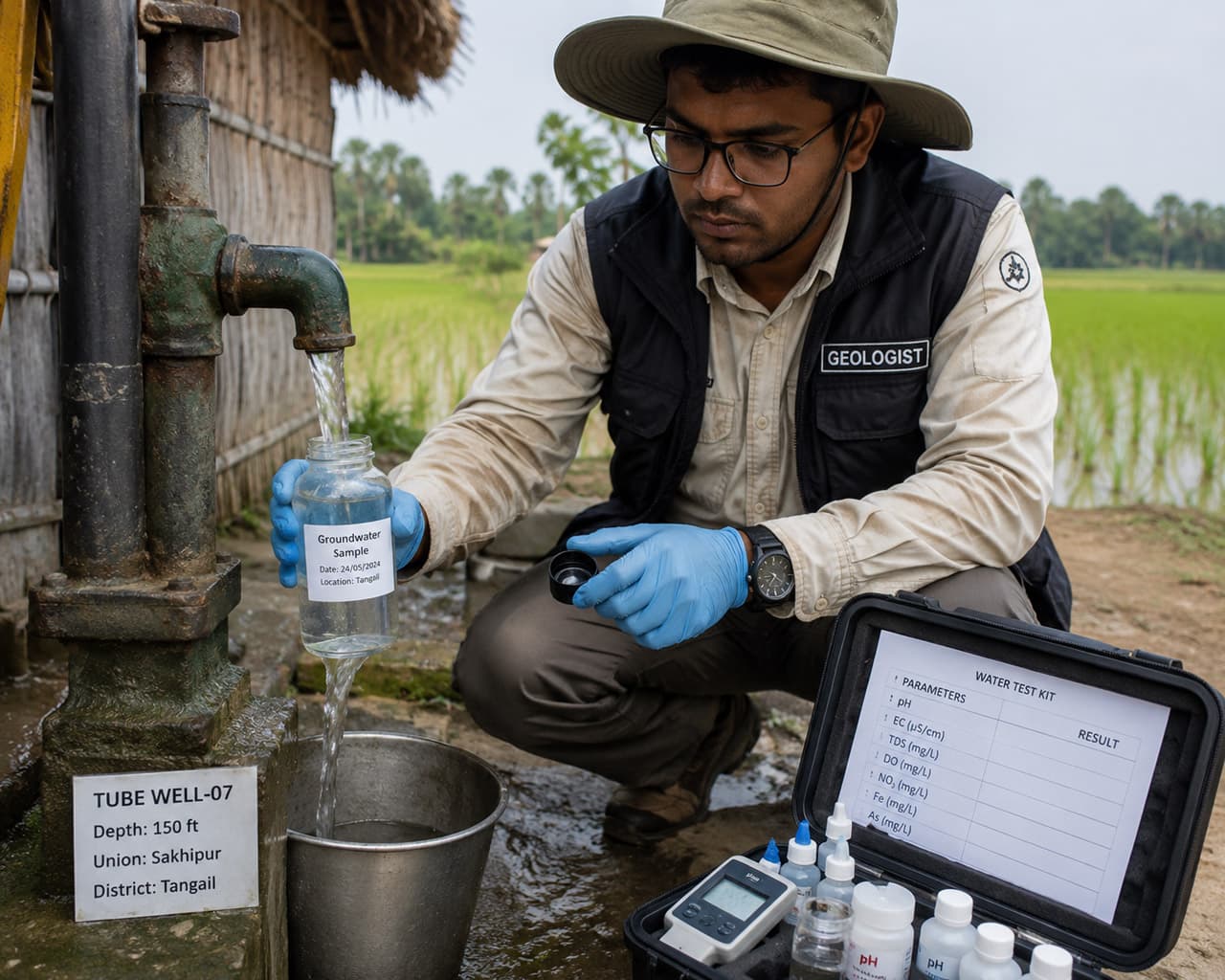
At dawn in a village on the Bengal delta, a mother steps into the courtyard with a metal pitcher. Her youngest child is still half-asleep; her husband is preparing for the fields. The family’s hand-pumped tube well stands beside the house, painted green years ago after a quick test. A few strokes of the handle bring up clear, cool water. It looks clean. It has no smell. It tastes normal.
That is the cruelty of Bangladesh’s arsenic crisis: the danger is invisible.
For decades, tube wells were promoted as a public-health victory. They protected families from ponds and rivers contaminated with bacteria, reducing diarrhoeal disease and child mortality. But beneath many villages, the shallow aquifers of the Bengal Basin held a slower poison. Arsenic, naturally present in sediments, entered groundwater and moved silently into kitchens, tea cups, rice pots, and children’s bodies. What began as a solution to one water crisis became one of the largest environmental health tragedies in modern history.
Photo caption: A field geologist tests water beside a village tube well in Bangladesh, where clear groundwater can still contain dangerous levels of dissolved arsenic.
How Arsenic Gets In
Arsenic in Bangladesh’s groundwater is mostly geogenic — it comes from the Earth itself, not from factories or mining. Rivers flowing from the Himalaya have carried enormous loads of sediment into the Bengal Basin for thousands of years. Some of those sediments contain iron oxyhydroxides: rusty coatings on sand and silt grains that can bind arsenic.
The problem begins under reducing, oxygen-poor conditions. In shallow aquifers rich in organic matter, microbes consume available oxygen and then begin using iron minerals in their metabolism. As iron oxyhydroxides dissolve, arsenic that was once attached to those mineral surfaces is released into groundwater. This process is often called reductive dissolution.
“Think of iron coatings on sand grains as tiny rusty sponges holding arsenic. When groundwater becomes oxygen-starved, microbes help dissolve those sponges — and the arsenic slips into the water.”
Arsenic also changes chemical form depending on groundwater conditions. In oxygenated water, arsenate species are more common; under reducing conditions, arsenite can dominate and is generally more mobile and harder to remove. A simplified arsenate speciation sequence can be written as inline chemistry: H₃AsO₄ → H₂AsO₄⁻ → HAsO₄²⁻ → AsO₄³⁻ depending on pH. In real aquifers, pH, redox state, iron, manganese, phosphate, bicarbonate, organic carbon, and sediment age all influence how much arsenic is released and how far it travels.
This is why two wells only a short walk apart can produce very different results. One may be safe; another may exceed the national standard. The underground landscape is patchy, layered, and chemically alive.
The Bengal Basin Trap
Bangladesh sits on one of the world’s great alluvial plains, built by the Ganges, Brahmaputra, and Meghna river systems. These rivers have created a vast, low-lying delta of sand, silt, clay, peat, and floodplain deposits. To a farmer, this geology means fertile soil. To a hydrogeologist, it means a complex aquifer system with sharp changes in sediment age, grain size, permeability, and chemistry.
The highest arsenic risks are often associated with young Holocene alluvial sediments, especially shallow aquifers. These sediments can contain reactive organic matter and iron minerals that support reducing conditions. Older Pleistocene aquifers, often deeper and more oxidized, may have lower arsenic concentrations, though depth alone is not a guarantee of safety. Proper testing and monitoring remain essential.
The “trap” is both geological and social. Shallow tube wells are cheap, convenient, and close to home. They transformed rural water access. But because arsenic cannot be detected by sight, taste, or smell, families may drink contaminated water for years before symptoms appear. Skin lesions, pigmentation changes, cancers, cardiovascular disease, diabetes, and developmental impacts have all been associated with long-term arsenic exposure.
The Bengal Basin therefore teaches a hard lesson: safe-looking water is not always safe water.
Scale of the Crisis
The scale of arsenic exposure in Bangladesh has been described by the World Health Organization as among the largest mass poisonings in history. Estimates vary by survey, threshold, and year, but the human burden remains immense. A national screening campaign in the early 2000s tested millions of wells and marked many pumps red or green, depending on whether they exceeded the Bangladesh standard. Later studies and reviews have continued to show that millions remain exposed, especially in rural areas where households rely on private wells.
The difference between international and national standards is important:
| Standard / guideline | Arsenic limit in drinking water | Equivalent | |
|---|---|---|---|
| —————————- | ——————————- | ———- | |
| WHO guideline value | 0.01 mg/L | 10 µg/L | |
| Bangladesh national standard | 0.05 mg/L | 50 µg/L |
The Bangladesh standard is less strict partly because of historical limitations in testing, treatment feasibility, and implementation capacity. But from a health perspective, lower exposure is better. Water between 10 and 50 µg/L may meet the national standard but still exceed the WHO guideline.
The crisis also has an inequality dimension. Wealthier households may be able to install deeper wells, buy filters, or access piped supply. Poorer families may depend on the nearest pump, even if they know it is unsafe. Women and children often bear the daily burden of collecting alternative water. In some villages, the safest source may be farther away, socially restricted, seasonally unreliable, or poorly maintained.
What Can Be Done
There is no single solution for all of Bangladesh. The geology varies, the settlement patterns vary, and the social realities vary. Effective mitigation must combine science, infrastructure, maintenance, and community trust.
- Deep tube wells
Properly installed and tested deep wells can access older aquifers with lower arsenic in many areas. However, they must be carefully sited and sealed to avoid cross-contamination from shallow layers.
- Filtration
Household or community filters can remove arsenic, but only if they are correctly designed, regularly maintained, and monitored. A neglected filter can create a false sense of safety.
- Piped supply
Treated piped water is often the most reliable long-term solution, especially for dense settlements. It requires investment, governance, water-quality testing, and protection from microbial contamination.
- Arsenic-removal units
Community-scale arsenic-removal plants can serve clusters of households. Their success depends on local management, sludge disposal, spare parts, and routine testing.
- Rainwater harvesting
In suitable areas, especially where groundwater is unsafe or saline, rainwater can provide a seasonal safe source. Storage design is critical to prevent bacterial contamination.
Progress is possible. Bangladesh has already shown that testing, public awareness, well switching, and targeted infrastructure can reduce exposure. Many families have moved from unsafe wells to safer sources. Researchers have mapped high-risk zones, improved understanding of aquifer chemistry, and developed better mitigation strategies.
But the work is unfinished. Wells change, populations grow, and infrastructure ages. Arsenic mitigation is not a one-time project; it is a long-term public-health commitment. The hopeful path is realistic rather than dramatic: test every source, share results clearly, invest in safe supply, maintain systems, and treat groundwater as both a geological resource and a human lifeline. In Bangladesh’s alluvial plains, the story of arsenic is a reminder that the ground beneath our feet is never separate from the lives lived above it.
Sources / References
- World Health Organization. “Arsenic.” WHO Fact Sheet, 2022. (World Health Organization)
- WHO Guidelines for Drinking-water Quality: arsenic guideline value of 0.01 mg/L, or 10 µg/L. (NCBI)
- Smith, A. H., Lingas, E. O., & Rahman, M. “Contamination of drinking-water by arsenic in Bangladesh.” Bulletin of the World Health Organization, 2000. (World Health Organization)
- Nickson, R. T. et al. “Mechanism of arsenic release to groundwater, Bangladesh and West Bengal.” Applied Geochemistry, 2000. (ScienceDirect)
- Zheng, Y. et al. “Redox control of arsenic mobilization in Bangladesh groundwater.” Applied Geochemistry, 2004. (ScienceDirect)
- British Geological Survey / DPHE. Arsenic contamination of groundwater in Bangladesh. (British Geological Survey)
- Human Rights Watch. “Bangladesh: 20 Million Drink Arsenic-Laced Water,” 2016. (hrw.org)













Responses (0 )