

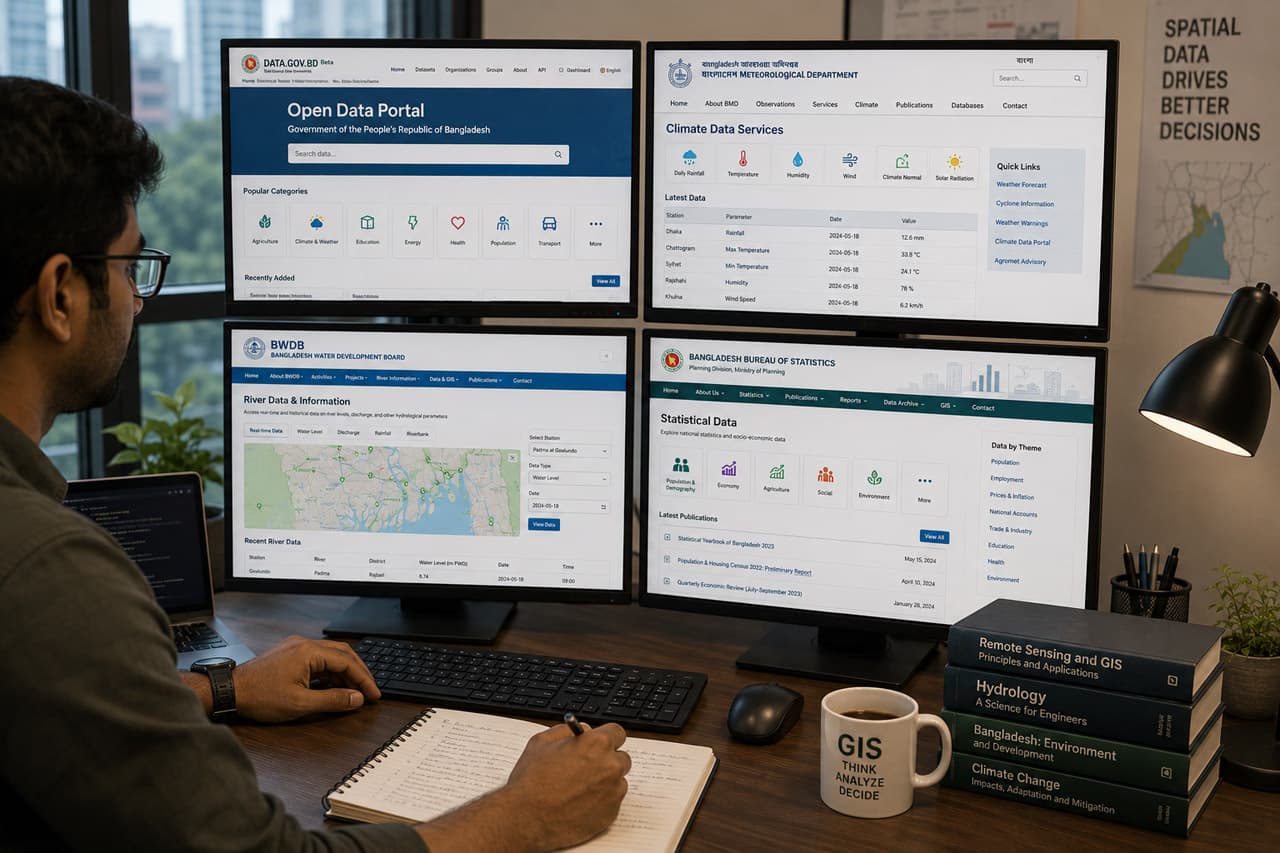

Hero image caption: A researcher comparing Bangladesh open data portals, satellite imagery catalogues, hydrological dashboards, and GIS boundary layers across multiple browser tabs.
The data you need for Bangladesh research probably exists somewhere — the problem is knowing where to find it, and whether to trust it.
For Bangladesh-focused GIS, remote sensing, climate, hydrology, urban planning, public health, agriculture, disaster risk, and development research, data discovery is often the hardest part of the project. A student may spend three weeks looking for a district boundary, rainfall table, road network, or census dataset before even starting the analysis. The good news is that Bangladesh now has a growing ecosystem of government portals, international repositories, satellite data catalogues, and open-source geospatial datasets. The challenge is knowing which source is suitable for which purpose.
This guide is designed as a practical bookmark: start here when you need Bangladesh geospatial data, then verify metadata, licensing, date, and scale before using it in serious research.
Government Open Data Portals
For official statistics, the first place to check is the Bangladesh government’s open data ecosystem. The national open data portal, <a href="https://data.gov.bd/?utmsource=chatgpt.com”>Bangladesh Open Data, hosts datasets across sectors such as population, economy, environment, agriculture, education, and local government. It is useful for quick statistical tables, but researchers should always check the publisher, update date, and whether the dataset includes machine-readable fields. The portal lists datasets such as literacy rate, GDP growth, population by gender, and national e-service data. (<a href="https://data.gov.bd/?utmsource=chatgpt.com”>data.gov.bd)
For national statistics, <a href="https://nsds.bbs.gov.bd/?utmsource=chatgpt.com”>Bangladesh Bureau of Statistics is the authoritative institution. BBS is the national statistical office responsible for collecting and publishing population, agriculture, industry, economy, demography, and socio-economic data. For census-based research, poverty mapping, household surveys, labour force data, and district-level indicators, BBS should be treated as a primary source. (<a href="https://nsds.bbs.gov.bd/?utmsource=chatgpt.com”>NSDS)
For geospatial layers, Bangladesh’s national GIS initiatives are important. The older <a href="https://www.gis.gov.bd/en/?utmsource=chatgpt.com”>Bangladesh GIS Portal was designed to coordinate GIS activities among government offices, reduce duplication, and share GIS initiatives of national interest. Its metadata listings include administrative boundaries and other spatial datasets from agencies such as BBS, RAJUK, DNCC, and land-related organizations. (<a href="https://www.gis.gov.bd/en/?utmsource=chatgpt.com”>gis.gov.bd) The newer <a href="https://new.nsdi.gov.bd/?utmsource=chatgpt.com”>NSDI Geoportal presents itself as a national spatial data infrastructure for managing, sharing, and utilizing geospatial data, with dataset categories such as agriculture, boundary, climate, economy, population, soil, tourism, and transport. (<a href="https://new.nsdi.gov.bd/?utmsource=chatgpt.com”>NSDI)
Five Bangladesh-specific data sources worth checking early:
- BNSIS / NSDI / Bangladesh GIS Portal — national geospatial metadata, boundaries, thematic GIS layers.
- BWDB — river, water level, discharge, flood forecasting, and hydrological data.
- BMD — weather, climate normals, rainfall, temperature, and meteorological observations.
- BBS — census, population, socio-economic, agriculture, and official statistics.
- LGED GIS Portal — roads, rural infrastructure, district/upazila maps, and local government engineering data.
International Repositories
International repositories are often easier to download from, better documented, and more consistent across time. For administrative boundaries, the Humanitarian Data Exchange is commonly used in humanitarian and development work. It hosts Bangladesh administrative boundary datasets and census-related datasets, including BBS-derived census data. For crisis mapping, disaster risk, and NGO reporting, HDX is often the fastest way to obtain ready-to-use Bangladesh layers. <a href="https://data.humdata.org/?utmsource=chatgpt.com”>Humanitarian Data Exchange lists Bangladesh datasets including population and housing census data from BBS. (<a href="https://data.humdata.org/dataset/populationa-and-housing-census-dataset?utmsource=chatgpt.com”>Humanitarian Data Exchange)
For roads, buildings, points of interest, and community-mapped features, OpenStreetMap is essential. It is especially useful for urban studies, accessibility analysis, disaster response, routing, and service coverage mapping. However, OSM quality varies by location. Dhaka, Chattogram, Cox’s Bazar, and project-mapped areas may be rich; remote chars or rural roads may need validation.
For global environmental data, researchers often combine Bangladesh boundaries with international gridded datasets: elevation, rainfall, land cover, water occurrence, night-time lights, population grids, and climate reanalysis. These sources are especially useful when national data is unavailable, restricted, or inconsistent.
Remote Sensing Sources
Remote sensing is one of the strongest data pathways for Bangladesh research because the country changes quickly. Landsat Collection 2 provides decades of optical imagery, making it ideal for riverbank erosion, land cover change, urban expansion, and coastal change. Sentinel-2 provides higher-resolution optical imagery for vegetation, agriculture, waterbodies, and land cover mapping. Sentinel-1 SAR is valuable for flood mapping because it can observe through cloud cover.
For beginners, Google Earth Engine is often the easiest access point because it provides cloud-based processing without downloading hundreds of scenes. For more controlled workflows, researchers can use USGS EarthExplorer, Copernicus Data Space, NASA Earthdata, or cloud-hosted catalogues.
Five international open datasets widely used for Bangladesh:
- SRTM / Copernicus DEM — elevation, slope, drainage, flood exposure, terrain correction.
- Landsat Collection 2 — long-term land cover, erosion, urban growth, vegetation change.
- OpenStreetMap — roads, buildings, POIs, community-mapped infrastructure.
- Global Surface Water Explorer — water occurrence, seasonality, permanent and seasonal water change.
- CHIRPS rainfall — rainfall time series, drought, monsoon variability, climate-risk studies.
Hydrological and Climate Data
Hydrology and climate data are critical for Bangladesh, but access conditions vary. The Bangladesh Water Development Board maintains hydrological systems including water level, discharge, groundwater, flood forecasting, and river information. BWDB’s Hydroinformatics and Flood Forecasting Circle provides water level and discharge data services, while its portal shows recent water level data and hydrological information. (<a href="https://www.hydrology.bwdb.gov.bd/index.php?pagetitle=discharge&utmsource=chatgpt.com”>Hydrology BWDB) BWDB also publishes data rate information for some hydrological datasets, meaning not all data is fully open or free. (<a href="https://www.hydrology.bwdb.gov.bd/index.php?id=225&pagetitle=rateofdata&subid=131&utmsource=chatgpt.com”>Hydrology BWDB)
For weather and climate, <a href="https://www.bmd.gov.bd/?utmsource=chatgpt.com”>Bangladesh Meteorological Department is the official source. BMD’s climate data portal states that its climate division stores and supplies meteorological data for related purposes, with some data provided in exchange for government-fixed fees. (<a href="https://dataportal.bmd.gov.bd/?utmsource=chatgpt.com”>BMD Climate Data Portal) For open gridded rainfall, CHIRPS is widely used because it provides long-term rainfall estimates from 1981 onward at roughly 0.05-degree resolution. It is not a replacement for station observations, but it is extremely useful for regional rainfall anomaly, drought, and monsoon studies.
How to Cite Open Data
Open data is not “citation-free” data. In a thesis, journal paper, consultancy report, or policy brief, cite datasets as carefully as you cite articles. A good data citation should include the provider, dataset title, version or collection, year or temporal coverage, DOI or stable URL, access date, and license or usage condition where available.
For example, instead of writing “Source: Internet,” write: “Bangladesh Bureau of Statistics, Population and Housing Census 2022 dataset, accessed 22 May 2026, via HDX/BBS.” For satellite data, include collection names such as “Landsat Collection 2 Level-2” or “Sentinel-2 Surface Reflectance Harmonized,” not just “satellite image.”
| Source name | Organisation | Data types | Resolution/scale | Access | |
|---|---|---|---|---|---|
| ——————————– | ————————————— | ———————————————————— | ———————————————————- | ———————————————— | |
| Bangladesh Open Data | Government of Bangladesh | Statistical datasets, sector data | National to local, varies | Free | |
| BBS / NSDS | Bangladesh Bureau of Statistics | Census, population, socio-economic indicators | National, division, district, upazila depending on product | Free/official publications; some data by request | |
| NSDI Geoportal | Government of Bangladesh | Boundary, climate, population, soil, transport, thematic GIS | Varies by dataset | Free/registration may vary | |
| Bangladesh GIS Portal | Government GIS initiative | GIS metadata, administrative boundaries, thematic layers | Varies by agency | Free/metadata; access varies | |
| BWDB Hydrology Portal | Bangladesh Water Development Board | Water level, discharge, groundwater, flood data | Station-based | Free preview; some paid/request-based | |
| BMD Climate Data Portal | Bangladesh Meteorological Department | Rainfall, temperature, climate normals, weather data | Station-based | Free/paid/request-based | |
| LGED GIS Portal | Local Government Engineering Department | Roads, rural infrastructure, maps | District/upazila/road network | Free portal; access varies | |
| HDX Bangladesh | OCHA / data contributors | Boundaries, census, humanitarian datasets | National to local | Free | |
| OpenStreetMap | OSM Foundation/community | Roads, buildings, POIs, land features | Feature-level, variable completeness | Free/open license | |
| Google Earth Engine Data Catalog | Google / data providers | Satellite, climate, DEM, land cover | Global gridded datasets | Free for eligible use/registration | |
| USGS EarthExplorer | USGS | Landsat, DEM, remote sensing archives | 30 m and other resolutions | Free/registration | |
| Copernicus Data Space | European Union / ESA | Sentinel imagery | 10–60 m Sentinel-2; SAR Sentinel-1 | Free/registration |
“I lost almost two weeks searching random blogs for district data. Once I found the right portal and understood the metadata, the actual analysis took only two days.” — A Bangladesh thesis student working on flood exposure mapping
The final advice is simple: never use a dataset only because it is easy to download. Check who produced it, when it was updated, what scale it supports, whether the boundary version matches your statistics, and whether the license allows your intended use. Good research starts with good data judgement.











Responses (0 )