

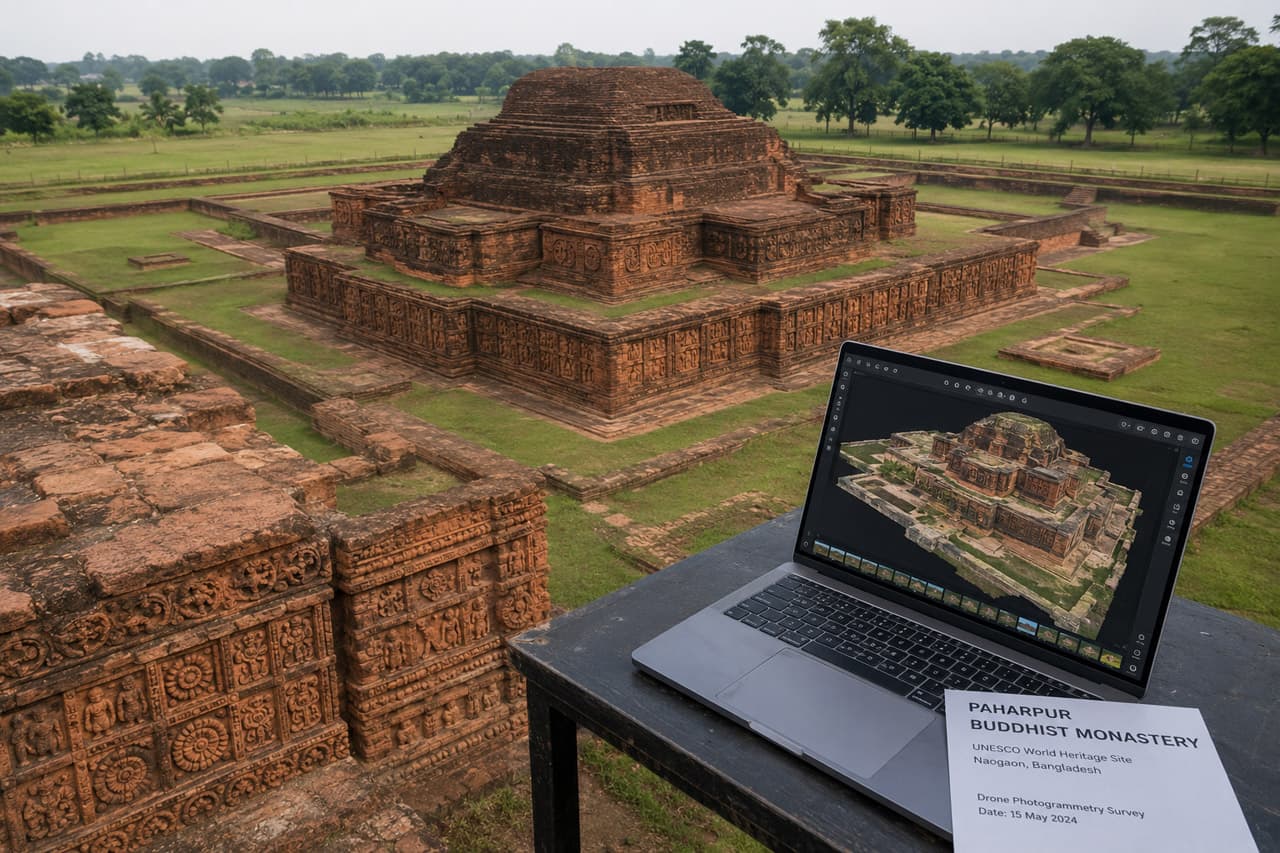
Hero image caption: Drone orthophoto of Paharpur Monastery, showing the cruciform central shrine, quadrangular monastic enclosure, terracotta wall lines, pathways, drainage patterns, and surrounding archaeological landscape from directly above.
Paharpur has stood for 1,200 years. We had three days and 140 drone photos to capture every terracotta brick before the next monsoon erodes another millimetre.
That is the strange urgency of digital heritage work. A monument may survive for centuries, yet a single rainy season can loosen brickwork, stain terracotta plaques, soften exposed foundations, and alter the surface geometry that archaeologists depend on. At Paharpur — officially the Ruins of the Buddhist Vihara at Paharpur, also known as Somapura Mahavihara — the challenge is not only to preserve a great monument physically. It is also to preserve its measurable form: its walls, courtyards, cells, plinths, slopes, cracks, drainage traces, and subtle surface changes.
Drone photogrammetry offers a way to do that with wonder and precision. It turns overlapping photographs into maps, point clouds, digital elevation models, and textured 3D reconstructions. For a site like Paharpur, where ancient brick architecture spreads across a broad open complex, the drone becomes both camera and measuring instrument.
Why Paharpur Needs Digital Documentation
Paharpur is one of Bangladesh’s most important archaeological sites and a UNESCO World Heritage property. UNESCO describes it as the most spectacular monument in Bangladesh and the second-largest single Buddhist monastery south of the Himalayas. The site was a major centre of Buddhist learning and religious life, linked historically with other famous centres such as Bodhgaya and Nalanda. (UNESCO World Heritage Centre)
The monastery’s scale is part of its significance. The complex is laid out as a large quadrangle with a monumental central shrine in the courtyard and rows of monastic cells along the enclosure walls. UNESCO archival material notes that Somapura Mahavihara was built under the Pala ruler Dharmapala and includes a cross-shaped central temple plan with 177 monastic cells around the four sides. (UNESCO)
But scale also creates a conservation problem. Ground survey teams can measure individual walls, cells, and features, but maintaining a complete, repeatable record of the whole site is difficult. Seasonal rainfall, vegetation growth, visitor movement, drainage issues, and brick decay can gradually change the surface. A high-resolution digital baseline allows conservation teams to compare the site year after year and ask: what moved, what cracked, what eroded, and what needs intervention?
Photogrammetry: Building 3D from 2D
Photogrammetry is the science of measuring objects from photographs. In drone heritage documentation, the key method is Structure from Motion, or SfM. The principle is simple to describe but powerful in execution: if the same brick corner, wall edge, terracotta detail, or ground feature appears in multiple overlapping photographs, software can match those features and calculate where the camera was when each image was taken.
The process begins with feature matching. The software detects distinctive points in each photo and finds the same points in neighbouring photos. Then comes bundle adjustment, a mathematical optimisation that simultaneously refines camera positions, camera orientation, and 3D point locations. Once the sparse geometry is solved, multi-view stereo densifies the reconstruction, producing millions of points that represent the visible surface.
This is why overlap matters. A single photograph is only an image. A network of overlapping photographs becomes geometry.
For heritage sites, UAV photogrammetry is now widely used because it can document complex structures quickly and at high resolution. Recent cultural heritage research describes UAV-based photogrammetry as a cost-efficient method for 3D geometric documentation, while broader studies show that drone imagery can generate dense 3D models, orthophotos, and digital surface products for conservation and monitoring. (SPIE Digital Library)
The Survey
The Paharpur survey was designed around two goals: capture the entire visible archaeological footprint and preserve enough image detail for measurement of small architectural features. Flights were planned during consistent daylight, avoiding harsh shadows where possible. The camera was pointed mostly downward for orthophoto and DEM generation, with selected oblique passes around the central shrine to improve wall-face reconstruction.
| Parameter | Value | |
|---|---|---|
| —————————– | ———————————————— | |
| Drone model | DJI Mavic 3 Enterprise / equivalent mapping UAV | |
| Flight altitude | 60–80 m above ground level | |
| Ground Sampling Distance, GSD | ~1.8–2.5 cm/pixel | |
| Image count | 140 nadir and oblique photos | |
| GCP count | 8 ground control points | |
| Software | OpenDroneMap / Agisoft Metashape / QGIS / Open3D |
Ground control points were placed around the enclosure and near key architectural zones. Their purpose was not decoration; they anchored the model to real-world coordinates. Without GCPs, a photogrammetric model may look beautiful but drift in scale or position. With control points, the orthophoto and 3D model become measurable heritage records.
The field team also had to respect the site. Drone flights over heritage monuments should be coordinated with the Department of Archaeology, site managers, and local authorities. Flight height, visitor safety, no-fly zones, and vibration-free operations matter. Digital preservation should never create physical risk for the monument it aims to protect.
Outputs: Orthophoto, DEM, and 3D Model
The first output was an orthophoto: a geometrically corrected aerial image where distances can be measured like a map. For Paharpur, this is useful for mapping wall alignments, cell layouts, pathways, vegetation encroachment, drainage traces, and visitor circulation.
The second output was a Digital Elevation Model. Even subtle height differences matter at archaeological sites. A few centimetres of relief can indicate buried walls, collapsed brick mounds, erosion channels, or surface deformation. The DEM can help conservation teams understand how rainwater moves across the site — a critical issue before and during monsoon.
The third output was a 3D model, usually generated as a dense point cloud, mesh, and textured surface. The point cloud can be inspected, cleaned, segmented, and measured using tools such as Open3D:
import open3d as o3d

pcd = o3d.io.read_point_cloud("paharpur_dense_cloud.ply")
print(f"Points: {len(pcd.points):,}")

# Remove outliers
pcd_clean, _ = pcd.remove_statistical_outlier(nb_neighbors=20, std_ratio=2.0)

# Visualise
o3d.visualization.draw_geometries([pcd_clean],
    window_name="Paharpur 3D Model",
    point_show_normal=False)
This kind of workflow allows researchers to remove noisy points, inspect geometry, and prepare the model for measurement, visualisation, or archiving. For a monument like Paharpur, the 3D model is not only a visual product. It is a spatial database of the site’s present condition.
Heritage Value of the Digital Twin
A digital twin of Paharpur has value far beyond a beautiful 3D rendering. It can support:
- Condition monitoring
- Virtual visitor access
- Restoration planning
- Academic measurement
For condition monitoring, repeated drone surveys can detect surface change: erosion along a wall base, settlement near a pathway, vegetation expansion, or loss of brick material. For virtual access, the model can bring Paharpur to students, researchers, and visitors who may never travel to Naogaon. For restoration planning, architects and conservators can measure slopes, wall heights, missing sections, and drainage patterns before proposing interventions. For academic research, the model supports precise spatial analysis of monastic layout, construction phases, and architectural relationships.
“The 3D model showed us shallow depressions and wall-line irregularities that were easy to walk past on the ground. After twenty years of survey notes, seeing the whole monastery as measurable terrain changed the questions we could ask.” — Archaeologist, Jahangirnagar University
The most important point is that digital documentation does not replace conservation. A model cannot stop rain, repair terracotta, or manage visitors. But it can make conservation smarter. It gives future researchers a timestamped record: this is what Paharpur looked like at this resolution, in this season, before the next monsoon.
Paharpur’s bricks carry the memory of a Buddhist world that once connected Bengal with South Asia and beyond. Drone photogrammetry gives that memory a new form — not stone, not brick, but coordinates, pixels, points, and meshes. Ancient archaeology meets modern computation, and the result is both scientific and deeply human: a way of saying that what has survived for 1,200 years deserves to be measured carefully enough to survive the next hundred.
Sources / References
- UNESCO World Heritage Centre — Ruins of the Buddhist Vihara at Paharpur. (UNESCO World Heritage Centre)
- UNESCO Archives — Paharpur and Bagerhat | World Heritage, noting the Pala-period foundation, quadrangular plan, central cross-shaped temple, and 177 cells. (UNESCO)
- Encyclopaedia Britannica — Somapura Mahavira, describing the 8th-century monastery and its 11-hectare scale. (Encyclopedia Britannica)
- Ioannidis, C. 2025 — UAV photogrammetry for the protection of cultural heritage: methodologies. (SPIE Digital Library)
- Febro, J. D. 2020 — 3D Documentation of Cultural Heritage Sites Using Drone Survey and Photogrammetry Technique. (tuengr.com)










Responses (0 )