



What can deep-sea sediment tell us about mountains 2,000 km away? More than we might expect. Far below the waves of the Bay of Bengal, layers of mud, silt, and sand lie stacked like pages in a waterlogged archive. Each layer began somewhere else: a Himalayan cliff face shattered by frost, a monsoon-swollen riverbank collapsing into brown water, a grain of mica swept from Nepal or Bhutan into the Ganges-Brahmaputra system. By the time these particles reach the deep ocean, they have travelled through valleys, floodplains, deltas, submarine canyons, and finally into the immense Bengal Fan.
To a casual observer, a sediment core is just mud. To a geochemist, it is evidence. The question is not simply “what is this sediment made of?” but “where did it come from, when did it arrive, and what does it reveal about the rise, erosion, and weathering of the Himalaya?” The detective work begins when scientists split open a core and start reading the chemistry of ancient landscapes.
Photo caption: Lab microscopy image of Bay of Bengal sediment grains, where mineral fragments and chemical signatures help scientists trace erosion from the Himalaya to the deep sea.
The Sediment Highway
The Himalaya are among the fastest-eroding mountain belts on Earth. Their steep slopes, active tectonics, intense monsoon rainfall, glaciers, and landslides produce enormous volumes of sediment. Much of that material enters the Ganges and Brahmaputra rivers, two of the planet’s great sediment conveyors. Together, they deliver Himalayan debris across Bangladesh and into the Bay of Bengal.
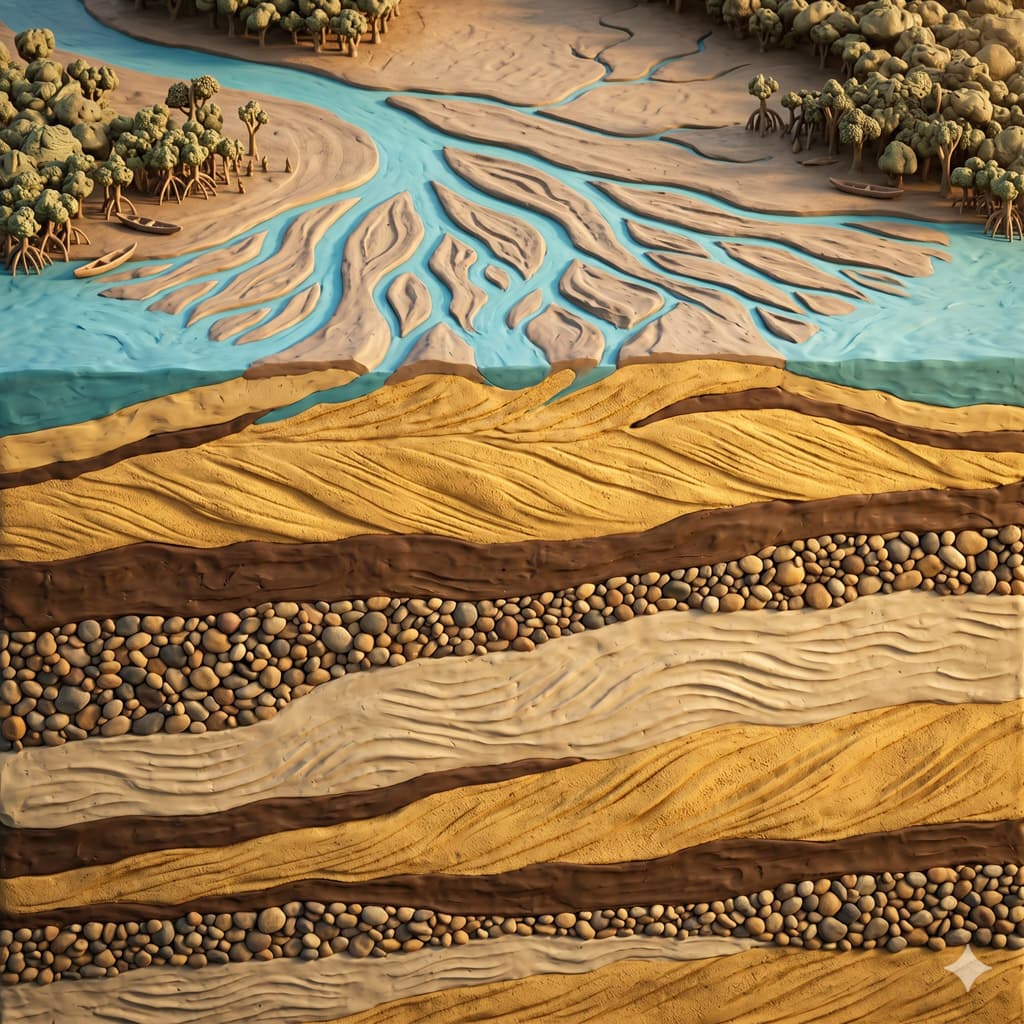
But the journey does not end at the shoreline. Sediment can move through the submarine Bengal Canyon and then spread across the deep ocean floor as turbidity currents — underwater avalanches of sand and mud. Over millions of years, these flows built the Bengal Fan, one of the largest submarine fans on Earth. Ocean drilling has shown that the fan preserves a long record of Himalayan erosion from the Miocene to the present, making it a key archive for understanding mountain building, climate, monsoon strength, and sediment transport. (IODP Publications)
The fan is not a neat pile of identical layers. Some intervals are sandy and energetic, deposited by powerful flows. Others are finer, quieter muds. Some layers reflect strong monsoon erosion; others may record glacial periods, changes in river routing, or shifts in source regions. The challenge is to separate these signals — like identifying different voices in a crowded room.
Chemical Fingerprints
Every mountain belt has a chemical accent. Rocks of the Higher Himalaya, Lesser Himalaya, Trans-Himalayan belt, Indo-Burman ranges, and Peninsular India differ in mineralogy, age, and elemental composition. When these rocks erode, their fragments carry those differences into river sediment and eventually into the ocean.
Geochemists use “proxies” — measurable chemical clues — to infer source, weathering intensity, and transport history. A single element rarely solves the mystery. Instead, scientists combine several lines of evidence: major elements, trace metals, clay minerals, magnetic susceptibility, and isotopes.
| Proxy | Element / ratio | What it indicates | |
|---|---|---|---|
| —————————- | ——————————– | ————————————————————————————————- | |
| Strontium isotopes | ⁸⁷Sr/⁸⁶Sr | Source-rock age and crustal contribution; useful for distinguishing radiogenic Himalayan material | |
| Neodymium isotopes | εNd / ¹⁴³Nd/¹⁴⁴Nd | Provenance and mixing between old continental crust and younger igneous sources | |
| Fe/Al ratio | Iron / aluminium | Changes in mineral source, redox-sensitive components, or heavy mineral contribution | |
| K/Al ratio | Potassium / aluminium | Clay and mica abundance; often linked to continental crust and weathering products | |
| Chemical Index of Alteration | Al₂O₃ relative to CaO, Na₂O, K₂O | Degree of chemical weathering before deposition | |
| Magnetic susceptibility | Magnetic mineral content | Sediment source, grain-size changes, and transport-energy shifts |
Among these clues, the strontium isotope ratio ⁸⁷Sr/⁸⁶Sr is especially useful. Rubidium-87 decays into strontium-87 over geological time, so old continental rocks often develop more radiogenic, or higher, ⁸⁷Sr/⁸⁶Sr values. Himalayan crystalline rocks, derived from ancient crustal material, can therefore leave a distinctive Sr signal in sediments. When that signal appears in Bay of Bengal mud, it points back toward Himalayan sources rather than younger volcanic or oceanic material.
This does not mean the ratio is a simple address label. Sediments are mixtures. Grain size, mineral sorting, weathering, and river routing can all modify the signal. But when Sr is paired with Nd isotopes, clay minerals, and elemental ratios, the pattern becomes much clearer. Studies of Bay of Bengal sediments have used Sr-Nd isotopes to show variable sediment contributions through time and to connect those changes with climate and Himalayan erosion. (<a href="https://www.prl.res.in/~sunil/22_TripathiGR%2C%20SIngh%20SK%20Sr-Nd%20isotopes.pdf?utmsource=chatgpt.com”>prl.res.in)
“When a fresh core is opened, it looks like a striped memory of the Earth — grey mud, tan silt, darker organic bands, tiny shells, mica flashes — each layer waiting to be matched with a mountain, a river, and a moment in time.”
Isotope Clocks
Isotopes are not clocks in the everyday sense, but they can carry time information. Some isotopic systems reveal the age of source rocks. Others help reconstruct the timing of erosion, exhumation, or sediment burial. Detrital minerals such as zircon, muscovite, apatite, and feldspar can preserve cooling ages, telling scientists when rocks moved upward through the crust and cooled near the surface.
In the Bengal Fan, these mineral ages are powerful because they connect deep-sea deposits to Himalayan exhumation. If a mineral grain in a fan deposit has a young cooling age, it may indicate rapid uplift and erosion in the source region. Work from ocean drilling and thermochronology has used Bengal Fan sediments to investigate Himalayan exhumation over millions of years, including evidence for rapid erosion since at least the Miocene. (ScienceDirect)
Even a simple data workflow begins with normalization — comparing measured ratios to a baseline so subtle shifts can be seen more clearly:
# Normalize Sr isotope ratio
sr_ratio <- (Sr87 / Sr86) - baseline
plot(depth_m, sr_ratio, type="l", main="Sr Ratio vs Depth")
Depth in a core becomes a rough timeline once scientists build an age model using fossils, magnetic reversals, oxygen isotopes, radiocarbon dates for younger sections, or correlation with seismic layers. A wiggle in the isotope curve may then become a clue: stronger monsoon erosion, more glacial grinding, a shift in Brahmaputra contribution, or increased input from the Higher Himalaya.
What the Bengal Fan Reveals
The Bengal Fan tells a story of persistence and change. Persistence, because Himalayan-derived sediment has dominated much of the fan’s history. Change, because the proportions of sources, intensity of weathering, and style of transport have varied with climate, tectonics, sea level, and monsoon dynamics.
IODP Expedition 354 drilled an east-west transect across the middle Bengal Fan to reconstruct Himalayan erosion and its links to climate and tectonics. The recovered sediments show mineralogical and geochemical signatures useful for tracking erosion, weathering, source-region shifts, and even broader carbon-cycle questions. (<a href="https://publications.iodp.org/preliminaryreport/354/?utmsource=chatgpt.com”>IODP Publications) Earlier Ocean Drilling Program work also found that Nd, Sr, and oxygen isotopes in Bengal Fan sediments strongly indicate a dominant Himalayan source through much of the record. (HAL)
One intriguing finding from Sr-Nd studies in the Bay of Bengal is that glacial and interglacial periods can alter the balance of sediment supply. During the Last Glacial Maximum, some records suggest relatively reduced Himalayan contribution, likely tied to weaker southwest monsoon intensity and expanded glaciation over high Himalayan source areas. (<a href="https://www.researchgate.net/publication/232522527Sr-NdisotopecompositionoftheBayofBengalsedimentsImpactofclimateonerosionintheHimalaya?utmsource=chatgpt.com”>ResearchGate) In other words, the mud at the bottom of the sea can preserve the rhythm of ancient climate.
That is the wonder of this detective story. A sediment core does not shout its secrets. It offers faint clues: a ratio slightly higher here, a mica-rich layer there, a magnetic spike, a shift in clay mineralogy, a cooling age that seems too young to ignore. Scientists assemble those clues into a moving picture of mountains being built, worn down, and carried grain by grain to the ocean.
The Himalaya may stand 2,000 km away from the deep Bengal Fan, but in geochemical terms they are close. Their erosion signals are written in the mud. And when scientists read that mud carefully, they recover not just the history of sediment, but the biography of a mountain range.
Sources / References
- International Ocean Discovery Program. Proceedings of IODP Expedition 354: Bengal Fan. (IODP Publications)
- France-Lanord, C., et al. “Expedition 354 summary: Bengal Fan.” Proceedings of the International Ocean Discovery Program, 2016. (<a href="https://publications.iodp.org/proceedings/354/101/354101.html?utmsource=chatgpt.com”>IODP Publications)
- IODP Expedition 354 Preliminary Report. “Bengal Fan.” (<a href="https://publications.iodp.org/preliminaryreport/354/?utmsource=chatgpt.com”>IODP Publications)
- Tripathy, G. R., Singh, S. K., Bhushan, R., & Ramaswamy, V. “Sr–Nd isotope composition of the Bay of Bengal sediments: Impact of climate on erosion in the Himalaya.” Geochemical Journal, 2011. (<a href="https://www.prl.res.in/~sunil/22_TripathiGR%2C%20SIngh%20SK%20Sr-Nd%20isotopes.pdf?utmsource=chatgpt.com”>prl.res.in)
- Derry, L. A., & France-Lanord, C. “Neogene Himalayan weathering history and river ⁸⁷Sr/⁸⁶Sr.” Earth and Planetary Science Letters, 1996. (ScienceDirect)
- France-Lanord, C., Derry, L., & Michard, A. “Evolution of the Himalaya since Miocene time: isotopic and sedimentological evidence from the Bengal Fan.” 1993. (HAL)
- Huyghe, P., et al. “Rapid exhumation since at least 13 Ma in the Himalaya recorded by detrital apatite fission-track dating of Bengal Fan sediments.” Earth and Planetary Science Letters, 2020. (ScienceDirect)












Responses (0 )