


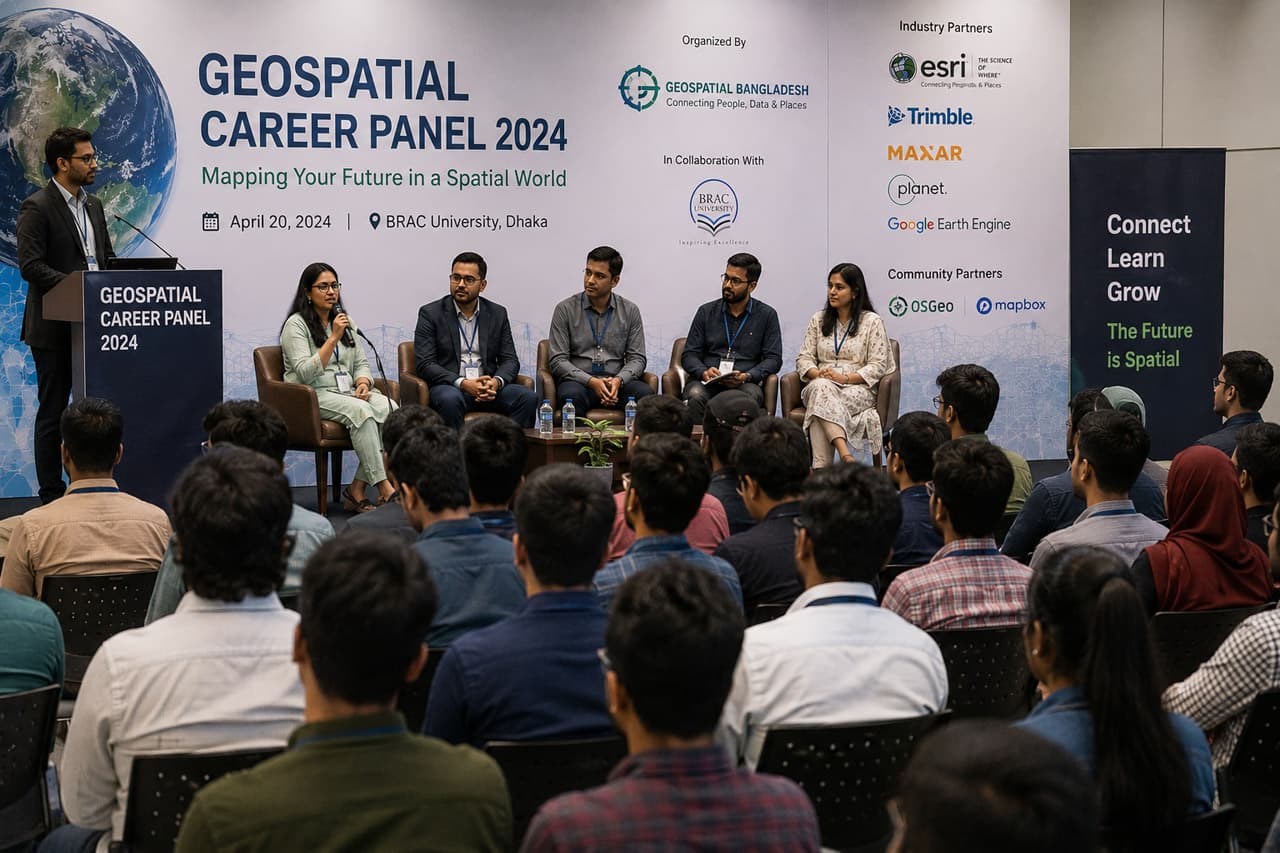
Hero image caption: A career panel event in Dhaka where GIS students, government officers, startup founders, and development-sector specialists discuss geospatial careers, remote sensing, and location intelligence.
Ten years ago, GIS in Bangladesh was a niche skill for government cartographers. Today, it’s a competitive advantage in everything from development consulting to disaster tech startups.
The change did not happen overnight. Bangladesh’s need for geospatial professionals grew because the country itself is spatially complex: dense cities, shifting rivers, cyclone-prone coasts, floodplains, agricultural change, road expansion, financial inclusion, and climate risk. Every one of these challenges has a location component. That means GIS and remote sensing are no longer only about making maps; they are about answering operational questions: Where should a service be expanded? Which union is most exposed to flooding? Which roads are missing from the database? Which areas are urbanizing fastest? Which households are farthest from health facilities?
For aspiring geo professionals, the opportunity is real. But so are the barriers: limited entry-level jobs, uneven university training, software licensing issues, low awareness among employers, and strong competition for donor-funded roles. The good news is that a strong portfolio can still open doors.
Where Geo Professionals Work in Bangladesh
GIS and remote sensing professionals in Bangladesh work across several sectors. Government agencies remain important employers because mapping, land records, agriculture, disaster management, water resources, infrastructure, and planning all require spatial data. SPARRSO is a national focal point for remote sensing and GIS applications, while the Survey of Bangladesh provides national mapping, topographic maps, GIS databases, aerial photographs, DTM data, GNSS services, and other geospatial products. (UN-SPIDER)
Development projects are another major career route. World Bank, ADB, JICA, UNDP, FAO, WFP, and international NGO-funded projects often need GIS specialists for vulnerability mapping, monitoring and evaluation, climate adaptation, urban planning, agricultural assessments, refugee response, and infrastructure planning. These jobs may be project-based, but they expose young professionals to high-quality methods and international reporting standards.
The private sector is growing quickly. Telecom, logistics, fintech, ride-sharing, e-commerce, retail expansion, utility services, and tech startups all use location data. In a company like bKash or other technology-driven organizations, GIS may support agent network planning, market coverage, service accessibility, fraud pattern analysis, field operations, and territory management. This is where GIS starts merging with data science, databases, APIs, dashboards, and business intelligence.
What Skills Employers Actually Want
Most employers do not hire someone just because they can open QGIS or ArcGIS Pro. They hire people who can solve problems with spatial data. Software matters, but thinking matters more.
A strong entry-level candidate should understand coordinate systems, projections, georeferencing, digitizing, topology, spatial joins, buffers, overlays, raster classification, NDVI, DEM analysis, and map layout design. For remote sensing roles, knowledge of Landsat, Sentinel-1, Sentinel-2, Google Earth Engine, supervised classification, change detection, and accuracy assessment is valuable.
Increasingly, employers also want technical fluency: Python, SQL, PostGIS, GeoPandas, GDAL, web maps, dashboards, and basic cloud workflows. If you can clean messy data, automate repetitive work, publish a web map, and explain your methodology clearly, you are already ahead of many candidates.
“The candidates who get hired are not always the ones with the longest software list. They are the ones who bring a small project, explain the data source, show the method, admit limitations, and tell us what decision the map supports.” — GIS team lead, Bangladesh development consultancy
Government vs Private vs International
Government roles often offer stability, institutional authority, and access to official datasets. The hiring process may be slower and more formal, and advancement can depend on civil-service structures or agency rules. These roles are good for people interested in national mapping, public planning, remote sensing applications, land administration, water resources, agriculture, or disaster management.
Private-sector roles are usually faster-moving. You may work on market expansion, routing, geocoding, field-force optimization, customer analytics, or location intelligence. The pressure can be higher, but the learning curve is strong if the organization values data.
International organizations and donor-funded projects often provide the best exposure to structured methodology, documentation, and cross-disciplinary work. However, contracts may be short-term, and competition can be intense. English communication, report writing, and stakeholder presentation skills matter a lot in this sector.
Top employers and project environments for GIS professionals in Bangladesh include:
- SPARRSO — remote sensing, satellite applications, environmental and disaster monitoring.
- Survey of Bangladesh — national mapping, topographic maps, geodetic control, GIS databases, and spatial data services.
- World Bank / ADB / JICA-funded projects — urban, transport, climate, disaster risk, agriculture, and infrastructure work.
- bKash and tech startups — location intelligence, service coverage, agent network planning, field operations, and analytics.
- International NGOs and UN agencies such as UNDP and FAO — development planning, food security, climate resilience, and humanitarian mapping.
Salary Expectations
Salary varies widely by organization, skill level, and whether the role is permanent or project-based. The figures below are practical ranges, not guarantees. A fresh graduate with only basic desktop GIS may start low. A candidate with Python, PostGIS, remote sensing, dashboarding, and strong communication can move faster.
| Sector | Typical employer | Required skills | Starting salary BDT/month | Growth potential | |
|---|---|---|---|---|---|
| ——————————– | ———————————————— | ——————————————————————— | ————————- | —————————————- | |
| Government mapping and research | SPARRSO, Survey of Bangladesh, planning agencies | ArcGIS/QGIS, remote sensing, cartography, official data handling | 25,000–45,000 | Stable, slower but respected | |
| Development consulting | Local consultancies, donor-funded projects | QGIS/ArcGIS, field data, dashboards, report maps, survey integration | 35,000–70,000 | Strong if project exposure is good | |
| International NGO / UN project | UNDP, FAO, WFP, INGOs | GIS analysis, remote sensing, M&E, English reporting, data ethics | 60,000–150,000 | High, but competitive and contract-based | |
| Tech / fintech / logistics | bKash, startups, e-commerce, mobility firms | SQL, Python, PostGIS, APIs, dashboards, geocoding, business analytics | 50,000–120,000 | Very strong for hybrid geo-data profiles | |
| Academic/research | Universities, research institutes | Remote sensing, GEE, statistics, publication writing | 25,000–60,000 | Good if linked to funded research | |
| Freelance / international remote | Upwork, consulting clients, map production | Portfolio, QGIS/ArcGIS, web maps, automation, communication | Variable | High but unstable at first |
Building Your Portfolio
A portfolio is the fastest way to prove skill. Do not wait for a job to create one. Use open data and build small, polished projects around Bangladesh.
Five portfolio projects that impress hiring managers:
- Flood vulnerability map combining elevation, river proximity, land cover, and population exposure.
- NDVI time series for a crop region using Sentinel-2 or Landsat in Google Earth Engine.
- OpenStreetMap contribution record showing roads, buildings, POIs, and validation work.
- 3D city model or simple urban visualization for Dhaka, Chattogram, or a municipality.
- Disaster assessment dashboard showing affected areas, shelters, roads, and population at risk.
Publish your work on GitHub, LinkedIn, a personal website, or a PDF portfolio. Include data sources, screenshots, methodology, tools used, limitations, and final outputs. A beautiful map without methodology is decoration; a documented workflow is professional evidence.
Salary Expectations
Be realistic. Entry-level GIS salaries in Bangladesh may not always match the technical effort required. Many organizations still treat GIS as a support function rather than a strategic capability. But salaries improve when you move from “map maker” to “spatial analyst,” then to “geo-data engineer,” “remote sensing specialist,” “GIS developer,” or “location intelligence lead.”
The highest growth usually comes from combining GIS with another skill: software development, database engineering, data science, disaster risk, urban planning, agriculture, climate science, or business analytics.
Building Your Portfolio
International certifications can help, but they are not magic. Esri Technical Certification validates expertise in applying ArcGIS products and capabilities, with exams offered at different levels. (<a href="https://www.esri.com/training/certification/?utmsource=chatgpt.com”>Esri) The GISP certification from GISCI is an international professional designation, and GISCI notes that full certification requires professional experience, portfolio review, and passing the core technical exam. (<a href="https://www.gisci.org/?utmsource=chatgpt.com”>gisci.org)
Are they worth it in Bangladesh? For fresh graduates, a strong portfolio is usually more valuable than an expensive certification. For mid-career professionals applying to international projects, donor-funded roles, or enterprise GIS positions, Esri certification or GISP can strengthen credibility. But no certificate replaces the ability to solve a real Bangladesh spatial problem clearly and responsibly.
The best career strategy is simple: learn the fundamentals, build public work, contribute to open data, understand Bangladesh’s development challenges, and keep improving your technical stack. GIS careers are no longer limited to map rooms. They now sit at the intersection of data, technology, planning, and decision-making — and Bangladesh needs more professionals who can work confidently at that intersection.
Sources / References
- SPARRSO official website: sparrso.gov.bd
- UN-SPIDER profile of SPARRSO as a national focal point for remote sensing and GIS: UN-SPIDER SPARRSO profile
- Survey of Bangladesh map services and geospatial information: Survey of Bangladesh Map Services
- Survey of Bangladesh online data service information: Survey of Bangladesh homepage
- GISCI / GISP certification: GIS Certification Institute
- GISCI portfolio requirements: GISCI Portfolio Requirements
- Esri Technical Certification: Esri Technical Certification
- Esri certification exams: Esri Certification Exams












Responses (0 )