

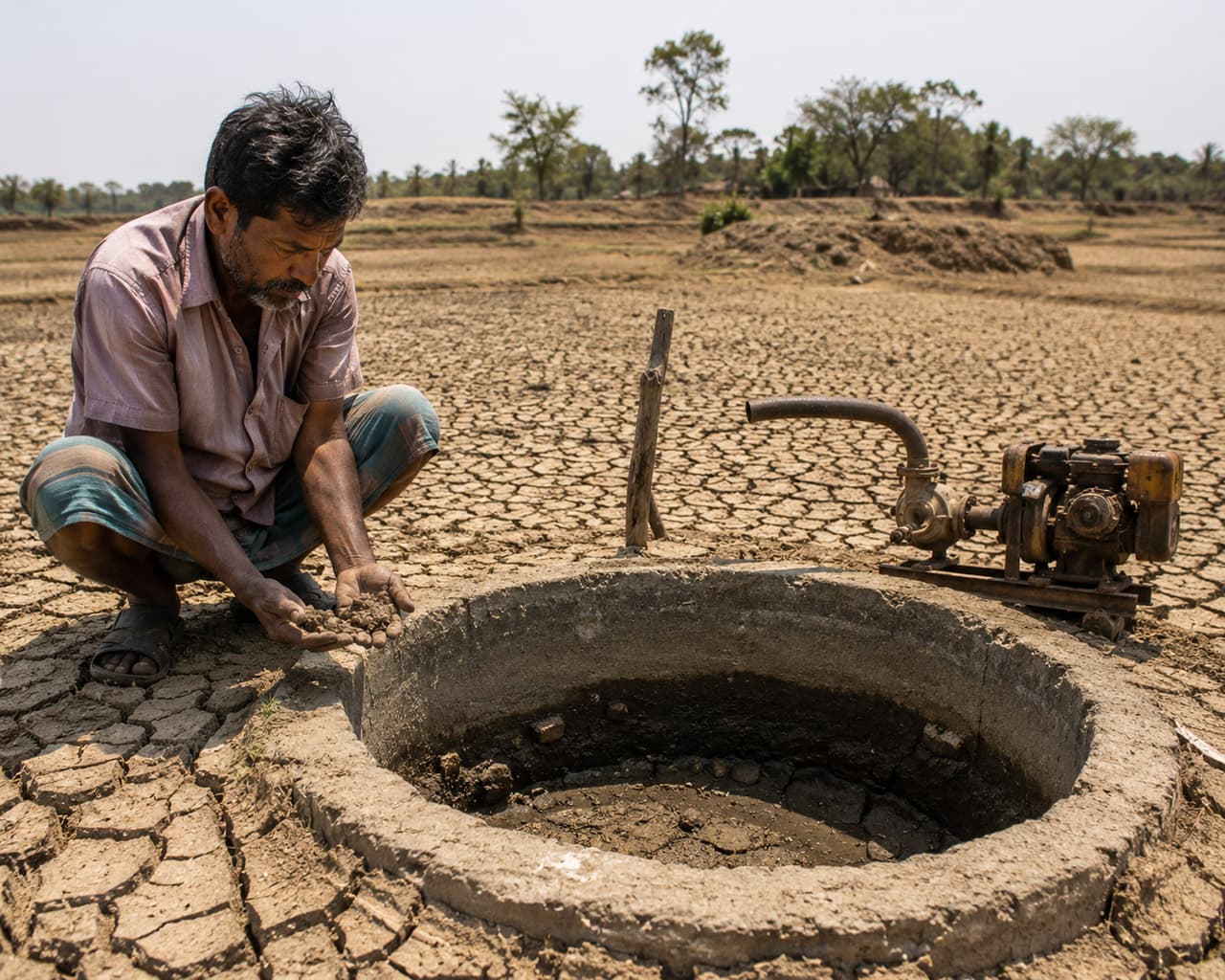
In April, when the heat begins to harden the fields of northwest Bangladesh, a farmer in the Barind Tract lowers a rope into his shallow well and waits for the familiar splash. Nothing comes back but a dry echo. The Boro rice seedlings still need water. The pump owner down the road says the deep tube well can run for a few more hours, but diesel is expensive, electricity is uncertain, and everyone in the village is asking for the same thing: groundwater.
This is how a hydrogeological crisis becomes personal. It does not arrive as a single disaster. It arrives as a longer pipe, a deeper pump, a higher irrigation bill, a cracked courtyard, a pond that no longer holds water through the dry season. In the Barind Tract — covering parts of Rajshahi, Naogaon, Chapai Nawabganj and adjoining districts — the falling water table is now one of Bangladesh’s most urgent environmental challenges.
Photo caption: A dry well and cracked earth in the Barind Tract, where falling groundwater levels are turning a seasonal water shortage into a long-term hydrogeological crisis.
The Barind Aquifer Under Stress
The Barind Tract is different from much of floodplain Bangladesh. It is an older Pleistocene terrace, slightly elevated, relatively drought-prone, and less regularly flooded than the younger alluvial plains. Its clay-rich surface and thick top layers can limit natural recharge, while rainfall is lower and more variable than in many other parts of the country. Groundwater therefore behaves like a savings account with modest deposits and increasingly large withdrawals.
For decades, groundwater irrigation transformed the region. The Barind Multipurpose Development Authority and related irrigation expansion helped turn a historically water-stressed area into a productive agricultural zone. Deep tube wells made dry-season Boro rice possible, raised cropping intensity, and supported rural livelihoods. The World Bank has described the Barind groundwater development experience as a major poverty-reducing intervention in a formerly underdeveloped agricultural region. But success created a new problem: the irrigation system became heavily dependent on pumping from aquifers that recharge slowly. (openknowledge.worldbank.org)
A simple water balance helps explain the stress:
ΔS = P + R_in - ET - R_out - G_absHere, ΔS means change in groundwater storage; P is precipitation entering the system; Rin is recharge or inflow from rivers, ponds, canals, and surrounding aquifers; ET is evapotranspiration from crops and vegetation; Rout is runoff or groundwater outflow; and G_abs represents groundwater abstraction by pumps. When abstraction and losses exceed rainfall and recharge year after year, storage declines. The water table falls.
How Fast Is the Water Table Falling?
The answer varies by location, season, and data source. Some areas show strong seasonal recovery after the monsoon; others show a long-term downward trend. Studies of the Barind region repeatedly identify intensive groundwater withdrawal for irrigation as a central driver of depletion, especially during the dry season. One study on Tanore Upazila reported continuous lowering of groundwater levels with expansion of irrigation, estimating declines of about 1.37 ft/year in wet-season levels and 0.72 ft/year in dry-season levels. (scirp.org)
The pattern is not uniform. Recent mapping of groundwater-stressed areas in Rajshahi, Chapai Nawabganj and Naogaon found that water stress varies sharply from union to union; in Rajshahi district alone, several unions were classified as very highly or highly water-stressed. (scirp.org) Another recent study using 2013–2022 groundwater-level data for Rajshahi, Chapai Nawabganj and Naogaon found significant spatial differences, with Chapai Nawabganj showing a statistically significant declining trend. (pg.result.ruet.ac.bd)
The table below gives an indicative, synthesized view of reported dry-season water-table depths and trends from published studies and regional assessments. Values should be read as approximate district-level examples, not a replacement for well-specific monitoring.
| Year | District / area | Approx. dry-season water-table depth | What it suggests | |
|---|---|---|---|---|
| —- | ————————————————- | ———————————— | —————————————————————————– | |
| 1990 | Rajshahi / early irrigation expansion zones | ~6–8 m | Shallow-to-moderate pumping depths before widespread intensification | |
| 2000 | Rajshahi / Tanore–Godagari belt | ~8–12 m | Irrigation expansion beginning to show persistent drawdown | |
| 2010 | Chapai Nawabganj | ~12–18 m | Dry-season stress increasing; rainfall recharge not keeping pace everywhere | |
| 2016 | Chapai Nawabganj / Barind upazilas | ~15–22 m | Study period shows rainfall-linked fluctuation but overall declining tendency | |
| 2024 | Rajshahi–Naogaon–Chapai Nawabganj stressed unions | ~20 m+ in critical pockets | Localized high stress; deeper pumping and higher energy costs |
“When I was young, we could reach water with a hand-dug well. Then we needed a shallow pump. Now the pipe goes so deep that the water feels like it belongs to another world.”
The Irrigation Paradox
The Barind crisis is not simply a story of misuse. It is also a story of food security. Boro rice, grown in the dry season, depends heavily on irrigation. Groundwater made reliable harvests possible when rainfall was absent. For many families, the pump is not a luxury; it is the difference between a crop and debt.
That is the paradox: the same groundwater that lifted agricultural productivity is being depleted by the scale of that productivity. Groundwater has become the region’s insurance policy against drought, but the policy is being overdrawn. Research on river-water irrigation alternatives in the Barind area notes that groundwater is the prime source of drinking and irrigation water because surface water sources are limited, and that continuous withdrawals for irrigation, domestic use and other purposes deplete groundwater levels. The same study found that river-water lifting and storage systems can reduce a portion of groundwater extraction and help raise groundwater levels where implemented. (sciencedirect.com)
Climate pressure adds another layer. Hotter dry seasons increase crop water demand. Irregular rainfall reduces dependable recharge. Upstream river flow changes and local surface-water loss further narrow the options. In this setting, every irrigation decision becomes a water-management decision.
Paths Forward
The Barind Tract does not need a single miracle technology. It needs groundwater-smart agriculture: many coordinated changes that reduce pumping while protecting farmer livelihoods.
- Shift crop choices and calendars
Encourage less water-intensive dry-season crops where suitable, including wheat, maize, pulses, oilseeds, and vegetables, supported by market access and price incentives.
- Improve irrigation efficiency
Promote alternate wetting and drying for rice, buried pipe distribution, prepaid or metered pumping, and scheduling based on soil moisture rather than habit.
- Expand managed surface-water use
Use river lifting, rubber dams, canals, ponds, and small reservoirs where hydrologically feasible to substitute part of dry-season groundwater demand.
- Recharge and retain water locally
Protect ponds, wetlands, canals, and low-lying recharge zones; support rainwater harvesting, check structures, and managed aquifer recharge pilots.
- Monitor, regulate, and share groundwater data
Install more observation wells, publish local groundwater dashboards, regulate new deep tube wells in stressed zones, and link irrigation permissions to aquifer conditions.
The solution must also be fair. Farmers cannot be asked to abandon water-intensive crops without alternatives, credit, storage, extension services, and reliable markets. Pump owners, local governments, irrigation authorities, researchers, and communities all need a shared picture of the aquifer.
Groundwater-smart agriculture in the Barind Tract would look practical rather than dramatic: rice fields irrigated only when needed, more diversified dry-season crops, ponds restored as recharge points, surface water used where possible, pumps monitored digitally, and village-level water budgets discussed before the dry season begins. It would mean treating groundwater not as an endless underground river, but as a common reserve.
The farmer with the dry well in April is not just facing a bad season. He is seeing the future unless the region changes course. The hopeful news is that the science is clear enough, and many tools already exist. The challenge now is to make conservation as central to Barind agriculture as irrigation once was.
Sources / References
- Banerjee, P. S., & De Silva, S. Pro-Poor Groundwater Development: The Case of the Barind Experiment in Bangladesh. World Bank. (openknowledge.worldbank.org)
- Rahman, M. M., et al. “Groundwater Depletion with Expansion of Irrigation in Barind Tract: A Case Study of Tanore Upazila.” Journal of Water Resource and Protection, 2012. (scirp.org)
- “Groundwater Depletion and its Sustainable Management in Barind Tract of Bangladesh.” Research Journal of Environmental Sciences, 2018. (scialert.net)
- Hossain, M. I., et al. “Application of double lifting method for river water irrigation in Barind Tract.” Groundwater for Sustainable Development, 2022. (sciencedirect.com)
- “Mapping for Groundwater Stressed Areas in Barind Region of Bangladesh.” Journal of Water Resource and Protection, 2026. (scirp.org)
- RUET Postgraduate Research. “Exploring the Dynamics of Groundwater Level using Innovative Trend Analysis in Drought-Prone Districts of Northwest Bangladesh.” (pg.result.ruet.ac.bd)














Responses (0 )