


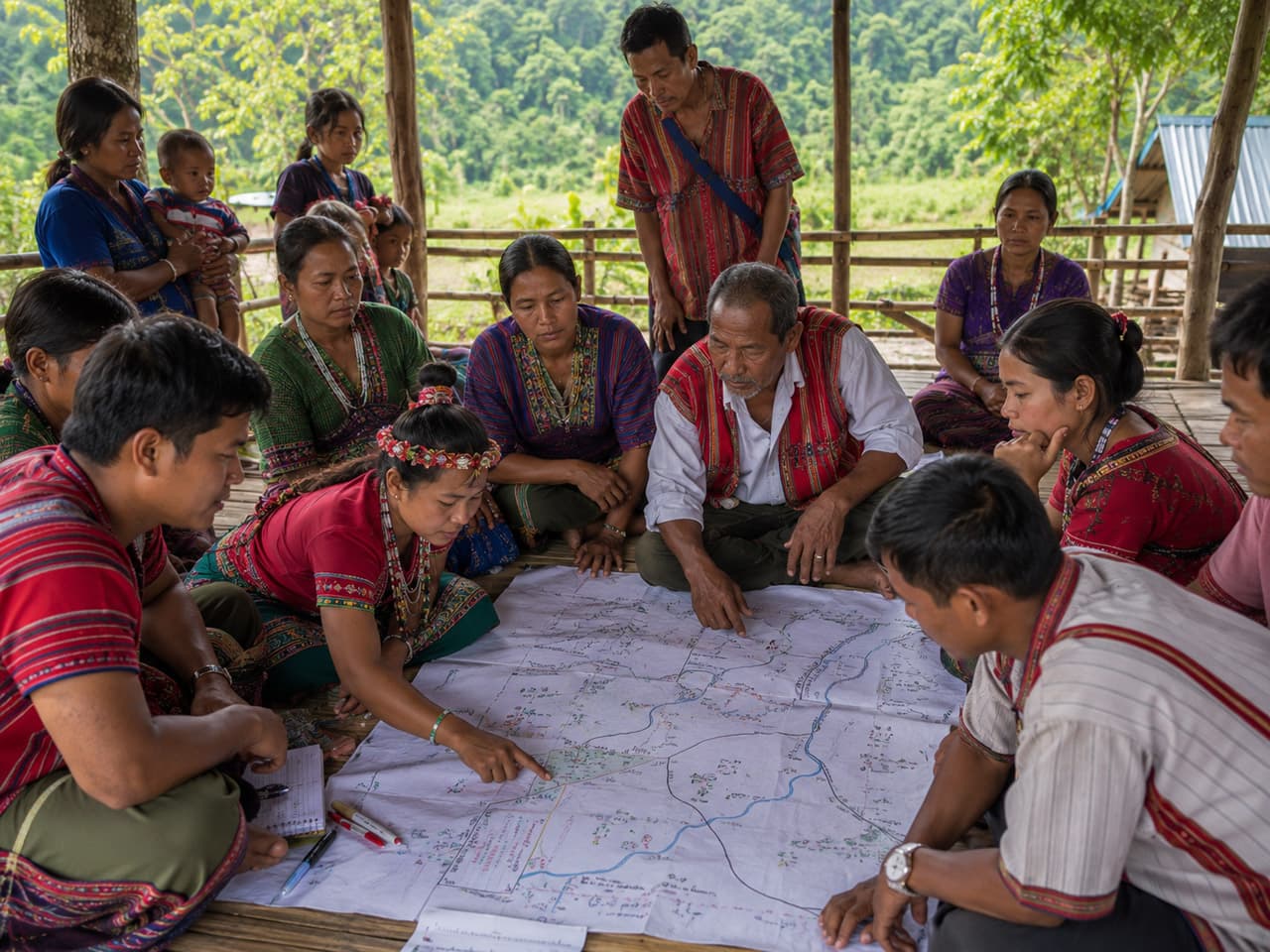
Hero image caption: Community members gathered around a large hand-drawn territorial map in a village meeting space, marking customary boundaries, sacred places, forest areas, trails, streams, and settlement histories in the Chittagong Hill Tracts.
Maps have always been political — and for the Jumma peoples of the Chittagong Hill Tracts, the right to map their own land is inseparable from the right to exist on it. A line on a cadastral sheet may look neutral to an outsider. But in the hills, that line may cut across a jhum field, a bamboo grove, a burial ground, a stream used by generations, or a forest protected by customary rules. Participatory mapping begins from a simple but powerful principle: people who live in a landscape should have authority in describing it.
In the Chittagong Hill Tracts, mapping is not only about geography. It is about memory, land rights, conflict, governance, and cultural survival.
Who Are the Jumma?
The Chittagong Hill Tracts, or CHT, cover the three hill districts of Rangamati, Bandarban and Khagrachari in southeastern Bangladesh. Unlike the deltaic plains that dominate much of the country, the CHT is a region of hills, valleys, streams, forests and shifting cultivation landscapes. It is home to multiple Indigenous peoples who are often collectively known as Jumma, a term associated with jhum, or shifting cultivation. Minority Rights Group describes the CHT as home to twelve or thirteen different Indigenous peoples, with Chakma, Marma and Tripura making up the majority of the Indigenous population. (Refworld)
The communities of the CHT are diverse in language, religion, settlement pattern and livelihood. They include Chakma, Marma, Tripura, Tanchangya, Mro, Bawm, Khumi, Khyang, Chak, Pankhua, Lushai and others. UNPO similarly lists Chakma, Marma, Tripura, Tanchangya, Mro, Lushai, Khumi, Chak, Khiyang, Bawm and Pangkhua among the groups collectively identifying as Jumma. (UNPO)
The following table gives broad, approximate categories for teaching purposes. Population and territorial figures vary by source, census category, migration history and political interpretation; “traditional territory area” is therefore best understood as customary presence within the CHT landscape, not a legally surveyed boundary.
| Community | Approx. population | Traditional territory area | Primary livelihood | |
|---|---|---|---|---|
| —————————————————– | ————————————————————————————————— | —————————————————————————- | ————————————————————— | |
| Chakma | Largest Indigenous community in CHT; often described as more than half of the Indigenous population | Mainly Rangamati and parts of Khagrachari and Bandarban | Jhum cultivation, settled agriculture, fishing, trade, services | |
| Marma | Second-largest major community | Bandarban, Rangamati and Khagrachari, often linked to Mong and Bohmong areas | Agriculture, horticulture, trade, forest-based livelihoods | |
| Tripura | One of the three largest CHT Indigenous communities | Khagrachari and adjoining hill areas | Jhum, settled agriculture, wage work, small trade | |
| Tanchangya | Smaller but historically rooted community | Rangamati and Bandarban areas | Agriculture, weaving, forest-related livelihoods | |
| Mro / Mru | Smaller hill community | Bandarban hill areas | Jhum, forest products, livestock, wage work | |
| Bawm, Khumi, Khyang, Chak, Pankhua, Lushai and others | Smaller communities | Dispersed hill territories, especially Bandarban and remote uplands | Jhum, horticulture, forest use, crafts, wage work |
The CHT Land Conflict
The CHT land question has deep historical roots. Indigenous land tenure in the hills has often been based on customary systems, collective use, oral recognition, village authority, and seasonal land-use cycles rather than individual titled ownership in the plains-style cadastral system. A major study on CHT land rights notes that Indigenous land rights in the region are historically distinct from other parts of Bangladesh and are tied to customary land-use systems such as jhum cultivation. (<a href="https://iwgia.org/images/publications/0128Chittagonghilltracts.pdf?utmsource=chatgpt.com”>iwgia.org)
The conflict is not only about old maps. It is about state forests, reserved forests, military presence, settlement programmes, development projects, migration, displacement, tourism, road building, and competing legal systems. The 1997 Chittagong Hill Tracts Peace Accord raised hopes for peace and recognition, but Indigenous rights organisations continue to argue that implementation has been incomplete and that land disputes remain unresolved. IWGIA notes that the Peace Accord was signed on 2 December 1997, but that many Indigenous peoples in the CHT have experienced little peace or development in the decades since. (iwgia.org)
In this context, participatory mapping becomes a rights-based practice. It asks: whose geography is visible to the state? Whose land-use system is recorded? Whose sacred sites are protected? Whose place names appear on the map?
What Is Participatory Mapping?
Participatory mapping is a process in which communities create maps of their own territories, resources, histories and concerns. It can use satellite imagery, printed base maps, GPS points, sketch maps, oral histories, transect walks, mobile data collection, or three-dimensional models. The method is not defined by the technology. It is defined by who controls the knowledge.
A conventional GIS project often begins with official data: administrative boundaries, roads, land parcels, forest blocks, and satellite images. A participatory mapping project begins with community questions: Where did our grandparents cultivate? Which forest areas are shared? Where are the springs? Which paths are safe in the monsoon? Which hilltops are sacred? Which lands are disputed? Which areas have been lost?
Typical features captured in Jumma territorial maps include:
- Customary land boundaries — village territories, clan areas, jhum cycles and shared-use zones.
- Sacred sites — burial grounds, ritual places, old village sites and spiritually significant hills.
- Water sources — streams, springs, wells, ponds and seasonal water points.
- Forest areas — bamboo groves, community forests, medicinal plant zones and gathering areas.
- Trails and settlements — footpaths, market routes, old settlements, new settlements and evacuation paths.
The map is often both analytical and emotional. It shows land cover, but also belonging. It records resource use, but also memory.
Community Mapmakers
The best participatory maps are not produced by consultants arriving with tablets and leaving with shapefiles. They are built through meetings, storytelling, walking, checking, arguing, revising and consent. Elders may remember old settlement locations. Women may identify water sources, fuelwood areas, safety concerns and informal paths that men overlook. Youth may handle GPS devices or mobile apps. Farmers may explain jhum rotation, soil quality and fallow cycles. Religious leaders may identify sacred places that should not be digitised publicly.
“When we drew the map, the young people saw that our village is more than houses. They saw the stream where our mothers collect water, the forest where our grandparents gathered bamboo, and the hill we do not cut because it belongs to our spirits. The map helped us speak together.” — Community mapper from the Marma community
A careful mapping process also recognises internal differences. Not every household has equal power. Women, poorer families, displaced people, youth and smaller communities may experience territory differently. Participatory mapping must therefore be facilitated with attention to inclusion, language, consent and conflict sensitivity.
Maps as Evidence, Maps as Memory
Participatory maps can serve several purposes. They can support land claims, document customary use, guide conservation, identify conflict zones, plan community forests, negotiate development projects, and teach younger generations about territory. They can also challenge official maps that show the hills as empty forest, state land or unclassified space.
But maps can also create risk. A sacred site digitised with precise coordinates may become vulnerable to tourism, extraction or surveillance. A customary boundary drawn publicly may intensify conflict with neighbouring communities. A GPS database can be copied, leaked or used outside the original consent agreement.
This is why many Indigenous mapping projects make a deliberate choice between GPS mapping and sketch mapping. GPS points offer precision and can support legal or technical claims. Sketch maps, by contrast, allow communities to represent relationships, memory and territorial meaning without exposing exact coordinates. Some communities intentionally prefer hand-drawn maps because they reduce the risk of digital data surveillance, especially where land conflict, militarisation or resource extraction is sensitive.
A human-rights-aware mapping project should therefore ask: Who owns the data? Who can view it? Can sensitive layers be hidden? Can the community withdraw consent? Are sacred sites generalized rather than precisely located? Is the map for internal memory, public advocacy, court evidence, or planning negotiation?
In the CHT, maps are never just technical outputs. They are records of belonging in a landscape where belonging has often been contested. Participatory mapping does not solve the land conflict by itself. But it gives communities a way to say, in their own spatial language: this is where we live, this is what we protect, this is what we remember, and this is why our land cannot be understood only through someone else’s map.
Sources / References
- Minority Rights Group International. “World Directory of Minorities and Indigenous Peoples: Chittagong Hill Tracts.” (Refworld)
- Unrepresented Nations and Peoples Organization. “Chittagong Hill Tracts.” (UNPO)
- International Work Group for Indigenous Affairs. “Chittagong Hill Tracts.” (iwgia.org)
- Roy, R. C. Land Rights of the Indigenous Peoples of the Chittagong Hill Tracts, Bangladesh. IWGIA / UNESCO record. (<a href="https://iwgia.org/images/publications/0128Chittagonghilltracts.pdf?utmsource=chatgpt.com”>iwgia.org)
- Ali, M. Emran and Tsuchiya, Toshiyuki. “Land Rights of the Indigenous People of the Chittagong Hill Tracts in Bangladesh: A Historical Analysis of Policy Issues.” (cwis.org)
- Banglapedia. “Chittagong Hill Tracts.” (<a href="https://en.banglapedia.org/index.php/ChittagongHillTracts?utm_source=chatgpt.com”>en.banglapedia.org)












Responses (0 )