


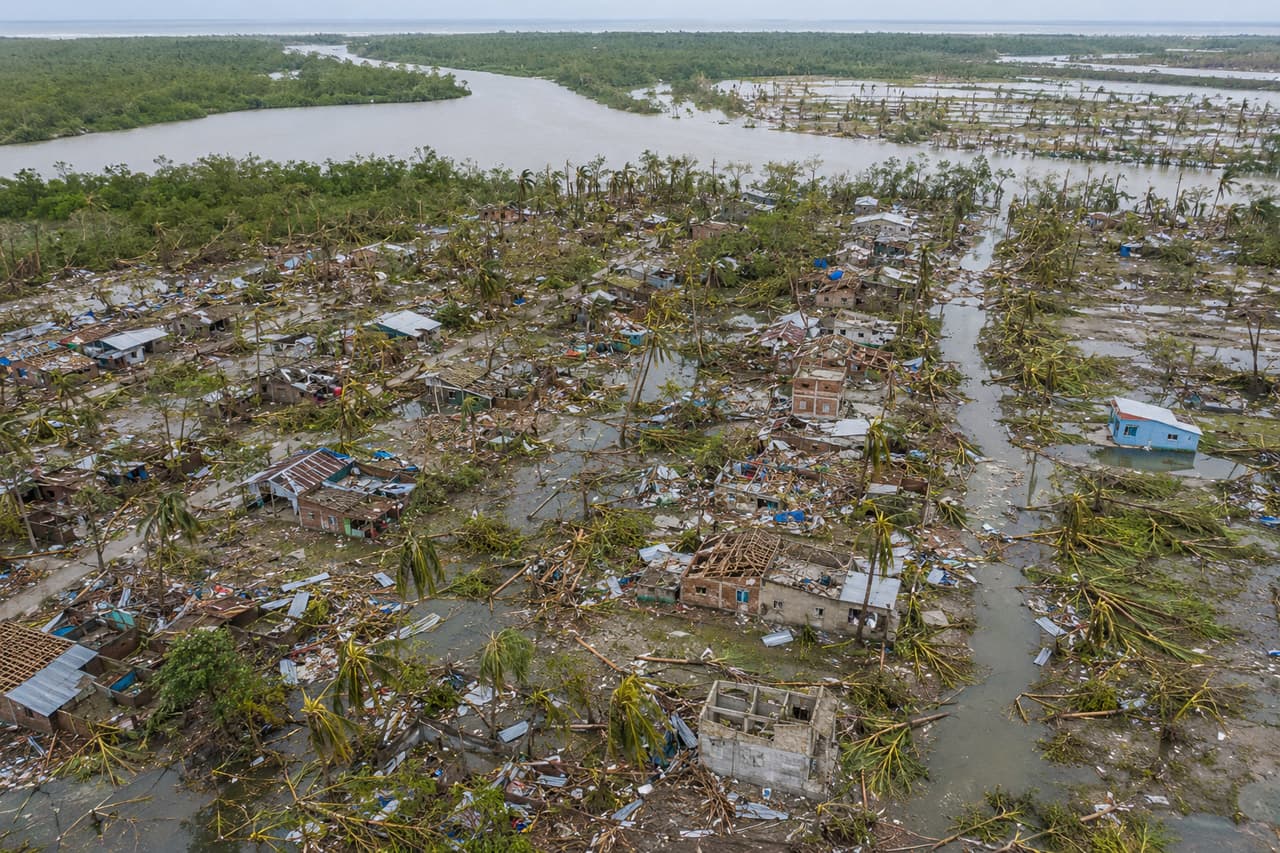
Hero image caption: Aerial view of cyclone-damaged coastal Bangladesh: broken embankments, flooded homesteads, scattered debris, and roads cut off by standing water.
Forty-eight hours after Cyclone Remal’s landfall, the roads were impassable and no one had a reliable picture of the damage extent. We had a drone.
That simple fact changed the first assessment mission. From the ground, every road seemed to end in water, fallen trees, or a broken culvert. Local officials had reports from union-level volunteers, but the information was fragmented: a damaged embankment here, a flooded road there, a cluster of collapsed houses somewhere beyond the next canal. What was missing was a single, visual layer of truth — a map that could show where the destruction was concentrated and how response teams should move.
A drone survey could not replace household-level assessment, relief distribution, or engineering inspection. But in the first days after Cyclone Remal, it offered something urgently practical: a fast, high-resolution view of the coastal damage pattern.
Cyclone Remal at a Glance
Cyclone Remal made landfall on 26 May 2024 near the Bangladesh and West Bengal coast, affecting coastal districts with high winds, storm surge, tidal flooding, and heavy rainfall. Humanitarian reports described widespread damage to houses, roads, embankments, crops, fisheries, and water sources. The Bangladesh Red Crescent and IFRC reported that the cyclone affected millions of people, while UNICEF noted landfall in Patuakhali district with maximum wind speeds around 111 km/h. (ReliefWeb)
The coastal geography made the impact worse. Many settlements sit beside tidal rivers, shrimp and fish enclosures, low embankments, and narrow rural roads. Once embankments are breached, saline water does not simply “flood” an area; it enters ponds, fields, homesteads, and local transport corridors. Reports after Remal described submerged villages, broken embankments, damaged homes, snapped road communication, and saline intrusion into freshwater sources. (Prothomalo)
For disaster response, the challenge was not only knowing that damage had occurred. It was knowing where, how much, and which access routes still worked.
The Drone Survey Plan
The survey plan was built around a practical question: what can be mapped in one day with a small UAV team, limited battery cycles, and uncertain weather?
The priority was not cinematic footage. It was repeatable mapping. We selected a grid-based flight pattern over the most affected settlement clusters, embankment sections, road junctions, and waterlogged agricultural areas. Each flight block was designed to produce overlapping images suitable for orthomosaic generation — a stitched, geometrically corrected aerial map.
| Parameter | Value | |
|---|---|---|
| —————————– | ————————————————– | |
| Flight altitude | 90–120 m above ground level | |
| Ground Sampling Distance, GSD | ~2.5–4 cm/pixel, depending on camera and altitude | |
| Coverage per flight | ~35–60 hectares | |
| Front/side overlap | 80% front, 70% side | |
| Software used | DJI flight planning app, OpenDroneMap/WebODM, QGIS |
A key planning metric was Ground Sampling Distance, or GSD:
GSD = (sensorwidth × altitude) / (focallength × image_width)
In simple terms, GSD tells us how much ground each image pixel represents. A GSD of 3 cm/pixel means one pixel covers about 3 cm on the ground. Lower GSD means higher resolution because each pixel represents a smaller real-world area. That matters when trying to distinguish a collapsed tin roof from a shadow, a broken road edge from floodwater, or a narrow breach in an embankment.
Flying the Damage Grid
The field team began with a safety check: wind, rain bands, nearby people, power lines, mobile towers, birds, and emergency helicopter activity. In post-cyclone conditions, the airspace may look empty, but the ground is unstable. Launch sites were selected from dry, open spaces near schools and cyclone shelters.
The drone flew pre-planned grid missions, capturing nadir images — straight down — rather than oblique footage. Oblique video is useful for communication, but nadir images are better for measurement and stitching. Each flight produced hundreds of overlapping photographs with GPS coordinates embedded in the image metadata.
Processing was done with OpenDroneMap, an open-source photogrammetry toolkit that can generate orthophotos, point clouds, 3D models, and digital elevation products from overlapping aerial images. (OpenDroneMap™)
docker run -ti --rm
    -v /drone_images:/datasets/project/images
    opendronemap/odm
    --project-path /datasets
    --dsm
    --orthophoto-resolution 3
    --max-concurrency 4
The output was an orthophoto that could be loaded into QGIS and compared with pre-cyclone basemaps, administrative boundaries, road layers, and known shelter locations. OpenDroneMap documentation notes that the project folder should contain dataset subfolders with an images folder, and its outputs can include georeferenced orthorectified imagery and elevation products. (OpenDroneMap Documentation)
What We Found from the Air
From ground level, damage appeared chaotic. From the air, patterns emerged.
The first visible pattern was water movement. Flooded roads were not random; they followed low-lying road sections, blocked culverts, and areas where embankments had failed. The second pattern was roof damage. Tin-roof houses near open river-facing edges showed more severe damage than houses behind tree cover or denser settlement clusters. The third pattern was debris concentration: broken timber, roofing sheets, household materials, and vegetation collected along drainage lines and road shoulders.
The drone imagery helped identify five major damage types:
- Collapsed roofs
- Fallen trees
- Flooded roads
- Breached embankments
- Debris fields
“Before seeing the orthophoto, we thought the main problem was the damaged road. After the drone map, we understood the road was only the symptom — the embankment breach was feeding water into three villages.” — BNFE disaster response officer
The orthophoto also helped reduce duplication. Two response teams that were planning to visit separate “flooded road” reports realized they were looking at different ends of the same waterlogged corridor. Another team used the imagery to select a safer route for carrying drinking water and emergency supplies.
Data to Decisions
A drone map is only useful if it changes decisions. In this case, the outputs supported four immediate actions.
First, the orthophoto helped prioritize embankment inspection. Engineers could see where water entered and where temporary closure might protect the largest number of households. Second, it supported access planning by showing which roads were still usable by motorcycles, boats, or small trucks. Third, it helped relief coordinators identify settlement clusters that were physically isolated but not obvious from road-based assessment. Fourth, it created a visual baseline for recovery monitoring: the same grid could be flown again after temporary repairs, drainage, or shelter reconstruction.
There are limits. Drone surveys require safe weather, trained pilots, batteries, permissions, and careful data handling. Images of damaged homes are sensitive. Aerial data should not be treated as public spectacle; it should be governed as humanitarian information. The most ethical drone survey is one that answers a response question, protects affected communities, and shares only the level of detail necessary for recovery.
Cyclone Remal showed why UAVs are becoming part of Bangladesh’s disaster response toolkit. Satellites provide regional coverage. Field teams provide human detail. Drones sit between them: close enough to see a broken roof, wide enough to understand a village-scale pattern.
In the first days after a cyclone, that middle layer can save time. And in disaster response, time is not just a metric. It is drinking water delivered before nightfall, a safer road chosen before an ambulance leaves, and an embankment breach repaired before the next tide.
Sources / References
- IFRC / ReliefWeb — Bangladesh: Cyclone Remal Operation Update Emergency Appeal No. MDRBD035, July 2024. (ReliefWeb)
- UNICEF / ReliefWeb — Bangladesh Humanitarian Situation Report No. 3: Cyclone Remal, 29 May 2024. (ReliefWeb)
- Prothom Alo English — Cyclone Remal leaves trail of destruction in coastal region, 28 May 2024. (Prothomalo)
- PreventionWeb — Layered response in Bangladesh: Cyclone Remal, 2025. (PreventionWeb)
- OpenDroneMap — official project and documentation. (OpenDroneMap™)
- OpenDroneMap GitHub — ODM command-line toolkit for aerial imagery processing. (GitHub)












Responses (0 )