


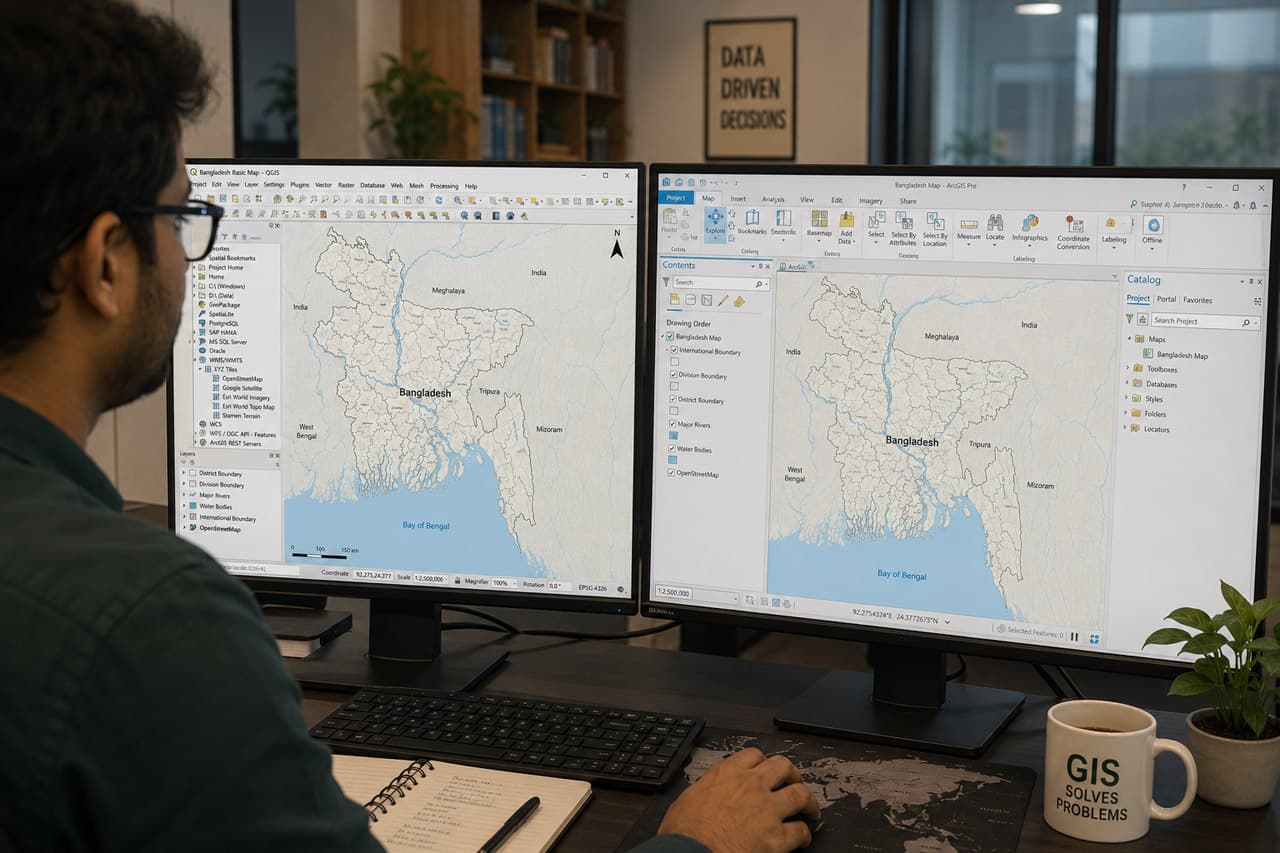
Hero image caption: A dual-monitor GIS workstation comparing QGIS on one screen and ArcGIS Pro on the other, with Bangladesh district boundaries, satellite imagery, and attribute tables open side by side.
The question every Bangladesh GIS student faces at some point: should I invest time in QGIS or ArcGIS? The honest answer depends on where you want to work.
This is not only a software question. It is a career question, a budget question, and sometimes an institutional question. In Bangladesh, GIS professionals work across government agencies, NGOs, universities, telecom, utilities, development projects, disaster management, urban planning, agriculture, and private consultancies. Some offices are built around Esri technology. Others survive because QGIS, PostGIS, GeoServer, Google Earth Engine, and open data keep costs manageable.
So the better question is not “Which software is best?” It is: which GIS ecosystem fits your project, your employer, and your future direction?
The Landscape in Bangladesh
Bangladesh has a mixed GIS landscape. Many government and donor-funded projects have historically used ArcGIS because it offers a complete enterprise ecosystem: desktop GIS, server GIS, web GIS, mobile data collection, dashboards, and formal vendor support. For institutions that need standardized workflows, training, procurement, and long-term technical support, ArcGIS remains a strong choice.
At the same time, QGIS has become extremely important for students, researchers, small consultancies, NGOs, and independent professionals. It is free, open source, and available on Windows, macOS, and Linux. QGIS describes itself as “Free and Open Source software, forever,” and OSGeo identifies it as a leading free and open-source desktop GIS for creating, editing, visualising, analysing, and publishing geospatial information. (QGIS)
In Bangladesh, this matters because many organizations need GIS but cannot afford recurring commercial licenses. A small NGO mapping flood shelters, a university student preparing a thesis, or a local consultant producing ward-level maps can often complete the work entirely in QGIS.
Feature Comparison: The Practical Differences
Both QGIS and ArcGIS Pro can make maps, edit vector data, process rasters, perform spatial analysis, connect to databases, and export professional layouts. The differences appear when projects become larger, more collaborative, or enterprise-driven.
| Feature | QGIS | ArcGIS Pro | |||
|---|---|---|---|---|---|
| —————————- | ————————————————————————— | ———————————————————————————————————————————————————————————————————————————————————————- | |||
| Cost | Free and open source; no license fee | Commercial license; student, organizational, and nonprofit options available | |||
| Scripting language | Python via PyQGIS; integrates well with GDAL, GeoPandas, PostGIS workflows | Python via ArcPy, a native Esri Python package for analysis, conversion, management, and map automation ([ArcGIS Pro](https://pro.arcgis.com/en/pro-app/3.4/arcpy/get-started/what-is-arcpy-.htm?utm_source=chatgpt.com “What is ArcPy?—ArcGIS Pro | Documentation”)) | ||
| 3D capability | Basic to moderate 3D through QGIS 3D views and plugins | Strong 2D, 3D, and time-aware data support built into ArcGIS Pro ([Esri](https://www.esri.com/en-us/arcgis/products/arcgis-pro/overview?utm_source=chatgpt.com “Desktop GIS Software | Mapping Analytics | ArcGIS Pro”)) | |
| Spatial database integration | Excellent with PostGIS, GeoPackage, SpatiaLite, WFS/WMS, and open standards | Excellent with enterprise geodatabases, ArcGIS Enterprise, feature services, and databases | |||
| Plugin ecosystem | Large community plugin ecosystem; strong for open workflows | Extensions, geoprocessing tools, ArcGIS Online/Enterprise integration, Esri apps | |||
| Mobile data collection | Works well with QField, Mergin Maps, Kobo/ODK-linked workflows | Strong integration with ArcGIS Field Maps, Survey123, QuickCapture, and ArcGIS Online/Enterprise |
For desktop cartography and common analysis, QGIS is more than enough. For enterprise GIS, multi-user editing, organization-wide dashboards, hosted feature layers, and mobile-to-web workflows, ArcGIS Pro plus ArcGIS Online or ArcGIS Enterprise often feels more integrated.
Cost Reality
Cost is where the decision becomes serious. QGIS costs nothing to download and use. That does not mean QGIS projects are “free” in a professional sense—you still need trained people, data management, quality control, documentation, and sometimes server infrastructure. But the entry barrier is extremely low.
ArcGIS Pro, on the other hand, is commercial software. For a government agency, large project, or donor-funded programme, the cost may be justified by support, integration, training, and enterprise features. Esri also offers student licensing, and ArcGIS for Student Use provides the same software at a student-focused price point. (Esri)
A very important note for NGOs: Esri’s nonprofit licensing can make ArcGIS much more accessible than many people assume. Esri states that its Nonprofit Organization Program provides nonprofit organizations with low-cost access to GIS software, training, content, and resources, and eligible organizations can apply for discounts and licensing options. (Esri) In practice, many NGOs should check eligibility before assuming ArcGIS is impossible.
Job Market in Bangladesh
If your goal is to work in government projects, large donor-funded programmes, utility mapping, telecom, or established GIS consultancies, ArcGIS knowledge is still valuable. Many job descriptions mention ArcGIS, ArcGIS Pro, ArcMap legacy workflows, geodatabases, Survey123, dashboards, or ArcGIS Online.
Examples of government and NGO/development contexts in Bangladesh where ArcGIS skills are often relevant include:
- SPARRSO — Bangladesh’s national organization for space science, remote sensing, and GIS applications; UN-SPIDER describes SPARRSO as a national focal point for remote sensing and GIS in Bangladesh. (UN-SPIDER)
- SRDI — soil, land resource, and agricultural mapping workflows where GIS and remote sensing skills are relevant.
- BNFE — education mapping, literacy, and non-formal education planning projects where GIS-based visualization may support decision-making.
- World Bank projects — urban, transport, disaster risk, climate, and infrastructure projects often require professional GIS deliverables and standardized geospatial workflows.
But the job market is changing. Employers increasingly value people who understand concepts, not only software menus: coordinate systems, topology, spatial SQL, raster analysis, web maps, data cleaning, metadata, and automation. A candidate who knows QGIS plus PostGIS plus Python may be stronger than someone who only knows basic ArcGIS button-clicking.
“In interviews, I don’t ask only ‘Do you know ArcGIS?’ anymore. I ask whether the candidate can clean messy data, explain projections, join tables correctly, write a basic spatial query, and defend their map design. Software can be taught faster than spatial thinking.” — Hiring manager, Bangladesh GIS consultancy
Which One Should You Learn First?
If you are a student or early-career professional with no institutional license, start with QGIS. It lets you learn the fundamentals without waiting for access: layers, CRS, attribute tables, joins, symbology, geoprocessing, raster analysis, print layouts, and plugins. You can install it today and build a portfolio.
QGIS wins especially in these contexts:
- Open-source and FOSS4G projects
- Academic research with limited software budget
- NGOs and community mapping teams with no license funding
- PostGIS, GeoServer, GDAL, and Python-based workflows
- Contributing to open geospatial tools, plugins, and documentation
After that, learn ArcGIS Pro if you want to work in enterprise GIS, government projects, large consultancies, donor-funded programmes, or organizations already using Esri infrastructure. ArcGIS Pro is not just a desktop tool; it connects tightly with ArcGIS Online and ArcGIS Enterprise for sharing and collaboration across platforms. (Esri)
Recommendation
For most Bangladeshi geo professionals, the best answer is: learn both, but learn GIS fundamentals first through QGIS.
Start with QGIS because it is accessible, practical, and powerful. Use it to build real projects: district choropleth maps, flood exposure maps, school accessibility analysis, road network cleaning, and PostGIS-connected workflows. Then add ArcGIS Pro when your career path requires enterprise GIS, Esri-specific tools, mobile data collection, dashboards, or institutional collaboration.
If you are choosing for an organization, decide based on budget, staff capacity, support needs, and workflow. A small research team may be better served by QGIS and PostGIS. A national programme with field apps, dashboards, multiple departments, and long-term vendor support may benefit from ArcGIS.
The real professional advantage is not loyalty to one brand. It is the ability to solve Bangladesh’s geospatial problems with the right tool, the right data, and the right judgement.
Sources / References
- QGIS Official Website — free and open-source GIS: https://qgis.org
- OSGeo QGIS Project Overview: https://www.osgeo.org/projects/qgis/
- ArcGIS Pro Overview — Esri: Desktop GIS Software | Mapping Analytics | ArcGIS Pro
- ArcPy Documentation — ArcGIS Pro: Introduction to ArcPy | ArcGIS Pro documentation
- Esri Nonprofit Program: Nonprofit Software Discounts | Apply to the Esri Nonprofit Program
- Esri Nonprofit Overview: Nonprofit Technology | GIS for Nonprofit Organizations & NGOs
- ArcGIS for Student Use: ArcGIS for Student Use Pricing | Add License to ArcGIS
- UN-SPIDER profile of SPARRSO: Bangladeshi Space Research and Remote Sensing Organization (SPARRSO) | UN-SPIDER Knowledge Portal











Responses (0 )