


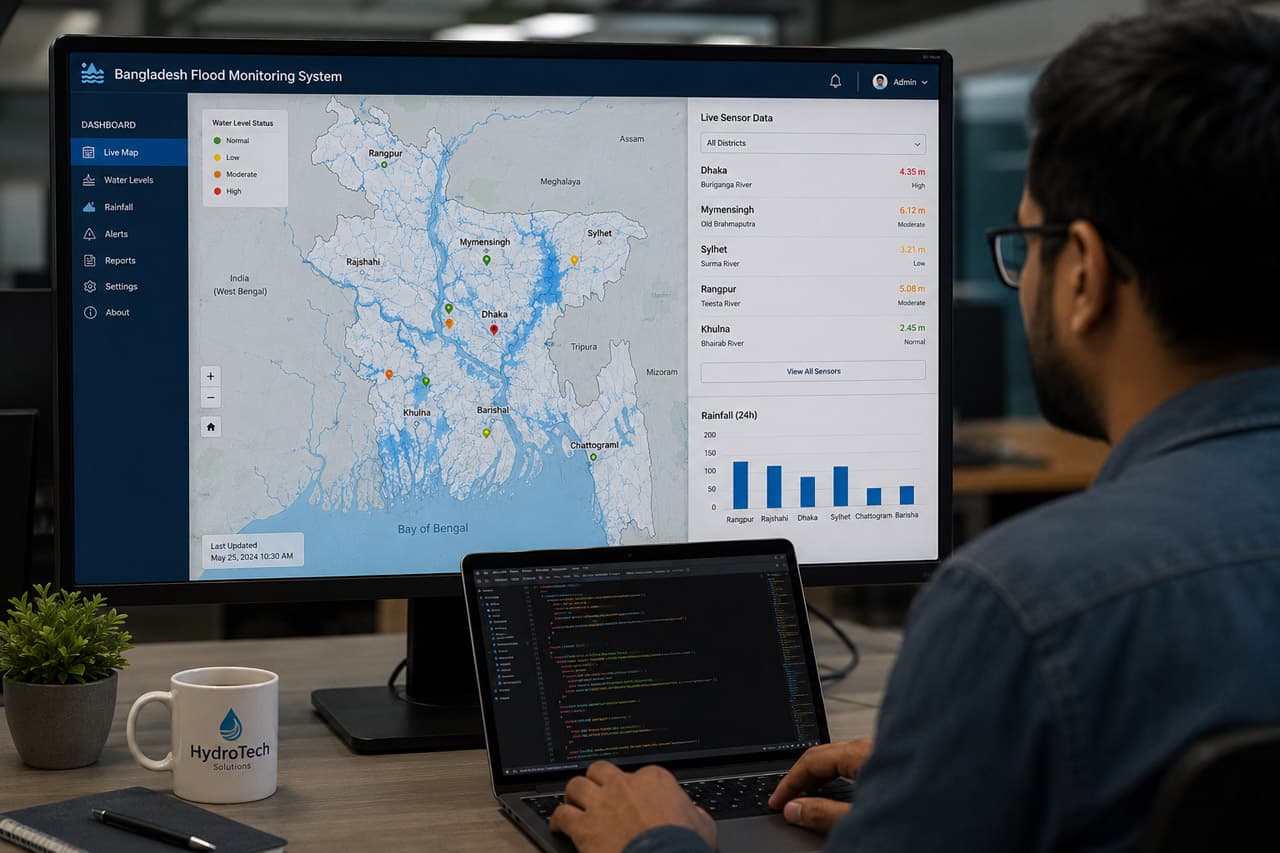
Hero image caption: A web map dashboard showing Bangladesh’s river gauges, live water levels, danger thresholds, rainfall overlays, satellite flood extent, and district-level evacuation alerts.
Bangladesh operates 900+ river gauging stations — but most of that data sits in government silos, invisible to the people it could save. During the monsoon, a few centimetres of river rise can decide whether a char settlement, haor village, or low-lying ward has one more day to prepare. Yet for many citizens, flood information still arrives as a PDF bulletin, a television scroll, a Facebook post, or a warning passed from one local office to another.
Modern open-source Web GIS can change that. A real-time flood dashboard does not replace hydrologists, forecasters, or disaster managers. It gives their work a faster public interface: live gauges on a map, colour-coded danger levels, forecast trends, satellite-derived flood extents, and alerts that can be understood by local officials, journalists, volunteers, and communities.
Why Real-Time Matters
Flood risk in Bangladesh is dynamic. The Jamuna, Padma, Meghna, Teesta, Surma, Kushiyara and many smaller rivers respond to rainfall, upstream flow, tidal conditions, embankment breaches, drainage congestion and backwater effects. A static flood hazard map is useful for planning, but it cannot tell a union disaster committee what is happening this morning.
Real-time monitoring matters because evacuation and asset protection are time-sensitive. Families need time to move livestock, dry food, medicine, documents, and children to safer ground. Farmers need time to protect pumps, harvest standing crops if possible, or move seed and fertilizer. Local government needs time to open shelters, position boats, check embankments, and coordinate relief.
Bangladesh already has important institutional foundations. The Flood Forecasting and Warning Centre (FFWC) under the Bangladesh Water Development Board publishes flood forecasts, water-level information, danger-level status, and river bulletins through its web platforms. Its station pages show values such as water level, danger level, recent trend and 24-hour rise or fall, which are exactly the kinds of variables a dashboard can expose more widely. (Flood Forecasting & Warning Centre)
“The most critical window is often the next 24 hours. If people understand that the river is rising toward danger level today, not after the road is already underwater, evacuation becomes organised instead of desperate.” — FFWC officer
Architecture of a Flood Dashboard
A flood dashboard should be designed as a public decision-support system, not just a technical demo. The architecture needs to ingest data, clean it, store it, serve it through APIs, and display it in a browser with minimal delay.
| Component | Technology | Purpose | |
|---|---|---|---|
| —————————– | —————————————————- | ————————————————————————————————————- | |
| Sensor and forecast ingestion | Python, Node.js, scheduled jobs, API connectors | Collect river gauge, rainfall, forecast and satellite flood data. | |
| Spatial database | PostgreSQL + PostGIS | Store gauge locations, administrative boundaries, flood polygons, river networks and historical observations. | |
| Time-series storage | TimescaleDB extension or optimized PostgreSQL tables | Store frequent water-level readings and trends efficiently. | |
| Backend API | FastAPI, Django REST Framework, Express.js | Serve /api/flood-sensors, alerts, station histories and map layers. | |
| Map server | GeoServer, Martin, Tegola, pg_tileserv | Publish vector tiles, WMS/WFS, or dynamic spatial services. | |
| Frontend map | Leaflet.js, OpenLayers, MapLibre GL JS | Display live gauges, flood extents, basemaps and risk layers. | |
| Cache and messaging | Redis, MQTT, Kafka | Speed up repeated requests and support streaming updates. | |
| Deployment | Docker, Nginx/Traefik, Linux VPS or cloud | Package and run services reliably. | |
| Monitoring | Prometheus + Grafana | Track API uptime, data freshness, station failures and alert latency. |
For Bangladesh, the dashboard should support both national and local views. At national scale, users need river basin status: which rivers are rising, which stations are above danger level, and where forecasts indicate worsening conditions. At local scale, users need station histories, nearby shelters, road access, union boundaries, flood depth estimates, and contact points.
The Data Pipeline
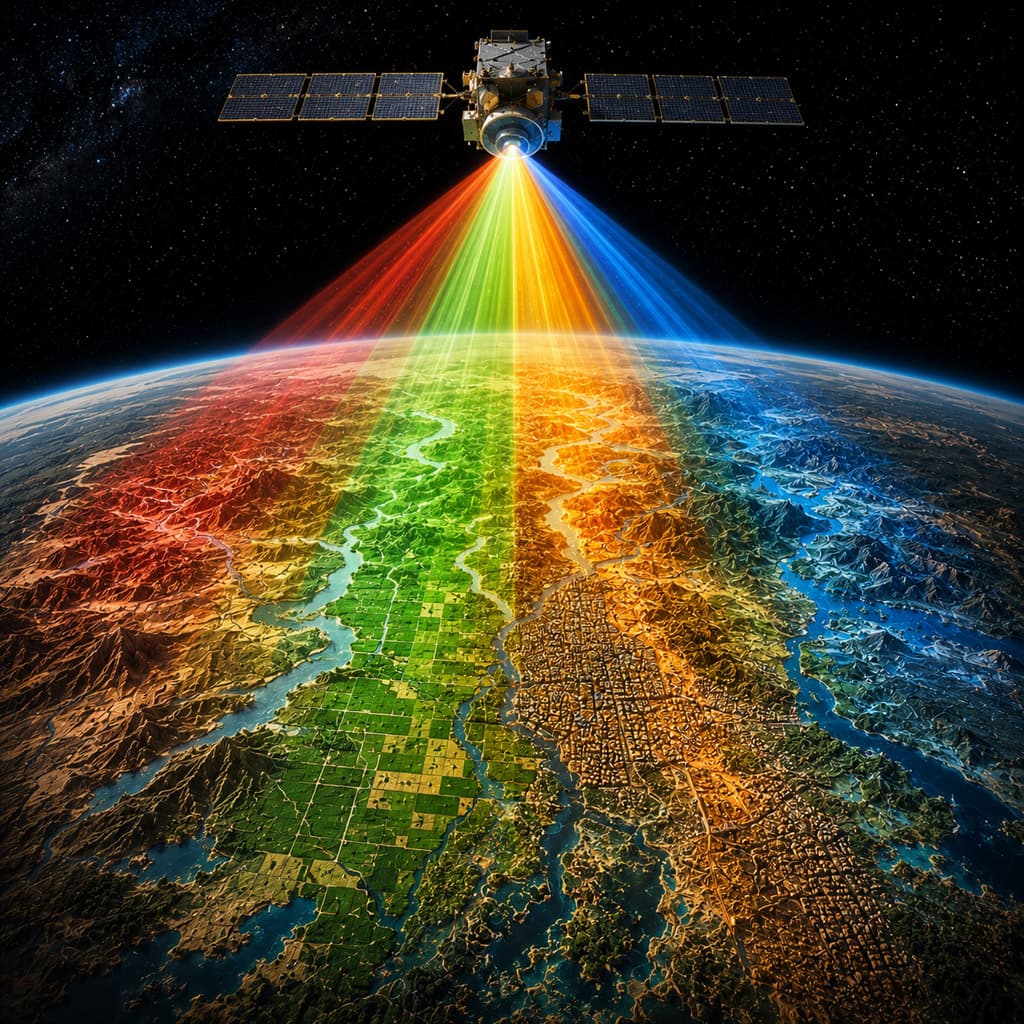
The pipeline begins with ingestion. River gauge readings may come from BWDB or FFWC feeds, web pages, CSV downloads, APIs, or internal databases. Rainfall may come from national meteorological sources, satellite rainfall products, or regional forecast models. Satellite flood extent can come from MODIS, VIIRS, Sentinel-1 SAR, or processed emergency products.
Four open or semi-open data sources are especially relevant for Bangladesh flood monitoring:
- BWDB — hydrological observations, water-level records, river stations and reports.
- SPARRSO — national remote sensing capacity and satellite-based disaster monitoring support.
- MODIS — moderate-resolution optical imagery useful for broad flood extent mapping.
- FFWC — flood forecasts, warning bulletins, river status, danger levels and station trends.
MODIS has been used in Bangladesh flood studies to map inundation using surface reflectance and water indices, while global MODIS-derived flood products provide event-based flood extent, duration and observation-condition layers. These products are not perfect under cloud cover, but they are valuable for national-scale flood monitoring and historical validation. (<a href="https://developers.google.com/earth-engine/datasets/catalog/GLOBALFLOODDBMODISEVENTSV1?utmsource=chatgpt.com”>Google for Developers)
The pipeline should validate every incoming observation. Is the station ID known? Is the timestamp current? Is the water level plausible compared with the previous reading? Is the danger level available? Has a station stopped reporting? These checks are not glamorous, but they decide whether the dashboard earns trust.
A simple backend schema might include tables for stations, waterlevelobservations, dangerlevels, forecastpoints, floodextents, adminunits, and alerts. In PostGIS, station points can be joined to districts, upazilas and river basins. Flood polygons can be intersected with settlements, roads and cropland to estimate exposure.
Visualising Risk in the Browser
The browser is where technical data becomes public understanding. The map should not overload users with every possible layer. It should answer immediate questions: Where is the river above danger level? Where is it rising quickly? Which districts are affected? What changed in the last 24 hours?
A minimal Leaflet.js layer can display flood sensors like this:
const map = L.map("map").setView([23.8, 90.4], 7);
L.tileLayer("https://{s}.tile.openstreetmap.org/{z}/{x}/{y}.png").addTo(map);

fetch("/api/flood-sensors")
  .then(r => r.json())
  .then(data => {
    data.features.forEach(f => {
      const { lat, lon, level, threshold } = f.properties;
      L.circleMarker([lat, lon], {
        radius: 8,
        color: level > threshold ? "red" : "green"
      }).addTo(map).bindPopup(`Level: ${level}m`);
    });
  });
In production, this can be extended with station names, river names, danger-level difference, 3-hour trend, 24-hour rise or fall, sparkline charts, forecast hydrographs and alert status. FFWC-style station information already includes many of these attributes, such as recorded time, water level, danger level, trend and 24-hour rise/fall. (FFWC)
Colour must be used carefully. Green can mean normal, yellow watch, orange warning, red danger, and purple severe flood. But colour alone is not enough. Icons, labels, tooltips and text summaries should support colour-blind users and low-bandwidth mobile users. The dashboard should also work in Bangla and English.
Challenges and Next Steps
The hardest challenge is not drawing points on a map. It is institutional and operational reliability. Data may be delayed, formatted inconsistently, or published in systems not designed for machine access. Gauge stations may fail during storms. Satellite images may be blocked by clouds. Danger thresholds may vary by station and need careful interpretation.
There are also ethical questions. A dashboard that shows “safe” when data is stale can be dangerous. Every map should display data timestamp, source, uncertainty and update status. If a station has not reported recently, the interface should say so clearly.
The next generation of flood dashboards for Bangladesh should combine real-time gauges, forecast models, satellite flood mapping, community reports and impact layers. Sentinel-1 radar is especially promising because it can observe flood extent through cloud and rain, which is critical during monsoon events; ESA has highlighted its usefulness for mapping Bangladesh floods under cloudy conditions. (<a href="https://www.esa.int/ESAMultimedia/Images/2022/06/CopernicusSentinel-1mapsBangladeshflood?utmsource=chatgpt.com”>European Space Agency)
The future is not just a national dashboard in Dhaka. It is a distributed flood intelligence system: APIs for developers, mobile alerts for communities, dashboards for district control rooms, open data for researchers, and map services that local governments can embed in their own websites. Bangladesh already has the hydrological knowledge and much of the data. Open-source Web GIS can help turn that knowledge into faster, clearer, life-saving communication.
Sources / References
- Flood Forecasting and Warning Centre, Bangladesh Water Development Board. “Flood Forecasting & Warning Centre, BWDB, Bangladesh.” FFWC official website
- Flood Forecasting and Warning Centre, BWDB. “Water Level / Station Information.” FFWC station data pages
- Bangladesh Water Development Board Hydrology. “Water Level Data View.” <a href="https://www.hydrology.bwdb.gov.bd/index.php?pagetitle=waterleveldataview&utmsource=chatgpt.com”>BWDB Hydrology water level data
- Google Earth Engine Data Catalog. “Global Flood Database v1 — MODIS Events.” <a href="https://developers.google.com/earth-engine/datasets/catalog/GLOBALFLOODDBMODISEVENTSV1?utmsource=chatgpt.com”>Global Flood Database MODIS Events
- NASA MODIS. “Flood inundation map of Bangladesh using MODIS surface reflectance data.” <a href="https://modis.gsfc.nasa.gov/sciteam/pubs/abstractnew.php?id=04006&utm_source=chatgpt.com”>NASA MODIS Bangladesh flood mapping study
- European Space Agency. “Copernicus Sentinel-1 maps Bangladesh flood.” <a href="https://www.esa.int/ESAMultimedia/Images/2022/06/CopernicusSentinel-1mapsBangladeshflood?utmsource=chatgpt.com”>ESA Sentinel-1 Bangladesh flood mapping









Responses (0 )