


On 8 July 1918, the ground beneath Srimangal shook with a violence still remembered in Bangladesh’s earthquake history. The Srimangal earthquake, estimated at roughly magnitude 7.2–7.6, damaged buildings across the tea-growing hills and was felt far beyond northeast Bengal. For Sylhet, Moulvibazar, Habiganj, and the surrounding lowlands, it remains more than a historical event. It is a warning written into the landscape: this region has shaken before, and it can shake again.
Today, northeast Bangladesh is growing fast. Sylhet city expands into wetlands and soft sediments; roads, bridges, hospitals, schools, apartment blocks, and power infrastructure now occupy ground that was once rural or floodplain. The science of seismic hazard zoning asks a practical question: not simply where can earthquakes happen? but where will shaking, soil failure, and building vulnerability combine to produce the greatest damage?
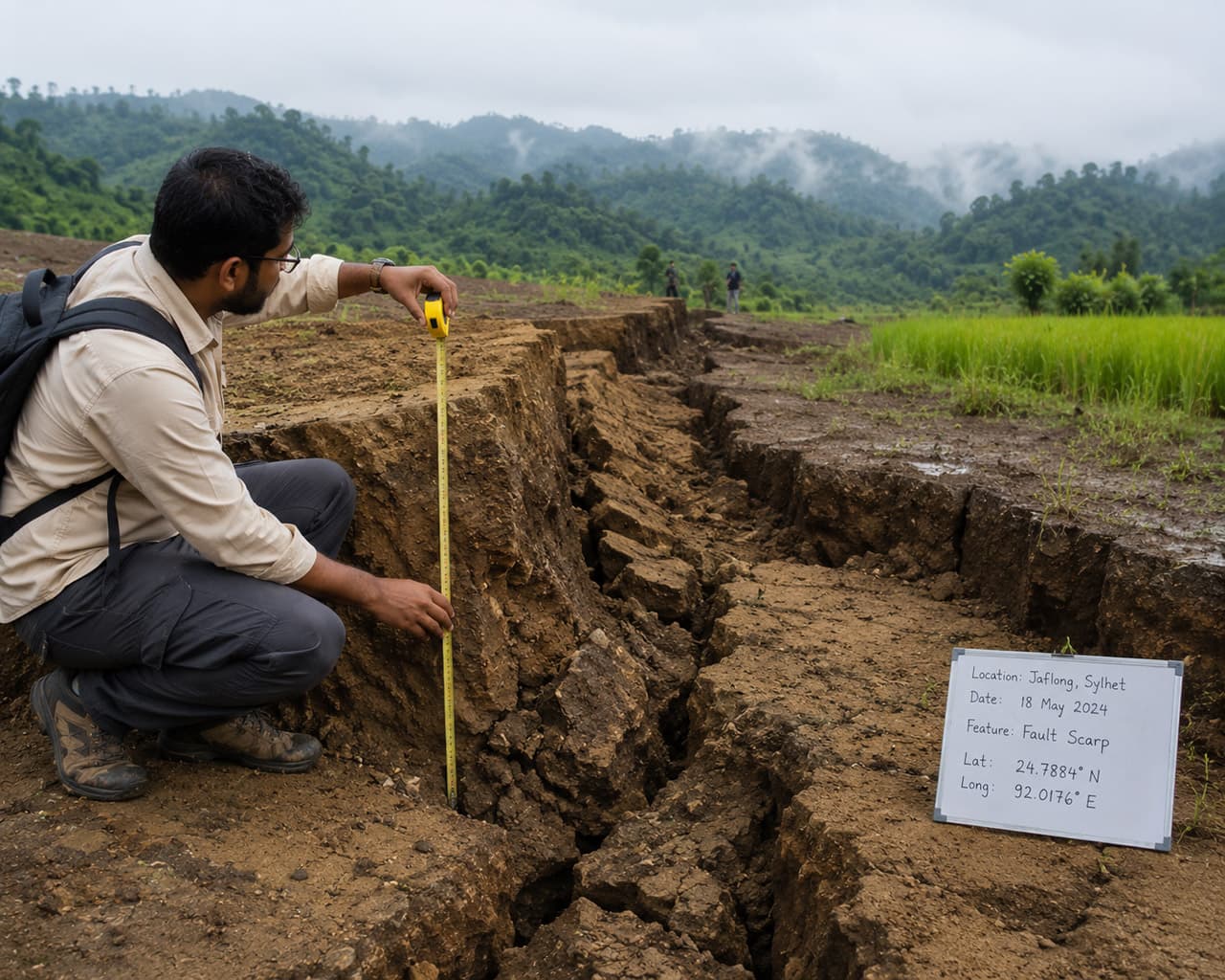
Photo caption: Cracked-earth field image from northeast Bangladesh, showing how ground deformation can expose the hidden stress of active fault zones.
The Sylhet Trough Explained
The Sylhet Trough is a deep sedimentary depression in northeastern Bangladesh, bordered by the Shillong Plateau to the north and the folded belts of eastern Bangladesh and northeast India to the east and southeast. Geologically, it is part of the larger Bengal Basin — one of the thickest sedimentary basins on Earth — but it is not a passive bowl of mud and sand. It is squeezed, flexed, and faulted by the continuing collision between the Indian Plate and the Eurasian/Burma plate systems.
To the north, the Shillong Plateau behaves like a rigid block pushing against the Bengal Basin. Studies of Bangladesh’s crustal structure describe the Shillong Plateau as overthrusting the Bengal Basin from the north, depressing the Sylhet Basin and shaping the trough’s geometry. (<a href="https://www.sciencedirect.com/science/article/abs/pii/S0040195116301184?utmsource=chatgpt.com”>ScienceDirect) To the east, the Indo-Burman and Chittagong–Tripura fold belts reflect oblique convergence, where compression and sideways motion combine to fold sediments and activate faults. (<a href="https://earthobservatory.sg/research/tectonics/structural-geology/bangladesh-active-faults-in-the-chittagong-tripura-fold-belt?utmsource=chatgpt.com”>Earth Observatory of Singapore)
This setting matters because earthquake hazard is not controlled by magnitude alone. A moderate earthquake close to Sylhet, on shallow crustal faults, could be more damaging locally than a larger event farther away. Soft alluvial sediments, wetlands, filled land, and river deposits can amplify shaking, while saturated soils may be prone to liquefaction.
Active Faults of Northeast Bangladesh
Northeast Bangladesh sits near several active or potentially active structures. Some are visible in landscape features; others are inferred from seismicity, geomorphology, geophysical surveys, or trench studies.
- Dauki Fault — A major east–west reverse fault along the southern margin of the Shillong Plateau. It is widely regarded as one of the most important seismic sources for Sylhet and adjoining areas; studies warn that rupture of its long segment could pose a major threat to Bangladesh. (cires1.colorado.edu)
- Jaflong Fault — Identified near Jaflong in Sylhet as a branch or related active structure of the Dauki system. Paleoseismological work around Jaflong has inferred active faulting from uplifted terraces and trench evidence. (ScienceDirect)
- Kopili Fault — A long, seismically active fault system in northeast India, often discussed in relation to the Shillong Plateau and Assam region. Research identifies it as one of the most active faults in the broader Shillong Plateau–Assam seismic zone. (ScienceDirect)
- Dhubri / Shillong Plateau boundary faults — Faults around the Shillong Plateau, including Dhubri, Oldham, Dapsi, and related structures, are considered important in regional seismic hazard models for northern and northeastern Bangladesh. (Taylor & Francis Online)
These faults do not operate in isolation. Stress can transfer from one structure to another, and the Sylhet Trough lies within a wider tectonic neighborhood that includes the Himalayan front, Shillong Plateau, Assam valley, and Indo-Burman ranges.
Measuring the Risk
Earthquake risk begins with seismic sources, but it ends with people, buildings, and infrastructure. Hazard scientists estimate how often certain levels of ground shaking may be exceeded at a location. Engineers then translate that shaking into design forces. Urban planners use the maps to decide where and how cities should grow.
A common probabilistic idea is expressed as:
P(exceedance) = 1 - e^(-λt)In plain language, this formula estimates the probability that a certain level of shaking will be exceeded during a time period. Here, λ represents the average annual rate of exceedance, and t is the exposure time, such as 50 years — roughly the design life of many buildings. If the annual chance is small but the time period is long, the cumulative probability becomes significant.
Magnitude also needs careful language. Many people still say “Richter scale,” but modern earthquake science usually reports moment magnitude, especially for larger events.
| Measure | What it describes | Best use | Limitation | |
|---|---|---|---|---|
| ——————– | ————————————————————— | ————————————————– | ——————————————————————– | |
| Richter magnitude | Size estimated from seismic wave amplitude on early instruments | Historical and small-to-moderate local earthquakes | Saturates for large earthquakes and is less used in modern reporting | |
| Moment magnitude, Mw | Energy release based on fault area, slip, and rock rigidity | Modern standard for moderate to great earthquakes | More complex to calculate, but physically more meaningful |
For Sylhet, risk measurement must include more than fault maps. It needs microzonation: mapping local soil conditions, sediment thickness, groundwater depth, slope stability, liquefaction susceptibility, building typology, road access, hospitals, schools, and emergency routes. A 2023 seismic hazard assessment for Sylhet compared estimated ground motions with code provisions, highlighting the need to align local design practice with realistic seismic input. (<a href="https://gfzpublic.gfz.de/pubman/faces/ViewItemOverviewPage.jsp?itemId=item5021631&utmsource=chatgpt.com”>GFZ Public) Studies of a repeat 1918-type event have also warned that losses in Sylhet could be severe. (<a href="https://www.researchgate.net/publication/310464130PotentiallossesforSylhetBangladeshinarepeatofthe1918Sri-mangalearthquake?utm_source=chatgpt.com”>ResearchGate)
“In the field, the most worrying buildings are not always the tallest ones. They are the soft-storey shops, poorly detailed columns, heavy roofs, and unreinforced masonry walls sitting on weak ground.”
Building for What’s Coming
The slightly urgent message from seismic science is this: Sylhet does not need to wait for prediction. Earthquake prediction remains uncertain, but earthquake preparation is entirely possible.
First, building codes must be treated as life-safety tools, not paperwork. Bangladesh’s building code provisions need consistent enforcement, especially for schools, hospitals, apartment blocks, markets, bridges, and emergency facilities. Second, urban expansion should be guided by hazard zoning maps. Areas with high liquefaction potential, deep soft sediments, unstable slopes, or poor drainage should face stricter foundation and structural requirements.
Third, older vulnerable buildings need screening. A rapid visual assessment program can identify structures needing detailed evaluation or retrofitting. Fourth, critical lifelines — water supply, gas lines, power substations, telecom networks, bridges, and hospitals — should be mapped against seismic hazard layers. A city does not fail only when buildings collapse; it also fails when roads are blocked, hospitals are damaged, and utilities stop working.
Finally, public communication matters. Hazard maps should not sit only in technical reports. Ward-level maps, school drills, builder training, and open GIS layers can turn science into action.
For urban planning in Sylhet, seismic hazard zoning maps are not abstract scientific products. They are decision maps. They show where high-rise development needs stronger controls, where emergency shelters should be placed, where roads must remain open after shaking, and where new neighborhoods require special ground investigation before construction. The 1918 Srimangal earthquake is the historical anchor; the Sylhet Trough is the geological setting; the next step is policy. If Sylhet reads its fault lines now, it can build a safer city before the ground writes the lesson again.
Sources / References
- The Business Standard. “Most devastating earthquakes in Bangladesh’s history.” (The Business Standard)
- Sarker et al. “Potential losses for Sylhet, Bangladesh in a repeat of the 1918 Sri-mangal earthquake.” (<a href="https://www.businessperspectives.org/images/pdf/applications/publishing/templates/article/assets/3103/ee201001Sarker.pdf?utmsource=chatgpt.com”>Business Perspectives)
- Singh et al. “Crustal structure and tectonics of Bangladesh.” Tectonophysics, 2016. (ScienceDirect)
- Morino et al. “A paleo-seismological study of the Dauki fault at Jaflong, Sylhet, Bangladesh.” Journal of Asian Earth Sciences, 2014. (ScienceDirect)
- Bilham & England. “Plateau pop-up during the 1897 Assam earthquake.” Nature, 2001. (cires1.colorado.edu)
- Al-Hussaini et al. “Seismic Hazard Assessment for Sylhet City – A Critical Review.” GFZ record, 2023. (<a href="https://gfzpublic.gfz.de/pubman/faces/ViewItemOverviewPage.jsp?itemId=item5021631&utmsource=chatgpt.com”>GFZ Public)
- Samm-A et al. “Probabilistic seismic hazard mapping for Bangladesh.” Geomatics, Natural Hazards and Risk, 2025. (Taylor & Francis Online)















Responses (0 )