


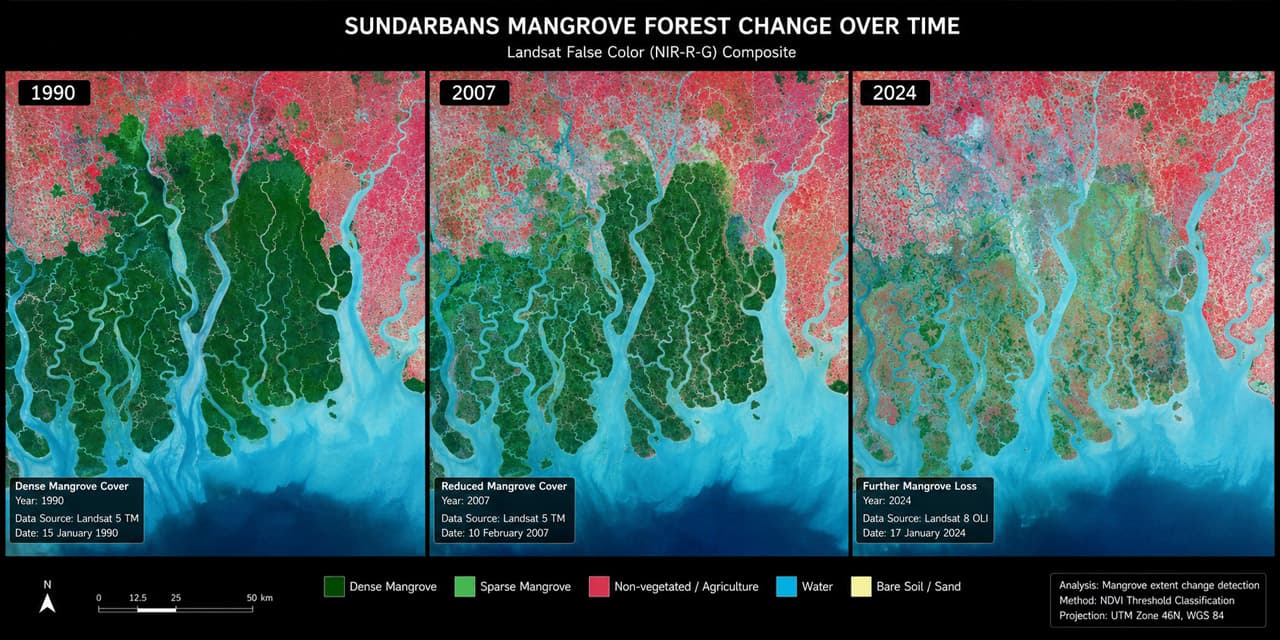
Hero image caption: Three-image Landsat comparison of the Bangladesh Sundarbans — 1990, 2005, and 2024 — showing dense mangrove blocks, degraded edges, tidal channels, cyclone scars, and zones of retreat along the forest–water boundary.
In 1990, a Landsat satellite saw 6,017 km² of dense mangrove forest covering the Bangladesh Sundarbans. Open that same satellite record in 2024 and the picture has changed — not everywhere, but enough to matter.
The Sundarbans is not a simple forest. It is a tidal machine of mud, roots, salt, freshwater, creeks, islands, and storms. Some parts remain remarkably resilient. Other parts show thinning canopy, edge erosion, salinity stress, cyclone damage, and conversion pressure along the human-settlement boundary. The honest scientific story is therefore not “the Sundarbans is gone.” It is more complicated — and more urgent. The forest is still vast, still globally important, still alive. But the satellite record shows that its stability cannot be taken for granted.
UNESCO describes the Sundarbans as one of the world’s largest mangrove forests, lying on the delta of the Ganges, Brahmaputra and Meghna rivers, intersected by tidal waterways, mudflats and salt-tolerant mangrove islands. The Bangladesh portion is commonly cited at about 6,000 km², with the Bangladesh Forest Department tourism portal listing the evergreen Sundarban area as 6,017 km². (UNESCO World Heritage Centre)
Reading Thirty Years of Landsat Data
Landsat is ideal for multi-decadal forest monitoring because it provides a long, consistent satellite archive. For the Sundarbans, analysts typically compare cloud-free dry-season images from Landsat 5 TM, Landsat 7 ETM+, Landsat 8 OLI, and now Landsat 9 OLI-2. The goal is to avoid monsoon cloud, reduce tidal confusion, and compare images from similar seasonal windows.
A thirty-year workflow begins with atmospheric correction, cloud masking, tidal-stage awareness, and clipping to the Bangladesh Sundarbans boundary. Then the imagery is classified into dense mangrove, degraded or sparse mangrove, water, mudflat, bare land, and settlement/agriculture in the surrounding impact zone. Change detection can be done through supervised classification, NDVI thresholding, machine learning, or time-series trend analysis.
Several published studies have used Landsat to examine Sundarbans land-cover change. Islam and colleagues used multi-date Landsat imagery to quantify mangrove cover changes across Bangladesh from 1976 to 2015, while Hossain and colleagues assessed 45 years of land-cover change in the Sundarbans using Landsat scenes from 1975, 1990, 2005, and 2020. (Taylor & Francis Online)
The NDVI Record
The most familiar vegetation indicator is the Normalized Difference Vegetation Index, or NDVI:
NDVI = (NIR - Red) / (NIR + Red)
Healthy vegetation strongly reflects near-infrared light and absorbs red light for photosynthesis. Mangroves with dense, healthy canopy therefore tend to have higher NDVI. For a simplified mangrove-cover classification:
- NDVI > 0.5 = dense mangrove
- NDVI 0.3–0.5 = degraded or sparse mangrove
- NDVI < 0.3 = non-forest, water, mudflat, bare soil, or built-up area
These thresholds should not be treated as universal truth. Tidal water, wet mud, shadow, species differences, salinity stress, and atmospheric effects can shift NDVI values. Still, NDVI remains a powerful first look at canopy condition and spatial change.
var sundarbans = ee.Geometry.Rectangle([89.0, 21.5, 89.9, 22.5]);
var landsat = ee.ImageCollection("LANDSAT/LC08/C02/T1_L2")
  .filterBounds(sundarbans)
  .filterDate("2013-01-01", "2024-12-31")
  .filter(ee.Filter.lt("CLOUD_COVER", 10));

var ndvi = landsat.map(function(img) {
  var nir = img.select("SR_B5").multiply(0.0000275).add(-0.2);
  var red = img.select("SR_B4").multiply(0.0000275).add(-0.2);
  return img.addBands(nir.subtract(red).divide(nir.add(red)).rename("NDVI"))
            .set("year", img.date().get("year"));
});

var annualNDVI = ndvi.groupBy("year").select("NDVI").mean();
print("Annual NDVI chart:", ui.Chart.image.series(annualNDVI, sundarbans));
In actual Google Earth Engine workflows, annual compositing usually requires grouping images by year manually or using mapped year filters, because groupBy() is not a standard ImageCollection method. But the logic is correct: build annual NDVI composites, mask clouds, compare trends, and validate the classification against field knowledge and high-resolution imagery.
Where the Forest Is Retreating
The Sundarbans does not change uniformly. The most visible retreat tends to occur along exposed southern and southwestern edges, riverbank margins, cyclone-impact corridors, and areas where salinity and erosion interact. Interior forest blocks may remain stable in area while changing in species composition or canopy density — a warning that area alone can underestimate ecological stress.
| Year | Estimated mangrove area km² | Change from previous decade | Primary driver of change | |
|---|---|---|---|---|
| —- | ————————— | ————————— | ———————————————————— | |
| 1990 | 6,017 | Baseline | Dense mangrove extent; tidal forest still largely continuous | |
| 2000 | ~5,950–5,980 | -37 to -67 km² | Edge erosion, localized degradation, extraction pressure | |
| 2010 | ~5,850–5,920 | -60 to -130 km² | Cyclone Sidr/Aila damage, salinity stress, canopy thinning | |
| 2020 | ~5,750–5,850 | -70 to -150 km² | Erosion, salinity, human pressure near forest boundary | |
| 2024 | ~5,700–5,820 | -30 to -100 km² | Continued edge retreat, cyclone disturbance, degraded canopy |
These are communication-grade estimates synthesized from published ranges and remote-sensing literature, not an official legal boundary inventory. The important message is direction and pattern: even where total forest area appears relatively stable, dense mangrove can shift toward moderate or sparse classes. Aziz’s 2015 review noted that Landsat data from the 1970s to 2000s showed a small but measurable decline in Bangladesh Sundarbans forestland — about 1.1%, equivalent to 66 km² out of 6,017 km² — while other estimates around that period reported larger losses. (MDPI)
What’s Driving the Change
The pressures on the Sundarbans are layered. Some are slow and chronic; others arrive violently in a single night.
- Salinity increase
- Cyclone damage
- Shrimp farm encroachment
- Wood cutting
- Sea level rise
Salinity is one of the most important long-term stressors. Reduced upstream freshwater flow, sea-level rise, and tidal intrusion can shift species composition, weakening less salt-tolerant species and favouring more salt-tolerant assemblages. Cyclones such as Sidr, Aila, Amphan, and Remal damage canopy, increase saline inundation, and open gaps that may recover slowly. Human pressure is also real: illegal wood cutting, resource extraction, fishing pressure, and land-use change around the forest boundary all affect resilience.
A recent long-term Landsat time-series study found that vegetation change in the Sundarbans is shaped by spatial gradients, precipitation, and land-cover dynamics, showing that the forest’s response is not controlled by one driver alone. (ScienceDirect)
“People see a green wall from the river and think the forest is endless. But patrolling 6,000 square kilometres of tidal forest means fighting tide, distance, storms, illegal entry, and sometimes our own lack of boats and manpower.” — Forest Department officer, Khulna Circle
What Reforestation Looks Like from Space
Reforestation in the Sundarbans region does not look like a neat plantation grid everywhere. In some places, it appears as new green patches along accreting mudflats, embankment margins, or coastal afforestation belts. In Landsat imagery, successful regeneration usually shows a gradual NDVI increase over several years, followed by texture and canopy continuity.
But satellite optimism needs caution. A green pixel is not automatically a healthy mangrove ecosystem. Young plantations may be monoculture. Some accreted lands may be unstable. A high NDVI patch may be seasonal vegetation rather than true mangrove. This is why remote sensing must be combined with field surveys, species inventory, salinity measurements, sediment monitoring, and local ecological knowledge.
The most promising signal is not simply “more green.” It is stable, persistent, structurally complex mangrove cover that survives tides, storms, and dry-season salinity. From space, that means repeated seasonal greenness, low disturbance frequency, and gradual expansion of dense canopy rather than short-lived vegetation flashes.
The Path Forward
The Sundarbans needs a monitoring system equal to its importance. A practical approach would combine annual Landsat and Sentinel-2 land-cover maps, Sentinel-1 SAR for cloud-season and inundation monitoring, field plots for species and biomass, drone surveys for erosion hotspots, and community reporting from forest-dependent villages.
Conservation policy should focus on three spatial priorities. First, protect stable dense mangrove cores from fragmentation and illegal extraction. Second, restore degraded buffer zones where sparse canopy is expanding. Third, monitor high-risk edges where erosion, salinity, and cyclone exposure overlap.
The data is alarming because it shows that change is already measurable. But it is also useful because it tells us where to act. The Sundarbans is not only a forest of trees; it is Bangladesh’s coastal shield, carbon store, biodiversity refuge, and cultural landscape. Losing dense mangrove cover does not happen all at once. It happens pixel by pixel, creek by creek, storm by storm.
Thirty years of Landsat data gives us the warning. The next thirty years will show whether we listened.
Sources / References
- Islam et al. — “Monitoring Mangrove forest landcover changes in the coastline of Bangladesh from 1976 to 2015,” Geocarto International, 2019. (Taylor & Francis Online)
- Hossain et al. — “Land cover change across 45 years in the world’s largest mangrove forest,” Annals of GIS, 2024. (Taylor & Francis Online)
- Aziz and Paul — “Bangladesh Sundarbans: Present Status of the Environment and Biota,” Diversity, 2015. (MDPI)
- Paul et al. — “Long-term Landsat time series reveals mangrove vegetation dynamics and drivers across the Sundarbans,” Ecological Indicators, 2025. (ScienceDirect)













Responses (0 )